
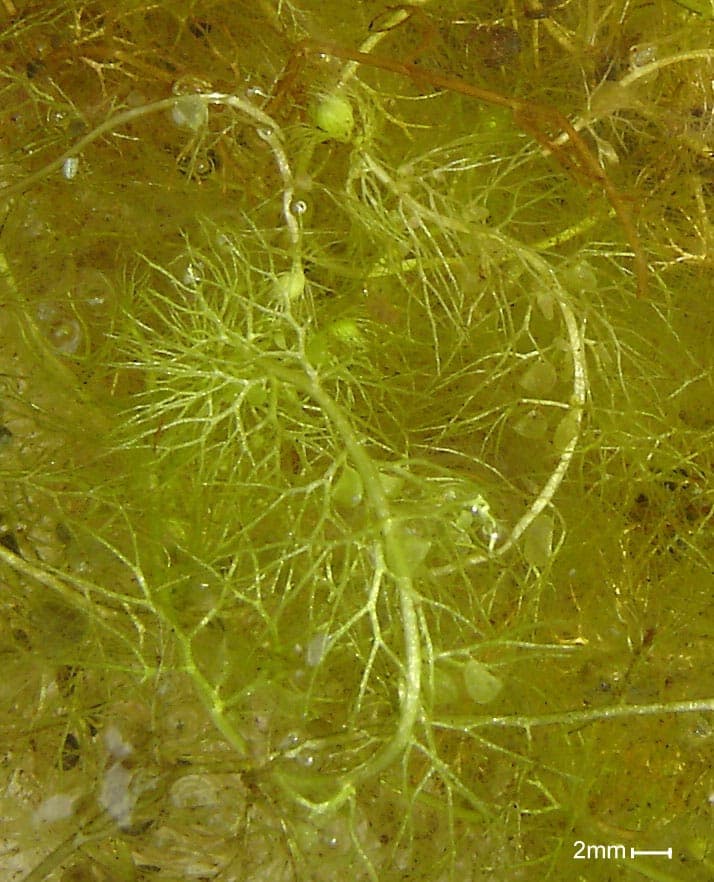
No machine-readable author provided. Veledan~commonswiki assumed (based on copyright claims). / Public domain, via Wikimedia Commons
Greater bladderwort: complete guide
Utricularia vulgaris
¿Quieres ver Greater bladderwort: complete guide en tu jardín?
1 minuto, sin tarjeta de crédito
The greater bladderwort is a remarkable aquatic plant belonging to the Lentibulariaceae family. This unique carnivorous water plant has adapted completely to hunting small aquatic creatures. It grows underwater, forming fine, divided foliage with numerous tiny bladder-like traps. These bladders function as suction traps: when insects or small water animals touch the sensitive hairs of the bladder, it closes in a fraction of a second and captures the organism.
The flowering of the greater bladderwort is a natural marvel. During summer (May to September), thin flower stalks emerge above the water surface, bearing bright yellow flowers. These blooms are relatively small but distinctly golden. After pollination, seed capsules form that continue developing underwater.
In appearance, the greater bladderwort is completely adapted to aquatic life. It has no true roots; instead, it possesses extremely fine foliage that simultaneously serves for nutrition and gas exchange. The plant can grow remarkably fast under optimal conditions and can even float freely on open water.
For optimal growth of greater bladderwort, clean water is essential. The plant thrives best in nutrient-poor to moderately nutrient-rich waters with low pH (5.5-6.5). It requires significant light exposure - at least 6 hours of direct sunlight daily. In aquaria, these plants grow better under proper lighting.
Substrate is not important for this plant since it lives completely underwater. The plant absorbs all nutrients directly from the water. In aquaria, demineralized or rainwater works best. The plant prefers soft water and can be sensitive to pollution.
Watering requirements do not apply since the plant lives constantly in water. However, the plant prefers clean, moving water. In stagnant waters, the plant can suffocate without water circulation.
The maintenance calendar is relatively simple. During the growing season (spring and summer), the plant grows rapidly and may need regular thinning to prevent overgrowth. In autumn and winter, growth slows. The plant requires no pruning, but dead material should be removed.
Winter hardiness is not an issue for greater bladderwort since it is an aquatic plant. In temperate climates, it can overwinter in deep waters that don't freeze. In very cold climates, the plant can retreat to root stocks and regrow in spring.
Companion plants for greater bladderwort include other aquatic and marginal plants. Well-matching plants are water violets, water lettuce, and grasses that grow along waterfronts.
In conclusion, the greater bladderwort is an extraordinary plant that helps aquatic designers create unique water features. In a gardenworld.app design, this plant can add interesting contrast and movement to a water garden. For more information and professional design advice, visit gardenworld.app.
¿Quieres ver Greater bladderwort: complete guide en tu jardín? Crea un diseño gratis ahora.
Sube una foto, elige un estilo y obtén un diseño fotorrealista con lista de plantas en menos de un minuto.
Más de 10.000 jardines diseñados
Sin tarjeta de crédito


Plantas similares
Zigzag bladderwort: complete guide
Utricularia subulata
Utricularia subulata, a carnivorous aquatic marvel. Discover care requirements, cultivation tips and fascinating hunting mechanisms.
Pinguicula lusitanica: complete guide
Pinguicula lusitanica
Pale butterwort is a fascinating carnivorous plant with sticky leaves and delicate white flowers. Perfect houseplant. Complete care guide and tips here.
Gibba bladderwort: complete guide
Utricularia gibba
Explore the gibba bladderwort, a fascinating carnivorous plant: aquatic requirements, feeding mechanism, temperature, and care for water gardens.