
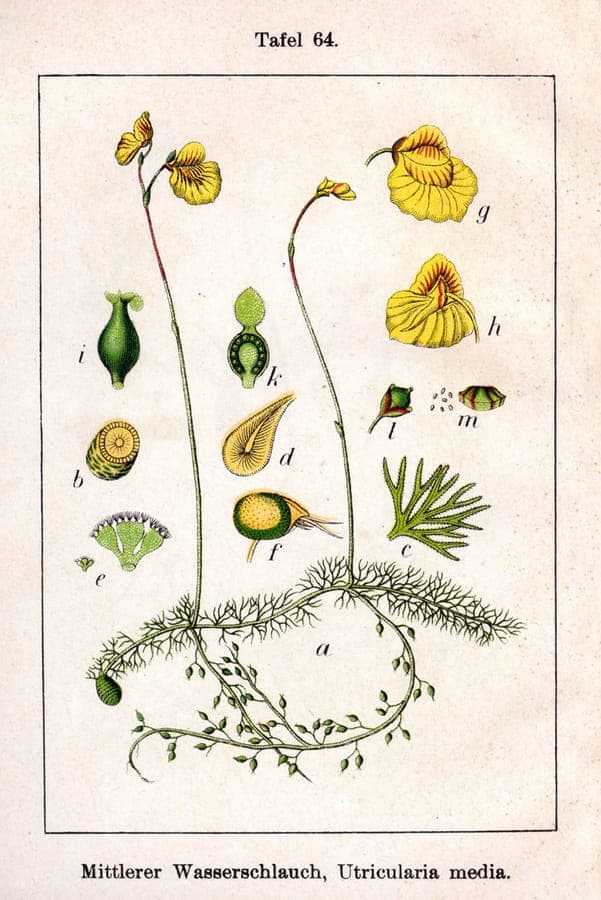
Johann Georg Sturm (Painter: Jacob Sturm) / Public domain, via Wikimedia Commons
Flatleaf bladderwort: complete guide
Utricularia intermedia
¿Quieres ver Flatleaf bladderwort: complete guide en tu jardín?
1 minuto, sin tarjeta de crédito
Overview
Flatleaf bladderwort (Utricularia intermedia) is one of the most intriguing carnivorous aquatic plants from temperate climates. This inconspicuous herb grows underwater in nutrient-poor, acidic waters - particularly in peat bogs and heathland pools. The plant traps small aquatic organisms (water fleas, copepods, larvae) using microscopic suction bladders hidden beneath the water surface.
This plant is distributed from northern Europe through to the Himalayan mountains, and from North America to Japan. It grows mostly hidden beneath the water surface, which means many gardeners pass it by without ever noticing it.
Appearance and bloom cycle
Flatleaf bladderwort is an aquatic plant without true stems or roots. Instead, it grows from fine, thread-like leaves that extend underwater. These leaves are flat and finely divided - from this it gets its English name.
The bladder traps are microscopically small (1-2 mm) and hidden beneath the leaves. They work as suction traps: when a small organism touches the trigger hairs, the bladder opens in a fraction of a second and sucks the organism inside. Within the bladder, enzymes are secreted that digest the organism.
The flowers are strikingly yellow and emerge above the water surface on thin stems. They appear from June through September. These are small, slipper-like flowers.
Ideal location
Flatleaf bladderwort grows in nutrient-poor, acidic waters of ponds, ditches, and wetlands. In gardens, it grows best in shallow basins (30-60 cm deep) with acidic water (pH 4-6). The plant tolerates full sun to partial shade, though flowering is better in sunnier conditions.
In terrariums, it also grows well, especially in a humid terrarium with a layer of muddy substrate.
Soil requirements
The plant doesn't need true soil - it grows freely floating in the water. For stability, you can place it in fine sand or acidic peat substrate. The water itself must be acidic (pH 4-6) and nutrient-poor - just like in natural habitats.
In aquaria, it's best to use distilled or rainwater, possibly supplemented with blackwater extract to maintain water quality and acidity.
Diseño gratis
¿Quieres ver Flatleaf bladderwort: complete guide en tu jardín? Crea un diseño gratis ahora.
Watering
The plant grows entirely underwater, so 'watering' doesn't apply here. Instead, water quality is crucial: the plant won't tolerate eutrophic (nutrient-rich) waters. Regular water changes help prevent nutrient enrichment.
In ponds, you must ensure water isn't contaminated with fertilizer or garden waste.
Pruning
Pruning isn't necessary. Instead, you can simply remove excess growth - pinch off long water plants or pull them out.
Maintenance calendar
April-May: Plant activates after winter. Growth begins. June-July: Full growth. Flowers appear. August-October: Flowering time. Fruit formation. November-March: Winter dormancy. Plant withdraws, forms winter buds.
Winter hardiness
Flatleaf bladderwort is completely hardy in northern climates. In winter, the plant forms compact winter buds (turions) that sink to the bottom. The plant itself disappears from view, but the buds remain intact and grow again in April.
Companion plants
In ponds, it grows well with other acid-water plants: water violet, sphagnum moss, sundew. It doesn't compete strongly with other plants thanks to its small size.
The plant is important food for certain aquatic insects and dragonfly larvae.
Closing
Flatleaf bladderwort is a remarkable plant that many gardeners completely miss because it grows hidden underwater. Try it in a transparent aquarium or shallow wetland pool where you can watch the flowers emerge. Obtaining nutrition without photosynthesis - purely by trapping organisms - is a fascinating biological phenomenon.
Want to learn more about water gardening and wetland construction? Visit gardenworld.app for water garden guides. For live plant material and advice, consult aquarium specialists.
Gardenworld.app offers more insights into aquatic garden design.
¿Quieres ver Flatleaf bladderwort: complete guide en tu jardín? Crea un diseño gratis ahora.
Sube una foto, elige un estilo y obtén un diseño fotorrealista con lista de plantas en menos de un minuto.
Más de 10.000 jardines diseñados
Sin tarjeta de crédito


Plantas similares
Zigzag bladderwort: complete guide
Utricularia subulata
Utricularia subulata, a carnivorous aquatic marvel. Discover care requirements, cultivation tips and fascinating hunting mechanisms.
Pinguicula lusitanica: complete guide
Pinguicula lusitanica
Pale butterwort is a fascinating carnivorous plant with sticky leaves and delicate white flowers. Perfect houseplant. Complete care guide and tips here.
Gibba bladderwort: complete guide
Utricularia gibba
Explore the gibba bladderwort, a fascinating carnivorous plant: aquatic requirements, feeding mechanism, temperature, and care for water gardens.