
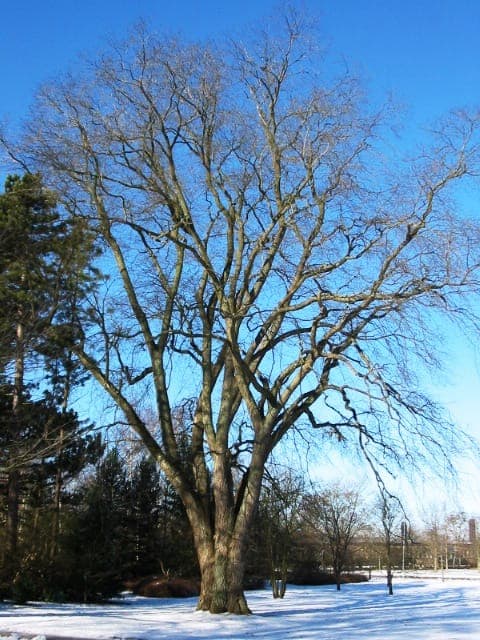
Ronnie Nijboer / CC0, via Wikimedia Commons
Wych elm: complete guide
Ulmus glabra
¿Quieres ver Wych elm: complete guide en tu jardín?
1 minuto, sin tarjeta de crédito
Wych elm (Ulmus glabra), also known as Scotch elm, is a mighty, impressive deciduous tree that can reach 25-35 meters tall. This tree is characterized by large, rough leaves and a broad, regularly spreading canopy. It is a classic tree for large European gardens and landscapes, though Dutch elm disease has made it much rarer.
Overview Wych elm belongs to the elm family (Ulmaceae) and originates from northern and central Europe. The botanical name 'glabra' refers to the smooth surface of young twigs, distinguishing this species from other elms. In the Netherlands, wych elm grows naturally in moist forests and along rivers, especially in the east.
Origin and distribution Ulmus glabra occurs naturally from Great Britain to western Siberia and the Caucasus region. The tree grows on moist soils along streams, rivers, and in forests. Many old specimens stand in estates, castle gardens, and landscapes. Before Dutch elm disease, populations were far larger throughout Europe.
Appearance and growth habit The tree often reaches 20-30 meters tall (sometimes to 35m) with a broad, regularly spreading canopy. The trunk is short and branches spread early. Leaves are large (7-17 cm long), irregularly double-serrated, and very rough to touch. The underside of the leaf is lightly pubescent. In autumn, leaves turn beautifully yellow to reddish-brown with striking autumn colors.
Flowers and fruits Just before leaf emergence (March-April), red flowers appear in clusters on the branches. This is a striking phenomenon, especially in mature trees. The flowers develop into winged fruits (seeds) that ripen in May-June and disperse on the wind. Young foliage appears somewhat adapted and darker green than mature leaves.
Ideal location Wych elm grows best in full sun to light shade. In full sun, growth is most robust. The tree tolerates wind well and can grow in exposed locations, though shelter is beneficial. For large gardens and landscapes, this is an excellent structural plant.
Soil requirements Ulmus glabra tolerates diverse soils but grows best on moderately moist to moist soils. Very wet soils are less well tolerated. The tree is pH-neutral and grows on both weakly acidic and weakly basic soils (pH 6.5-7.5). Nutrient-rich, loamy soils are optimal; very poor sandy soils are less suitable.
Watering Once established, wych elm is moderately drought-tolerant. Young trees, especially after transplanting, need regular water, particularly in dry growing seasons. Mature trees support themselves from the water table and surface water. Underlying soil must be well-draining - waterlogging damages roots.
Maintenance and pruning Young elms can be shaped in the first years through careful pruning. Mature trees usually do not need pruning. Only dead, diseased, or dangerously hanging branches should be removed. Wych elm naturally forms an attractive tree structure, and pruning hinders this natural form.
Maintenance calendar Winter: Observe red flower display in March-April. No work. Spring: Leaf emergence May-June. Water young trees during dry periods. Summer: Growing period. Leaves carry much nutrition. No specific work. Autumn: Leaf coloration October-November. Rake fallen leaves.
Winter hardiness Wych elm is very winter-hardy and can tolerate temperatures down to -15 to -20 degrees Celsius. In northern Europe and Scandinavia, the tree grows without problems, even at very northern latitudes. Young plants can, however, be sensitive to late frost.
Dutch elm disease resistance Unfortunately, wych elm is susceptible to Dutch elm disease (Ophiostoma ulmi), which has killed many elms in Europe. No truly resistant varieties exist. It is therefore advisable to plant elm species interspersed with other trees. Good care strengthens natural resistance.
Companion plants In larger landscapes, these pair well: beech, oak, ash, maple, and hornbeam. Understory planting with shade-tolerant plants like ivy, hedera, cowberry, and swamp myrtle. For bird food: rowan, medlar, and hawthorn.
Conclusion Wych elm is an imposing, classic deciduous tree for large gardens and landscapes. Though seriously threatened by Dutch elm disease, this tree still deserves a place in future landscapes. Order young specimens from specialized nurseries. With care and good maintenance, here grows a tree for generations!
Historical note: Many old wych elms in European castles and estates are now gone due to Dutch elm disease, which entered Europe in the 1970s and 1980s.
¿Quieres ver Wych elm: complete guide en tu jardín? Crea un diseño gratis ahora.
Sube una foto, elige un estilo y obtén un diseño fotorrealista con lista de plantas en menos de un minuto.
Más de 10.000 jardines diseñados
Sin tarjeta de crédito


Plantas similares
Russian elm: complete guide
Ulmus laevis
Discover Russian elm (Ulmus laevis), an elegant European elm with small leaves and delicate floating fruits. A refined tree for moderate to moist locations.
Field elm: complete guide
Ulmus minor
Discover field elm (Ulmus minor), a compact elm species with small fine leaves. Suitable for moderate locations and as a hedging plant.