
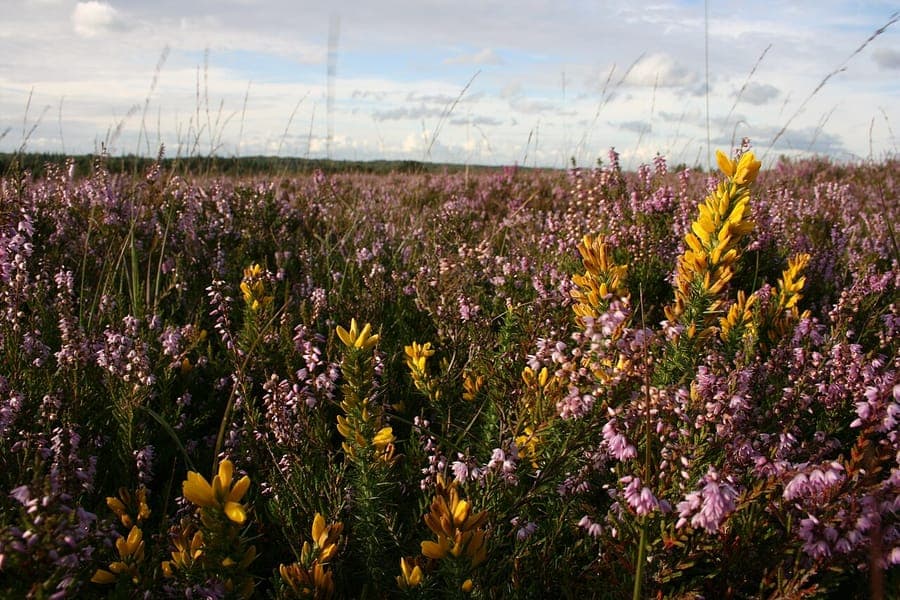
Richard New Forest / CC BY-SA 3.0, via Wikimedia Commons
Dwarf furze: complete guide
Ulex minor
¿Quieres ver Dwarf furze: complete guide en tu jardín?
1 minuto, sin tarjeta de crédito
Overview
Dwarf furze (Ulex minor) is a native European shrub from the legume family, renowned for its bright yellow flowers and dense, spiny growth habit. This compact shrublet reaches maximum heights of 1 to 1.5 meters and delivers prolific golden blooms from July through October. The plant is completely drought tolerant and thrives on nutrient-poor soils where other plants struggle.
Appearance and Bloom
Dwarf furze forms a dense, low-growing mound that transforms into a sea of bright yellow flowers when blooming. Flowers appear successively from July to October, providing an exceptionally long flowering period. The plant bears sharp thorns along all stems. Fragrant pea-like flowers attract numerous insects. After flowering, characteristic seed pods develop and mature over time.
Ideal Location
This plant thrives best in full sun exposures. Partial shade results in sparse flowering. Ensure good air circulation to prevent fungal diseases. Avoid placement near frequently used paths due to sharp thorns. The plant makes an excellent screen or boundary element in landscape designs.
Soil
Dwarf furze performs best on poor, sandy, clay or loamy soils with pH 4.0 to 4.5. The plant tolerates no rich soils whatsoever. Poor drainage is unacceptable. For best results, plant on slopes or raised beds where water drains readily. No fertilization is needed and may actually prove harmful to plant performance.
Watering
Once established, this plant is extraordinarily drought tolerant and requires no supplemental water. During the first year after planting, maintain moderate moisture until roots are firmly established. Avoid standing water around the plant base, as this may cause root rot. In extreme drought, a single deep watering proves beneficial.
Diseño gratis
¿Quieres ver Dwarf furze: complete guide en tu jardín? Crea un diseño gratis ahora.
Pruning
Minimal pruning is needed. After flowering, remove damaged or weak growth. Avoid heavy pruning, as the plant recovers slowly. Regular light pruning maintains neat form. Old, woody specimens can be cut back hard in early spring, though young plants respond more vigorously.
Maintenance Calendar
This is an exceptionally low-maintenance plant. April-May: Check for dead wood and remove if needed. June: Apply no fertilizer. July-October: Enjoy the extended bloom period. November: Light prune if needed. December-March: No action required. This plant is practically disease and pest immune.
Winter Hardiness
Dwarf furze is completely winter hardy and tolerates temperatures to -10 to -15 degrees Celsius depending on local provenance. In temperate climates like the Netherlands, no winter protection is necessary. The plant retains evergreen foliage year-round. In very cold regions, young plants may need first-winter protection.
Companion Plants
Dwarf furze combines well with other drought-loving shrubs such as rosemary (Rosmarinus officinalis), lavender (Lavandula) and sea holly (Eryngium). Herbaceous plants like sedums and large euphorbias make excellent partners. For color contrast, combine with grey-foliaged plants like Artemisia. Consider this plant for wild planting schemes.
Closing Remarks
Dwarf furze is an outstanding choice for gardeners seeking drought-tolerant, low-maintenance plants. With its explosive, extended bloom and native status, this plant is invaluable for wild garden concepts and Mediterranean-style designs. Visit gardenworld.app to plan your complete garden design featuring this plant as an accent element. Professional garden centers also stock this species. With gardenworld.app, effortlessly create a flower-filled garden.
¿Quieres ver Dwarf furze: complete guide en tu jardín? Crea un diseño gratis ahora.
Sube una foto, elige un estilo y obtén un diseño fotorrealista con lista de plantas en menos de un minuto.
Más de 10.000 jardines diseñados
Sin tarjeta de crédito


Plantas similares
Tall Silky Lupine: complete guide
Lupinus elatus
Tall silky lupine is a fast-growing Californian perennial with silvery foliage and blue-purple flower spikes, ideal for a prairie-style garden.
Garfield Lupine: complete guide
Lupinus garfieldensis
The Garfield lupine is a rare, fast-growing American perennial for alkaline, dry grassland gardens, with striking blue flower spikes.
Lupinus elegans: complete guide
Lupinus elegans
Lupinus elegans, the elegant lupine, is a spectacular blooming plant from Mexico with blue flower spikes. Care, cultivation and garden use.