
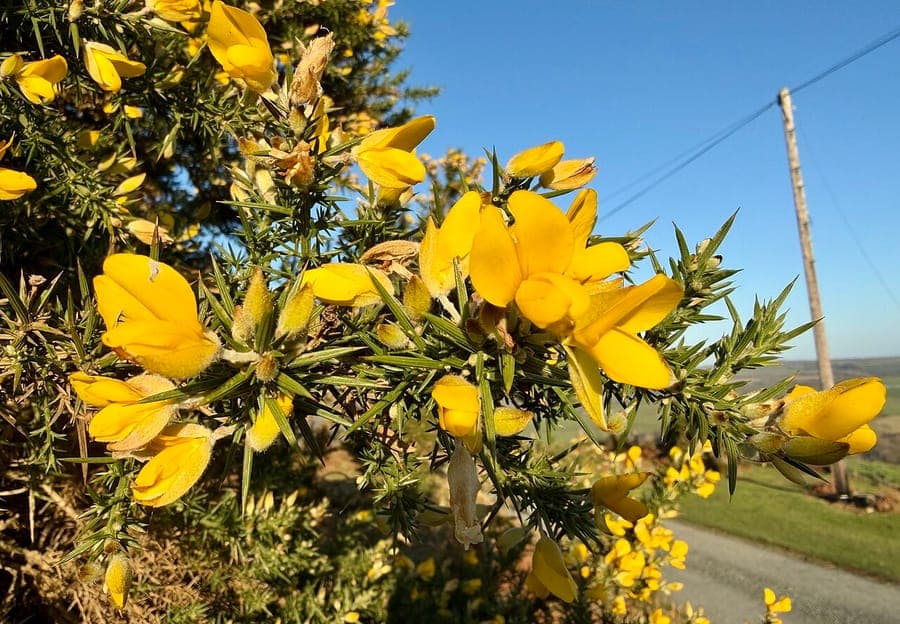
Kieran Roy Powell / CC BY 4.0, via Wikimedia Commons
European gorse: complete guide
Ulex europaeus
¿Quieres ver European gorse: complete guide en tu jardín?
1 minuto, sin tarjeta de crédito
European gorse (Ulex europaeus) is a spectacular winter-flowering shrub distinguished by its brilliant orange-gold flower cascades against dark foliage. The plant blooms especially from October through May, providing valuable nectar when other food sources diminish. It is an extraordinarily tolerant shrub that thrives on poor, acidic soils where most plants struggle.
Overview European gorse is a South and Central European shrub from the pea family (Fabaceae). The plant is known by various names: gorse, furze, gaspeldoorn, and spiny broom. It is an important bird plant in European landscapes, sheltering many small birds with its formidable spines. The botanical name Ulex europaeus reflects its widespread distribution across Europe.
Origin and distribution Ulex europaeus occurs naturally in western and central Europe, from Great Britain to the Mediterranean. The plant grows on acidic, impoverished soils, often on heathlands, hillsides, and lime-free sandy grounds. From Europe it has become naturalized on many other continents, sometimes as an invasive species in regions like New Zealand and California.
Appearance and bloom The shrub reaches 150-250 cm in height with a compact, stiff growth habit. The entire plant is heavily thorned - the spines are modified branches and needles. In winter and early spring, golden-yellow flowers (up to several centimeters across) appear in enormous quantities, almost obscuring the plant in golden bloom. The flowers emit a coconut-like fragrance, especially on warm days. This massed display is unparalleled among winter bloomers.
Ideal location European gorse thrives in sunny, open positions. The plant tolerates half to full sun excellently. In deep shade, flowering diminishes and growth becomes loose. The plant is extremely wind-resistant and grows on exposed hillsides without difficulty. Bark and foliage are green - photosynthesis occurs mainly in young shoots, as spines are the modified leaves.
Soil requirements Ulex europaeus is a true acid-lover and grows optimally on soils with pH 5.0-5.5. The plant tolerates very poor, impoverished soils due to symbiosis with nitrogen-fixing bacteria. Drainage must be excellent; waterlogged soil is not tolerated. Soil should be loose and not compacted.
Watering Once established, European gorse is extremely drought-tolerant and requires minimal watering. Young plants must, however, receive regular water during the first growing season (especially in dry summers). Once established, the plant grows well without supplemental irrigation, even on very dry sites.
Pruning and maintenance Pruning is not essential for gorse, but gentle cutting after flowering (May-June) promotes more compact growth and richer blooming. Do not cut into old wood; the shrub does not recover well from heavy pruning. Good drainage is more important than feeding. Annual organic amendments are unnecessary.
Maintenance calendar Winter: Observe the winter bloom display in January-March. No work required. Spring (March-May): After blooming, gentle heading-back if desired. Growth season begins. Summer: No watering needed for established plants. Check drainage conditions. Autumn: Preparation for forthcoming winter bloom. No intervention required.
Winter hardiness Ulex europaeus is hardy to approximately -10 to -15 degrees Celsius in much of northern Europe, depending on seed provenance. Specimens from more northerly populations are hardier. Very young plants may be damaged in severe winters.
Companion plants On similar soil types, these grow well: heaths (Calluna, Erica), purple moor grass (Molinia), fine sedges (Carex), sundew (Drosera), and daisy. In larger borders, potentillas and jasmine complement gorse beautifully.
Conclusion European gorse is a flamboyant winter-bloomer for difficult, acid soils. With its spectacular, long-lasting flowers and bird-sheltering growth form, this shrub deserves far more attention in northern European gardens. Find gorse plants at specialized nurseries. On any poor, acid site, this is definitely worth trying.
Fun facts: The flowers are edible and are used in some countries for tea or liqueur. The wood is extremely hard and was historically used for tools and implements.
¿Quieres ver European gorse: complete guide en tu jardín? Crea un diseño gratis ahora.
Sube una foto, elige un estilo y obtén un diseño fotorrealista con lista de plantas en menos de un minuto.
Más de 10.000 jardines diseñados
Sin tarjeta de crédito


Plantas similares
Tall Silky Lupine: complete guide
Lupinus elatus
Tall silky lupine is a fast-growing Californian perennial with silvery foliage and blue-purple flower spikes, ideal for a prairie-style garden.
Garfield Lupine: complete guide
Lupinus garfieldensis
The Garfield lupine is a rare, fast-growing American perennial for alkaline, dry grassland gardens, with striking blue flower spikes.
Lupinus elegans: complete guide
Lupinus elegans
Lupinus elegans, the elegant lupine, is a spectacular blooming plant from Mexico with blue flower spikes. Care, cultivation and garden use.