
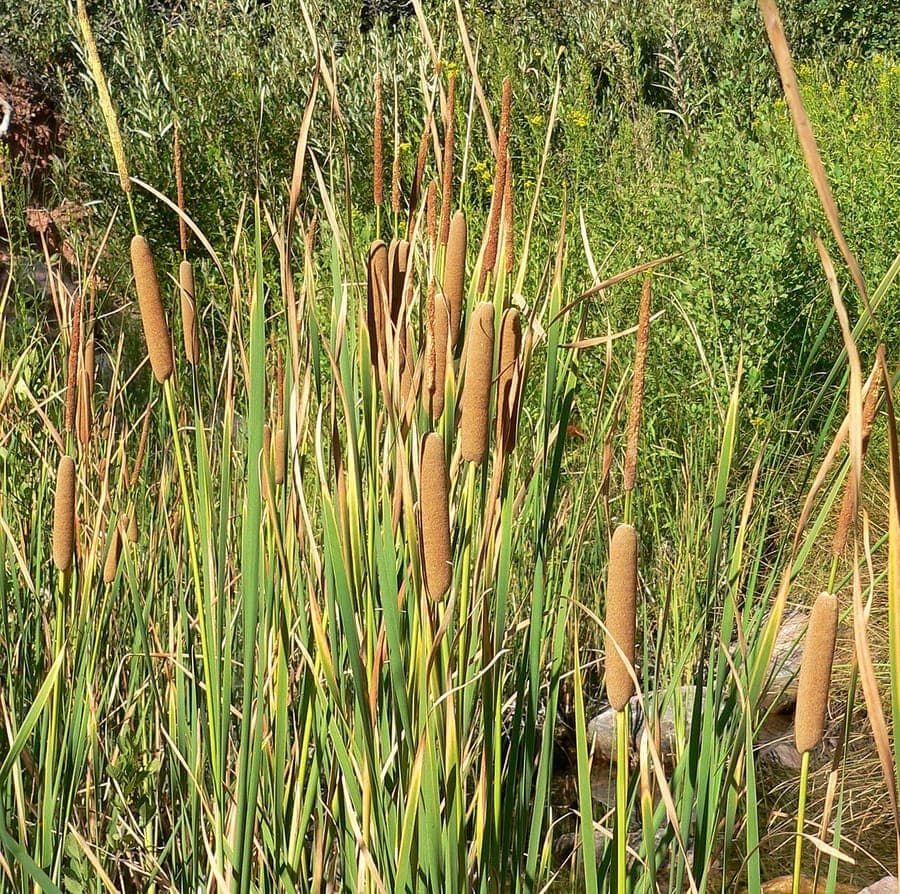
Stan Shebs / CC BY-SA 3.0, via Wikimedia Commons
Narrow-leaf cattail: complete guide
Typha domingensis
¿Quieres ver Narrow-leaf cattail: complete guide en tu jardín?
1 minuto, sin tarjeta de crédito
Overview
Narrow-leaf cattail (Typha domingensis), also known as southern cattail or lesser bulrush, is a magnificent water plant from the Typhaceae family. The plant is native to tropical and subtropical regions of Africa, Asia, and America. In Europe, it is particularly established in southern regions.
This plant is primarily valued for its characteristic brown flower spikes that provide a sculptural effect in marsh gardens and water gardens. The plant plays an important ecological role by providing food and shelter for birds and insects.
Appearance and bloom
Narrow-leaf cattail grows into a substantial water plant that can reach 1 to 2 meters in height. The leaves are linear and grayish-green, typical for cattails. The stems are strong and upright, providing structure to water plant arrangements.
Flowering occurs in summer and autumn, with flower spikes appearing from July onward. The characteristic flower spikes are blackish-brown, dense, cylindrical, approximately 1 to 2 centimeters thick and 5 to 10 centimeters long. After flowering, seed heads form and remain on the plant for months, providing food for birds in autumn and winter.
Ideal location
Narrow-leaf cattail grows best in full sun to partial shade. At least 4 to 5 hours of sunlight daily is desirable. The plant also tolerates shade, although growth will be less robust.
The plant is very flexible for water environments. It grows in shallow waters (0.5 to 1 meter), still waters, ditches, shorelines, and wet soils. It even tolerates poor water quality that other plants cannot endure.
Soil/Water
Narrow-leaf cattail grows in aquatic environments and is not dependent on traditional soil quality. However, the plant grows best in nutrient-rich water environments. Muddy shores and shallow waters are ideal.
The plant accepts both clean and slightly polluted waters. In aquatic applications, such as ponds, a nutrient-rich aquatic potting soil works excellently.
Watering
Narrow-leaf cattail is a water plant and requires permanent water supply. Plant in ponds, marshes, ditches, or other permanent water situations. The plant tolerates seasonal water level fluctuations but grows better with consistent water.
During dry periods, supplemental water may be necessary, depending on the initial water environment. Ensure good water drainage in pond cultivation.
Diseño gratis
¿Quieres ver Narrow-leaf cattail: complete guide en tu jardín? Crea un diseño gratis ahora.
Pruning
Pruning is not essential but can help with control. At the end of the growing season (October to November), dead stems can be removed. This keeps the pond neat and stimulates new growth next spring.
However, retain some dead material for overwintering purposes, as it provides bird food. Complete removal can be ecologically negative.
Maintenance calendar
Spring (March - May): Plant young plants in shallow waters. Regular water supply. No pruning needed. Summer (June - August): Plant grows rapidly. Flowering begins to appear in late summer. Monitor water quality. Fall (September - October): Flower spikes ripen and attract birds. Leave dead material for bird feeding. Check water levels. Winter (November - February): Plant is dormant. Depends on water levels and weather conditions. Minimal care needed.
Winter hardiness
Narrow-leaf cattail is hardy to zones 6-7 in most situations. The plant survives severe frosts in temperate climates, especially if water levels remain constant. In very harsh winters, above-ground growth may die back, but the underground rhizome usually survives.
In areas with very severe winters or extreme water disturbances, protection may be desirable, for example by applying a layer of peat moss over the winter area.
Companion plants
Narrow-leaf cattail works well in combination with:
- Common reed (Phragmites australis)
- Yellow water lily (Nuphar lutea)
- Pickerel rush (Pontederia cordata)
- Shield plant (Rhododendron simsii or water begonia)
- Sweet flag (Acorus calamus)
- Meadowsweet (Filipendula ulmaria)
Together they form an ecologically rich, bird-friendly water environment.
Closing
Narrow-leaf cattail is an impressive, ecologically valuable plant for marsh gardens and water gardens. With its characteristic brown flower spikes, sculptural form, and bird habitat potential, it deserves recognition. As a structural plant in aquatic systems, it is indispensable.
Young plants are available from specialized water garden centers. For more inspiration about water gardens and wetland design, visit gardenworld.app for detailed aquatic garden plans.
Find regular updates and inspiration at gardenworld.app, your source for water garden ideas.
¿Quieres ver Narrow-leaf cattail: complete guide en tu jardín? Crea un diseño gratis ahora.
Sube una foto, elige un estilo y obtén un diseño fotorrealista con lista de plantas en menos de un minuto.
Más de 10.000 jardines diseñados
Sin tarjeta de crédito


Plantas similares
American bur-reed: complete guide
Sparganium americanum
Everything about Sparganium americanum: location, soil, care and use of this robust North American aquatic plant in ponds and water margins.
Broadfruit bur-reed: complete guide
Sparganium eurycarpum
Everything about broadfruit bur-reed (Sparganium eurycarpum): location, soil, care, and use in ponds and waterside plantings.
Laxmann's bulrush: complete guide
Typha laxmannii
Laxmann's bulrush is an elegant wetland plant with compact brown flowerheads arranged in tight clusters. Perfect for pond edges and shallow water up to 1.5 meters deep.