
Stickpen / Public domain, via Wikimedia Commons
Bristly clover: complete guide
Trifolium hirtum
¿Quieres ver Bristly clover: complete guide en tu jardín?
1 minuto, sin tarjeta de crédito
Overview
Bristly clover (Trifolium hirtum) is an annual or biennial plant from the Fabaceae family, native to the Mediterranean region through to Iran. This graceful legume is known for its striking pink flowers and its ability to fix nitrogen in the soil. This makes it not only beautiful but also ecologically valuable for gardens that promote biodiversity.
The plant is widely used in organic farming and green manure projects, but deserves a place in ornamental borders as well. With its pearly green leaves and lovely pink flowers, it brings a cheerful, vibrant character to any garden.
Appearance and bloom
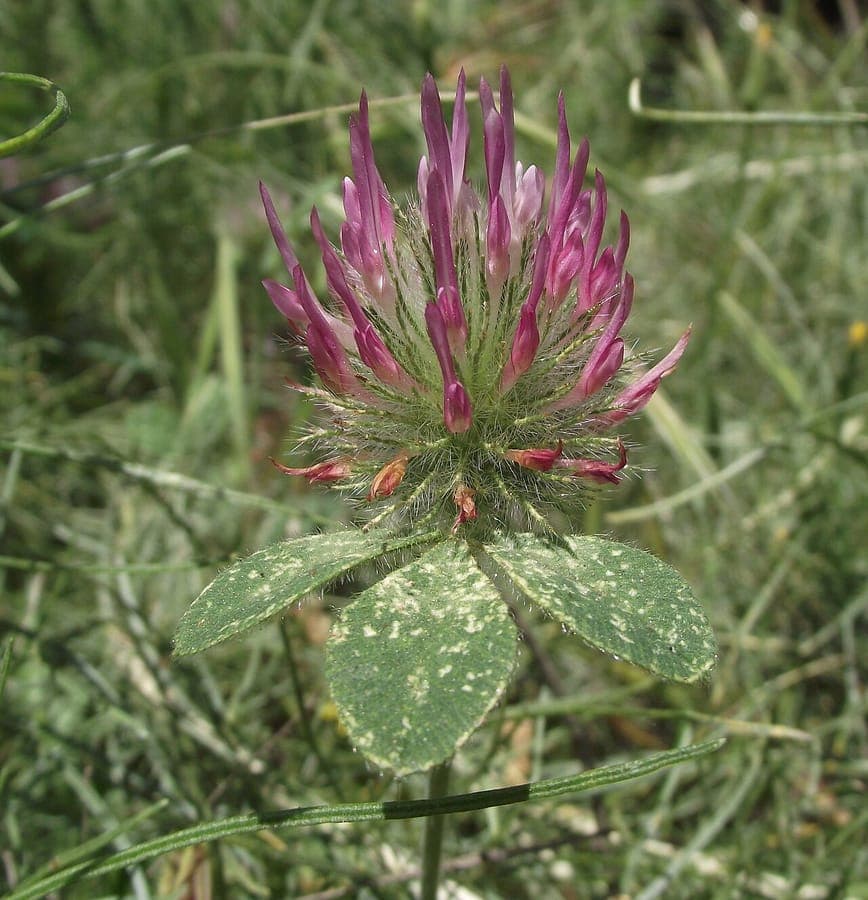
Bristly clover grows into a compact plant reaching approximately 30 to 50 centimeters in height. The leaves display the characteristic three-part form of clovers, making the genus immediately recognizable. The leaves have a distinctly bristly appearance, which explains the plant's name.
Flowering occurs from May to July and is the plant's main attraction. The flowers appear in dense, round clusters 15 to 25 millimeters in diameter. Color varies from deep pink to purplish, sometimes with white tips on the sepals. These flowers attract numerous bees, butterflies, and other pollinators.
Ideal location
Bristly clover prefers a sunny location with at least 6 to 8 hours of direct sunlight daily. At higher elevations it also grows in partial shade, though flowering will be less profuse. The plant is wind-tolerant and grows well in open locations.
The plant can grow on virtually any soil type, including moderately poor soils. This is an advantage as it can stimulate soil improvement.
Soil
Bristly clover is not particularly fussy about soil quality. It grows on sandy, loamy, and clayey soils as long as drainage is reasonable. The ideal pH ranges from 6.0 to 7.5. The plant tolerates even moderately acidic to neutral soils well.
Through its nitrogen-fixing ability, this plant is particularly valuable as a green manure crop. After flowering and dying, the organic matter contributes to soil enrichment.
Watering
Bristly clover has moderate water requirements. It tolerates drought reasonably well once established, but grows better with regular moderate watering. During very dry periods, supplemental watering may be necessary, especially during the growing season.
Wet feet are less tolerable. Ensure good drainage. In a normal European summer season, regular rainfall is usually sufficient.
Diseño gratis
¿Quieres ver Bristly clover: complete guide en tu jardín? Crea un diseño gratis ahora.
Pruning
Formal pruning is not necessary for bristly clover. The plant forms a compact, orderly shape. However, remove spent flower stems regularly to encourage continued blooming.
When the plant finishes at season's end, you can remove the dead material. This helps keep the site tidy and encourages next season's growth.
Maintenance calendar
Spring (March - May): Sow seeds in early spring. Water regularly while plants establish. No pruning needed. Summer (June - August): Regular watering during dry spells. Remove spent flowers to extend blooming. Watch for insect pests. Fall (September - October): Plant naturally dies back at the end of its growth cycle. Leave dead material for soil enrichment. Winter (November - February): Dormant season. No maintenance needed. Plant prepares for the coming season.
Winter hardiness
Bristly clover is hardy to zones 6-9, depending on subspecies. It generally overwinters well in temperate European regions. However, it is primarily a spring and summer plant, dying back with frost.
In very cold regions, seed can overwinter until the next spring if properly stored. Self-seeding can occur, so the plant may return year after year.
Companion plants
Bristly clover works well in combination with:
- Red clover (Trifolium pratense)
- Calendula (Calendula officinalis)
- Cornflower (Centaurea cyanus)
- Californian poppy (Eschscholzia californica)
- Cowslip (Primula veris)
- Pincushion flower (Scabiosa atropurpurea)
Combined this way, they form a luxuriant, pollinator-friendly border full of color.
Closing
Bristly clover is a valuable addition to ecological and ornamental gardens. With its striking pink flowers, nitrogen-fixing ability, and minimal maintenance needs, it deserves more attention in garden design. Whether you use it for green manure or purely for beauty, bristly clover will enrich your garden.
Seed is available at garden centers. For more inspiration about flower-rich gardens and pollinator-friendly borders, visit gardenworld.app for detailed planting schemes. Make your garden a welcoming place for pollinators using species like bristly clover.
Find regular updates and inspiration at gardenworld.app, where you can plan your next flower-filled garden.
¿Quieres ver Bristly clover: complete guide en tu jardín? Crea un diseño gratis ahora.
Sube una foto, elige un estilo y obtén un diseño fotorrealista con lista de plantas en menos de un minuto.
Más de 10.000 jardines diseñados
Sin tarjeta de crédito


Plantas similares
Tall Silky Lupine: complete guide
Lupinus elatus
Tall silky lupine is a fast-growing Californian perennial with silvery foliage and blue-purple flower spikes, ideal for a prairie-style garden.
Garfield Lupine: complete guide
Lupinus garfieldensis
The Garfield lupine is a rare, fast-growing American perennial for alkaline, dry grassland gardens, with striking blue flower spikes.
Lupinus elegans: complete guide
Lupinus elegans
Lupinus elegans, the elegant lupine, is a spectacular blooming plant from Mexico with blue flower spikes. Care, cultivation and garden use.