
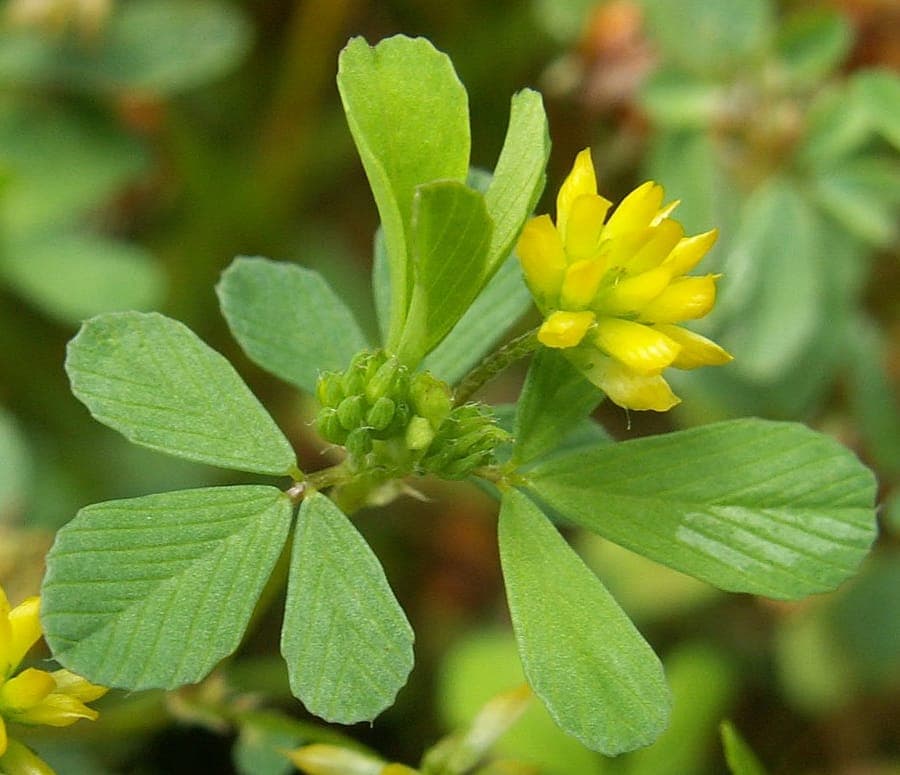
Kenraiz / CC BY-SA 3.0, via Wikimedia Commons
Suckling Clover (Trifolium dubium): complete guide
Trifolium dubium
¿Quieres ver Suckling Clover (Trifolium dubium): complete guide en tu jardín?
1 minuto, sin tarjeta de crédito
Overview
Succling clover (Trifolium dubium), also called lesser trefoil, is a delightfully diminutive annual plant from Europe to the Mediterranean. The plant grows as a weak sprawl of only 5-30 cm tall, producing tiny, golden flower heads throughout the summer. This is the smallest European clover and naturally spreads in grassland, meadows, and ungrazed terraces.
Despite its tiny size, suckling clover plays an important role in flower-rich grasslands. The plant is a classic component of traditional meadow communities and natural ground covers. Through self-seeding, suckling clover can return year after year.
Appearance and Bloom
Trifolium dubium distinguishes itself through extremely refined, delicate foliage with a transparent, fragile appearance. The plant is nearly invisible beside larger grasses. The tiny, spherical flower heads are golden and only several millimeters across - the tiniest of all clover depictions.
Flowers appear May through September, providing value for very small insects and microorganisms. The plant spreads via very fine stems growing low along the ground.
Ideal Location
Succkling clover grows best in full sun to partial shade in well-maintained grasslands. The plant is highly tolerant and thrives in virtually all soil types provided moisture is not excessive. For classical natural meadows, suckling clover is essential.
Plant suckling clover in extensive grasslands, meadows, and rough fallow land where turf is not too dense.
Diseño gratis
¿Quieres ver Suckling Clover (Trifolium dubium): complete guide en tu jardín? Crea un diseño gratis ahora.
Soil
Succkling clover grows in virtually all soils from acidic to alkaline. The plant prefers lean rather than rich soils. In nutrient-rich garden soils, suckling clover grows poorly and is overwhelmed by stronger grasses.
Soil should be well-draining. Wet soils create problems.
Watering
Once established, suckling clover is extremely drought-tolerant and rarely needs supplemental water. During initial establishment, careful moisture helps, but intensive watering is unnecessary.
Pruning
Succkling clover requires no pruning. Because the plant is annual, it dies after frost unless it has self-seeded.
Maintenance Calendar
April-May: sow directly into existing grassland. May-June: first flowers. June-September: full bloom, no maintenance. September-October: allow seed heads to drop.
Winter Hardiness
Succkling clover is hardy in the Netherlands but annual. Seed overwinters and germinates the following spring.
Companion Plants
Combine suckling clover with other delicate meadow herbs: daisies, dandelions, and fine grasses. For color effects add red clover and white clover.
Conclusion
Succkling clover is a refined, ungrazed plant that naturally spreads. For those wanting to create flower-rich grasslands, this is indispensable. Learn more at www.gardenworld.app/en.
Find more meadow plants at www.gardenworld.app/en.
¿Quieres ver Suckling Clover (Trifolium dubium): complete guide en tu jardín? Crea un diseño gratis ahora.
Sube una foto, elige un estilo y obtén un diseño fotorrealista con lista de plantas en menos de un minuto.
Más de 10.000 jardines diseñados
Sin tarjeta de crédito


Plantas similares
Tall Silky Lupine: complete guide
Lupinus elatus
Tall silky lupine is a fast-growing Californian perennial with silvery foliage and blue-purple flower spikes, ideal for a prairie-style garden.
Garfield Lupine: complete guide
Lupinus garfieldensis
The Garfield lupine is a rare, fast-growing American perennial for alkaline, dry grassland gardens, with striking blue flower spikes.
Lupinus elegans: complete guide
Lupinus elegans
Lupinus elegans, the elegant lupine, is a spectacular blooming plant from Mexico with blue flower spikes. Care, cultivation and garden use.