
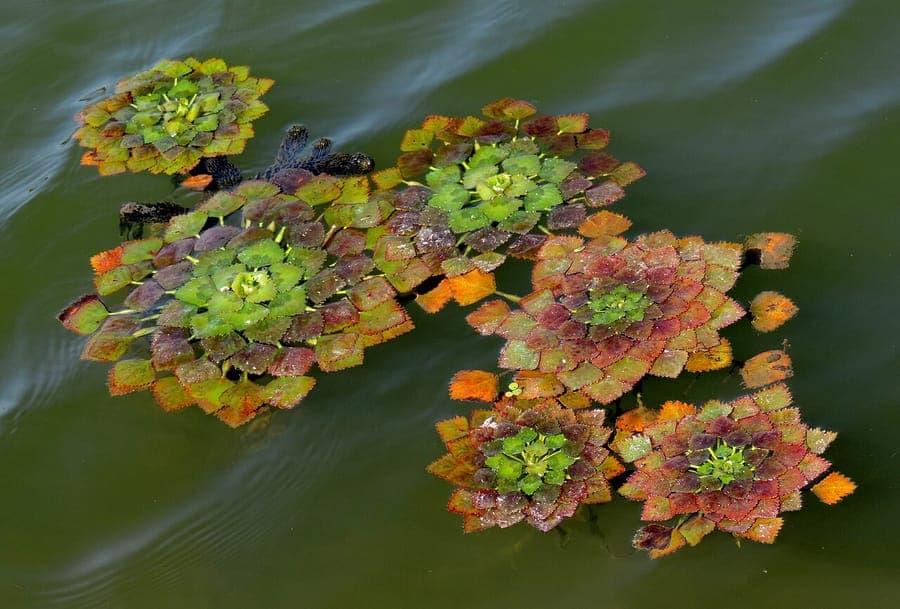
Krzysztof Ziarnek, Kenraiz / CC BY-SA 4.0, via Wikimedia Commons
Water chestnut: complete guide
Trapa natans
¿Quieres ver Water chestnut: complete guide en tu jardín?
1 minuto, sin tarjeta de crédito
Overview
Water chestnut (Trapa natans) is a fascinating aquatic plant with millennia of cultivation in Eurasian waters. This isn't a conventional ornamental garden plant, but rather a botanical marvel with an impressive history in Asian food cultures. The fruits are genuinely edible, nutritious, and flavorful - harvested and processed as food for thousands of years.
The plant grows as a floating rosette with elongated roots anchoring deep into muddy substrates. Leaves are remarkably asymmetrical, with inflated petioles creating natural flotation chambers. The fruits are uniquely hard, black, and equipped with four distinctive horn-like projections - earning colorful folk names like "devil's claws" or "water caltrop".
This plant demands cautious handling. In several European countries (including the Netherlands), it appears on invasive species lists. Nevertheless, in well-managed garden ponds, it offers both educational value and productive potential.
Appearance and bloom
Water chestnut forms floating rosettes reaching 5-20 centimeters in diameter. Each rosette consists of multiple leaves with strikingly asymmetrical forms. The bases of petioles display inflated bladders - natural flotation cells maintaining buoyancy.
Leaves present glossy green on upper surfaces, often reddish-purple beneath. This color contrast makes the plant genuinely decorative in aquariums or ponds. Prior to flowering, tiny discrete white or pale pink blooms appear nestled between leaf rosettes during July-August. These flowers, though small and delicate, are botanically fascinating.
Fruits follow flowering and represent the plant's most interesting feature. Black or dark-brown, approximately 2-4 centimeters across, they bear four powerful horn-like projections. These appendages serve as dispersal mechanisms - they cling to animal fur, facilitating worldwide spread in ecological networks.
At maturity, fruits sink and overwinter on muddy bottoms. Shoots die back in autumn, but fruits persist through winter.
Ideal location
Water chestnut requires no conventional soil location. It floats freely in water, so environmental focus shifts entirely to aquatic conditions.
Sunlight: Minimum 5-6 hours of direct daily sunlight. More is superior - 8-10 hours produces optimal fruiting. Full shade restricts growth severely.
Water type: Must be still-water environments - no strong currents or wave action. This isn't suitable for fast-flowing rivers or marine habitats, only ponds, canals, and slack-water conditions.
Water temperature: 15-30 degrees Celsius is perfect. Plants tolerate brief cooler periods, but flowering and fruiting cease below 15 degrees. In Netherlands and Belgium, optimal growth occurs May through October, with plant die-back in winter.
Water quality: Surprisingly undemanding. Both fresh and brackish water are accepted. pH can range 6-8. Nutrient-rich waters (with algal potential) are actually beneficial.
Soil requirements
Water chestnut needs no soil. This entirely aquatic plant derives all nutrition from water. Nevertheless, when cultivating in managed ponds with substrate or containers, these guidelines apply:
Muddy, nutrient-rich substrates prove favorable. Silty sediment or heavy clay works well. Sand alone is insufficient - too little available nutrition.
Substrate depth: Non-critical. The plant floats, making bottom-contact unnecessary. However, some substrate in confined ponds ensures nutrient availability.
Algal growth: Actually beneficial. Water chestnut thrives in nutrient-rich waters where algal competition indicates abundant resources.
Diseño gratis
¿Quieres ver Water chestnut: complete guide en tu jardín? Crea un diseño gratis ahora.
Watering
Traditional watering concepts are irrelevant here. This is an aquatic plant growing in water.
Water level: Maintain consistent pond depth. Fluctuating water heights create stress. Ideally 60-120 centimeters deep, though deeper functions equally well.
Water circulation: Slow circulation (like in filters) is beneficial, but strong flow is detrimental. The plant prefers nearly-still water.
Water quality parameters:
- Temperature: 15-30 degrees Celsius, ideally 20-25
- pH: 6-8 (fresh water)
- Nutrients: More is better. This plant never hunger-limits itself.
- Visibility depth: 30+ centimeters is good. Excessive algae may restrict growth.
Pruning
Pruning is unnecessary. This fast-growing aquatic plant experiences no natural limitation.
Maintenance actions:
- Population thinning: When plants cover entire pond surface, remove several rosettes to permit light penetration.
- Dead leaves: Automatically remove wilted or yellowed foliage to reduce disease pressure.
- Fruit harvesting: In autumn, when fruits mature, collect them for culinary use or seed production for next season.
While active pruning isn't needed, growth control is crucial given invasive potential.
Maintenance calendar
May: Water warms to 15+ degrees Celsius. Introduce plants to pond or containers. Ensure anchoring if necessary.
June: Rapid growth commences. Plant expands noticeably. Monitor to prevent total pond coverage.
July-August: Blooming occurs. Delicate white flowers appear. Reproduction begins.
September-October: Fruit development. Fruits ripen completely. Water temperature begins declining.
November: Plant senescence follows first frost. Fruits sink toward bottom.
December-March: Winter dormancy. Plant is dead or slumbering. Fruits overwinter on substrate.
April: Preparation phase. Water begins warming.
Winter hardiness
In Netherlands and Belgium: The growing plant is not winter-hardy. Shoots die after first frost.
Fruit hardiness: Fruits are extremely cold-tolerant. They survive -20 degrees Celsius and germinate next spring when water warms. This is how the plant naturally reproduces annually.
Seed storage: Harvest ripe fruits, dry completely, and resow next spring. Fruits retain germination viability for years.
In USDA zones 8+: The plant might overwinter as a short-cycle perennial, though this is exceptional.
Companion plantings
Water chestnut integrates well with other aquatic species in ponds:
Nymphaea (water lily) varieties coexist without direct competition. Both are floating and distribute pond surface utilization.
Eichhornia (water hyacinth) shares identical warm-water preference and grows excellently together.
Salvinia molesta (aquatic fern) is another fast-growing floating species that combines beautifully.
Potamogeton (pond weed) submerged varieties support oxygen production without direct leaf competition.
Marsh grasses in margins: Phragmites or Typha can grow adjacent without conflict.
Notes: Avoid sole aquatic plantings. Water chestnut's vigorous growth can suppress algae and overshadow weaker-growing species.
Closing thoughts
Water chestnut is not suitable for every gardener - it appears on invasive species lists in many regions and cultivation may be prohibited. Check local regulations before planting.
But in well-managed garden ponds, sealed basins, or educational tanks, it offers fascinating botanical observation and actual food production. The edible fruits represent nutritional food supplements. The plant itself is biologically remarkable.
For more information on aquatic garden design and pond planting, visit gardenworld.app/en. You'll find plant-use guides and regulations for protected waters in various regions.
Nurseries often carry water chestnut plantlets in spring, though availability varies regionally and seasonally. Ensure legal permission for cultivation in your area.
¿Quieres ver Water chestnut: complete guide en tu jardín? Crea un diseño gratis ahora.
Sube una foto, elige un estilo y obtén un diseño fotorrealista con lista de plantas en menos de un minuto.
Más de 10.000 jardines diseñados
Sin tarjeta de crédito


Plantas similares
Winged loosestrife: complete guide
Lythrum alatum
Everything about Lythrum alatum, the winged loosestrife. Care, location, pruning and garden pairings for this native North American wetland perennial.
Dnieper loosestrife: complete guide
Lythrum borysthenicum
Everything about Lythrum borysthenicum, the Dnieper loosestrife: location, bloom season, care in pond margins and bog gardens. Full growing guide included.
Grand redstem: complete guide
Ammannia robusta
Everything about Ammannia robusta: pond margins, bog gardens, soil, care and propagation. Practical advice for water garden enthusiasts in temperate climates.