
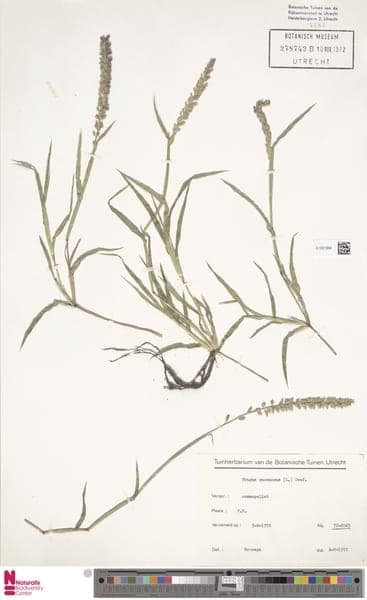
Naturalis Biodiversity Center / CC0, via Wikimedia Commons
European bur grass: complete guide
Tragus racemosus
¿Quieres ver European bur grass: complete guide en tu jardín?
1 minuto, sin tarjeta de crédito
Overview
European bur grass (Tragus racemosus) is a humble annual grass that has adapted masterfully to hot, dry climates stretching from southeastern Europe through Central Asia to North Africa. While not typically cultivated as an ornamental, this plant demonstrates remarkable resilience in hostile growing conditions where few other plants thrive.
Many gardeners discover this grass spontaneously as a self-sown volunteer in their gardens, particularly in regions with hot summers. It establishes itself readily on neglected, bare patches where competition from other species is minimal. The distinctive seed heads with their characteristic barbed bristles ensure effective dispersal - a botanical adaptation worth observing.
The botanical name offers clues to its identity: 'Tragus' derives from Greek, referencing the hairy nature of the fruits, while 'racemosus' describes the characteristic racemose (cluster-like) flowering pattern. This nomenclature reflects the plant's most distinctive feature.
Appearance and bloom
European bur grass forms a compact, low-growing mound typically reaching 20-40 centimeters in height. The stems are thin and yellow-green, with a distinctive architecture that speaks to its evolutionary adaptations. Leaves are narrow and linear, with a rough texture that reduces water loss in arid conditions.
Flowering occurs from July through October, producing a truly unique inflorescence. Rather than the typical plumed seed heads found on many ornamental grasses, this species develops a branched, compressed raceme studded with distinctive spikelets bearing barbed bristles. These wicked little hooks are evolutionary genius - they cling to passing animals' fur or clothing, ensuring seed dispersal across vast distances.
Color development is subtle compared to showier ornamental grasses. Initially green-yellow, the entire plant gradually shifts to warm bronze-brown as maturity approaches. This transformation, while understated, offers its own aesthetic charm in late-summer borders.
As a frost-sensitive annual, the plant obligingly dies back completely after the first hard freeze. This eliminates the need for spring cutting and allows simple removal and composting of dead material.
Ideal location
Full sun exposure is non-negotiable. Provide at least 8 hours of direct, unobstructed sunlight daily. Partial shade results in weak, floppy growth that lacks vigor.
Air circulation matters greatly. Avoid planting in enclosed corners or densely packed plantings. This grass thrives in open settings where air moves freely around the foliage.
Interestingly, windy locations are actually beneficial. The plant naturally evolved in exposed, breezy habitats and performs better with air movement. Sheltered, humid microclimates promote fungal issues.
Regarding hardiness: this is strictly a warm-season annual. Germination occurs only after the last frost date in spring. In frost-free regions (USDA zones 8-10), it may persist as a short-lived perennial. In temperate Europe, expect it to be purely annual.
Soil requirements
This grass is notably undemanding regarding nutrition. Indeed, lean, impoverished soils are actually ideal. Excessive fertility encourages soft, lush growth vulnerable to disease.
Sandy to gravelly soils are perfect. If you have heavy clay, improve drainage with sand and gravel before sowing. Waterlogged conditions guarantee root rot and failure.
Soil pH can range from lightly acidic (6.5) to neutral (7.5), with some tolerance for slightly alkaline conditions. However, the plant grows most vigorously in slightly acidic soils.
When preparing the seed bed, avoid incorporating compost or manure. This adds unwanted nutrition and encourages competing species. A lean, mineral-rich seed bed is genuinely superior to enriched soil.
Diseño gratis
¿Quieres ver European bur grass: complete guide en tu jardín? Crea un diseño gratis ahora.
Watering
Once established, European bur grass is impressively drought-tolerant. In fact, overwatering poses more risk than underwatering.
During germination through the first four weeks: maintain consistently moist (not waterlogged) conditions. Daily misting or careful moisture monitoring helps achieve this balance.
After establishment (beyond four weeks): water only during extreme drought stress. If new shoots begin to wilt, irrigation is warranted, but otherwise allow natural rainfall to suffice.
Avoid overhead watering on foliage during wet seasons. This elevates disease pressure. Water should reach the soil directly.
For container cultivation: much more frequent watering is necessary than for in-ground plantings. Check soil moisture daily at 2 centimeters depth.
Pruning
Pruning is neither necessary nor recommended. This grass requires no cutting back.
When the plant dies following first frost in October-November, you may leave the dry stems standing through winter for wildlife benefit. Seeds and insects utilize the remaining structure.
Alternatively, remove completely dead material once it browns for a tidier appearance. This also improves air circulation and reduces fungal problems.
Watch for self-sown seedlings: remove unwanted volunteers, as this grass can become weedy in certain locations.
Maintenance calendar
May: Sow seed directly on prepared soil after final frost date. Maintain consistently moist seed bed.
June-July: Vigorous growth phase. Water during dry spells. Monitor for disease in wet weeks.
August-September: Distinctive seed heads emerge and mature. No maintenance required.
October: Seeds ripen and disperse. Plant takes on bronze tones. Natural reseeding may occur.
November-December: Plant dies back after first hard freeze. Remove dead material or leave for winter habitat.
January-April: Dormancy. Plant is dead in temperate climates.
Winter hardiness
In Northern Europe: not winter-hardy. This strictly annual grass dies after the first hard frost (below -3 to -5 degrees Celsius).
In warmer climates (USDA zone 8+): may overwinter and persist as a short-lived perennial, though this is uncommon.
Seed survival: abundant seed production ensures the species returns next season through natural reseeding. This can be either a benefit (automatic reappearance) or a drawback (weedy self-sowing).
Container plants: bring indoors before frost or protect with burlap wrapping. In-ground plants: simply allow to freeze and die naturally.
Companion plants
This grass thrives alongside other warm-season annuals in dry gardens:
Partial Buckwheat (Eriogonum compostura) shares identical cultural requirements and produces charming yellow flowers.
Salvia nemorosa and related salvias prefer the same dry, sunny conditions and won't compete aggressively.
Heuchera 'Obsidian' offers striking dark foliage contrast and appreciates the same lean, well-drained soil.
Sedum species, particularly creeping types, fill gaps and tolerate identical moisture and fertility conditions.
Speakerlow creeping thyme provides groundcover without competing for resources.
Critical note: avoid pairing with moisture-loving or heavy-feeding plants. This grass thrives in lean conditions and doesn't benefit from fertile neighbors.
Closing thoughts
European bur grass may not appeal to everyone, but it deserves serious consideration from dry-garden enthusiasts. It establishes itself readily, demands minimal maintenance, and thrives where more delicate grasses falter.
Sow once in May and enjoy a season of wildlife shelter and interesting seed-head architecture. Just monitor self-seeding carefully - this grass can become weedy in certain situations.
For more inspiration on integrating unusual grasses into garden design, visit gardenworld.app/en. Discover how this plant fits into larger dry-garden plans and explore companion planting combinations.
Nurseries often stock seed packets in late spring and early summer. An inexpensive and rewarding experiment for minimalist gardeners seeking authentic, low-input plantings.
¿Quieres ver European bur grass: complete guide en tu jardín? Crea un diseño gratis ahora.
Sube una foto, elige un estilo y obtén un diseño fotorrealista con lista de plantas en menos de un minuto.
Más de 10.000 jardines diseñados
Sin tarjeta de crédito


Plantas similares
Sporobolus pungens: complete guide
Sporobolus pungens
Sporobolus pungens is a stoloniferous Mediterranean coastal grass with outstanding salt and drought tolerance, perfect for seaside and dry gardens.
Mediterranean aegilops: complete guide
Aegilops biuncialis
Everything about Aegilops biuncialis, a Mediterranean annual grass with ornamental spikes and outstanding drought tolerance for dry gardens.
Silver bluestem: complete guide
Bothriochloa saccharoides
Full guide to Bothriochloa saccharoides (silver bluestem): site, soil, watering, winter hardiness, pruning, and garden companions.