
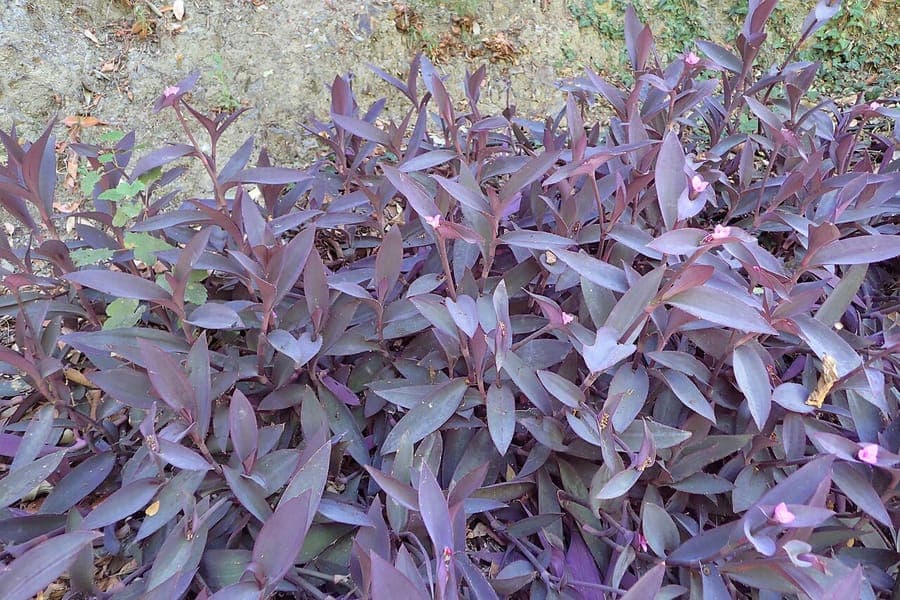
Krzysztof Ziarnek, Kenraiz / CC BY-SA 4.0, via Wikimedia Commons
Purple queen: complete guide
Tradescantia pallida
¿Quieres ver Purple queen: complete guide en tu jardín?
1 minuto, sin tarjeta de crédito
Tradescantia pallida, better known as Purple Queen or Purple Heart, is a striking tropical plant originating from Mexico's diverse ecosystems. This herbaceous plant belongs to the Commelinaceae family, the same family as zebra plant and other tradescantia species. It is a popular houseplant thanks to its striking purple foliage, compact growth habit, and easy care requirements. The plant originates from Mexico's heathland ecosystems where it grows as a low-spreading groundcover in partial shade.
The Purple Queen is a compact, lightly trailing to semi-upright plant typically growing 20 to 40 centimeters long, though under ideal conditions it may reach 60 centimeters or longer when supported. The stems are glossy purple to dark red in color, developing this hue due to anthocyanin pigments. The leaves are lanceolate to oblong-elliptic, approximately 5 to 10 centimeters long and 2 to 3 centimeters wide. The leaf color is the most striking feature: deep purple to burgundy on the upper surface and slightly lighter purple underneath. This color is most intense under bright light conditions when UV radiation stimulates anthocyanin production. In moderate light, the leaf color tends to become more greenish. The leaf texture is smooth and glossy.
Blooming can occur throughout the year under favorable conditions, with peaks in spring and summer. The flowers are not the main attraction of this plant, however - they are small, approximately 1 centimeter in diameter, and blue-purple in color with three petals. They appear in small clusters in the leaf axils. Following pollination, small seed capsules form, though seed set is rare in cultivation since self-pollination often fails.
Tradescantia pallida thrives best in bright, indirect light, which stimulates healthy growth and maintains vibrant leaf color. The plant tolerates full sun, which also helps maintain and even deepen the purple leaf color through increased anthocyanin production. In moderate light, the leaves will become more greenish. In very low light levels, the plant will become dull and grow tall and leggy - this should be avoided. The plant prefers temperatures between 18 to 26 degrees Celsius, which is standard room climate. At temperatures below 10 degrees Celsius, the plant grows slowly or stagnates entirely, potentially proving lethal.
Watering should be regular but not excessive. The soil should be moist but not waterlogged. In summer, water more frequently; in winter, less. Excessive watering leads to root rot, a common problem. The plant can go several days without water without damage. Fertilization can occur monthly during the growing season with balanced houseplant fertilizer. In winter, fertilization can be omitted or minimal.
The Purple Queen is extremely easy to propagate via cuttings. A stem section approximately 10 centimeters long can be placed in water or moist potting soil, where it will usually root within 1 to 2 weeks. This makes it an ideal plant for amateur growers and children learning plant propagation. Pruning can be done as desired to maintain a fuller, more compact plant. Regular pinching of young stem growth promotes branching and fuller appearance.
Pest infestations are relatively rare but can include spider mites, mealybugs, and scale insects, especially in dry indoor air. Regular misting or spraying with lukewarm water helps prevent this. With severe infestations, insecticidal soaps or biological controls can be used.
The Purple Queen is an excellent plant for desks, shelves, and windowsills. The trailing habit also makes it suitable for hanging baskets. In warmer regions, it can also grow outdoors in partial shade or dappled sunlight, though it is usually kept as a houseplant. In southern Europe, it thrives outdoors in summer and is brought indoors for winter.
Thanks to its attractive foliage color, easy cultivation, and propagation, Tradescantia pallida is one of the most popular houseplants, widely available at garden centers and nurseries in various sizes. Many retailers stock this plant year-round. The plant is also excellent for purifying indoor air by absorbing formaldehyde and other harmful substances from the atmosphere.
¿Quieres ver Purple queen: complete guide en tu jardín? Crea un diseño gratis ahora.
Sube una foto, elige un estilo y obtén un diseño fotorrealista con lista de plantas en menos de un minuto.
Más de 10.000 jardines diseñados
Sin tarjeta de crédito


Plantas similares
Virginia dayflower: complete guide
Commelina virginica
Full guide to Virginia dayflower (Commelina virginica): ideal location, soil, watering, pruning, winter care and companion plants.
Commelina diffusa: complete guide
Commelina diffusa Burm.f.
Commelina diffusa, the climbing dayflower, is an elegant perennial with soft blue flowers that bloom for just a day. This tropical grower thrives in shaded locations and is ideal for hanging baskets, pergolas, and moist garden corners.
Callisia repens: complete guide
Callisia repens
Creeping Inchplant is an elegant trailing plant with delicate foliage, perfect for hanging baskets and groundcover. Learn how to cultivate this popular houseplant successfully.