
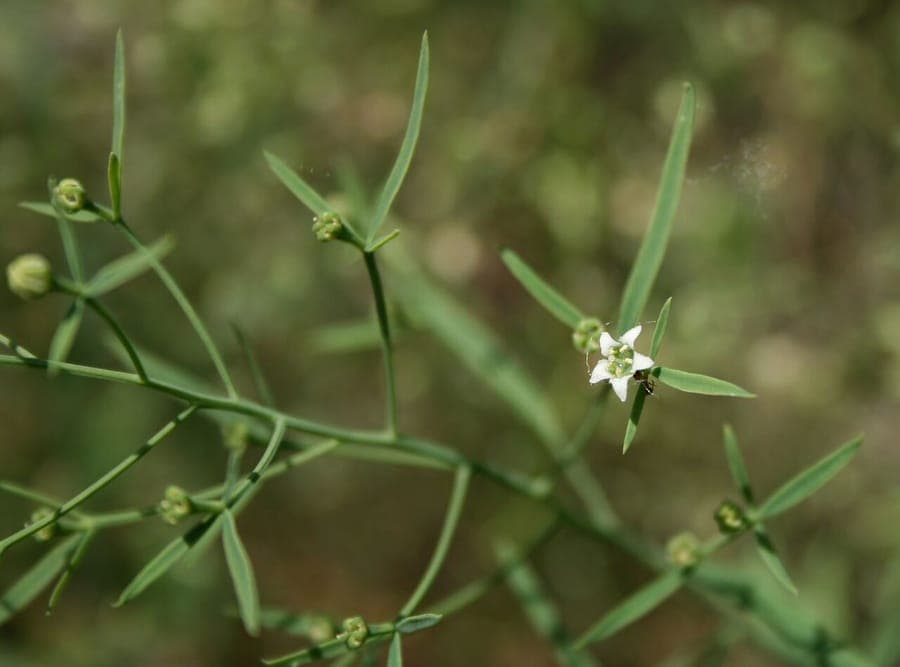
Franz Xaver / CC BY-SA 3.0, via Wikimedia Commons
Flaxleaf: complete guide
Thesium linophyllon
¿Quieres ver Flaxleaf: complete guide en tu jardín?
1 minuto, sin tarjeta de crédito
Overview
Flaxleaf (Thesium linophyllon) is an elegant European wildflower from the mountainous regions of central Europe. This small herbaceous species is known for its delicate white flowers and fine, linear leaves. Although semi-parasitic, it makes a beautiful addition to alpine gardens, cottage gardens, and rock gardens. It has great ecological significance for birds.
Appearance and bloom
Flaxleaf grows as a compact, finely branched herbaceous species reaching about 40 cm tall. The plant has long, narrow linear leaves uniquely resembling flax leaves (hence the name). Flowers are small, predominantly white with subtle pink tones appearing in small clusters June through August. Flowers are understated but elegant and attract bees. Following flowering, seed capsules form that feed birds.
Ideal location
Flaxleaf thrives best in full sun with well-draining soil. Alpine and rock gardens are ideal, as are sunny mountainsides in temperate gardens. This plant prefers cool, ventilated locations and doesn't thrive in warm, humid conditions. Ensure adequate light with at least 6-8 hours of direct sun daily.
Soil
The plant makes high demands on soil: very well-draining, lightly alkaline to neutral (pH 6.5-8.0) is preferred. Sandy and stony soils work well. Add gravel, perlite, or sand to heavy soils. The plant is unfussy about nutrition and grows even in poor soils. This actually encourages more compact growth and better flowering.
Diseño gratis
¿Quieres ver Flaxleaf: complete guide en tu jardín? Crea un diseño gratis ahora.
Watering
Once established, Flaxleaf is fairly drought-tolerant. Provide regular but moderate watering during the growing season in dry periods. The plant dislikes wet, waterlogged soils. In humid climates be cautious with watering. Most damage comes from excess moisture during growth.
Pruning
Pruning is unnecessary for managing this plant; it maintains its natural form. After flowering, you can remove seed stems for neat appearance, though this deprives birds of food. If the plant becomes too tall, lightly prune in early spring. Avoid heavy pruning.
Maintenance calendar
Early spring: Start seeds or set young plants\nMay-June: Flower growth preparation\nJune-August: Peak flowering period\nAutumn: Seed ripening, autumn cleanup
Winter hardiness
Flaxleaf is very winter-hardy in its natural European habitats. It tolerates temperatures well below freezing. This makes it ideal for temperate gardens with heavy winters. The plant thrives best where winter temperatures regularly drop below freezing.
Companion plants
Flaxleaf fits well in alpine gardens with other mountain wildflowers such as Silene, Saxifraga, and Dryas. The same applies to rock gardens where it grows among other small species. Moorland grasses and other alpine species work well together.
Conclusion
Flaxleaf is a beautiful choice for anyone wanting a fine wildflower for alpine or rock gardens. With its elegant leaves, delicate white flowers, and ecological importance, this plant deserves a place in well-draining, sunny gardens. Rare in commerce but can be grown from seed.
¿Quieres ver Flaxleaf: complete guide en tu jardín? Crea un diseño gratis ahora.
Sube una foto, elige un estilo y obtén un diseño fotorrealista con lista de plantas en menos de un minuto.
Más de 10.000 jardines diseñados
Sin tarjeta de crédito


Plantas similares
Juniper Dwarf Mistletoe: complete guide
Arceuthobium oxycedri
Full profile of Arceuthobium oxycedri, the juniper dwarf mistletoe: biology, host range, identification, and garden management advice.
Meadow Flax: complete guide
Thesium pyrenaicum
Cultivate Meadow Flax (Thesium pyrenaicum): delicate alpine plant, white flowers, acid soil preference, sparse nutrition, and Pyrenean mountain garden care.
Thesium humile: complete guide
Thesium humile
Discover Low Bastard Toadflax, a modest herb with fine foliage and tiny white flowers. Perfect wild plant for Mediterranean drought gardens.