
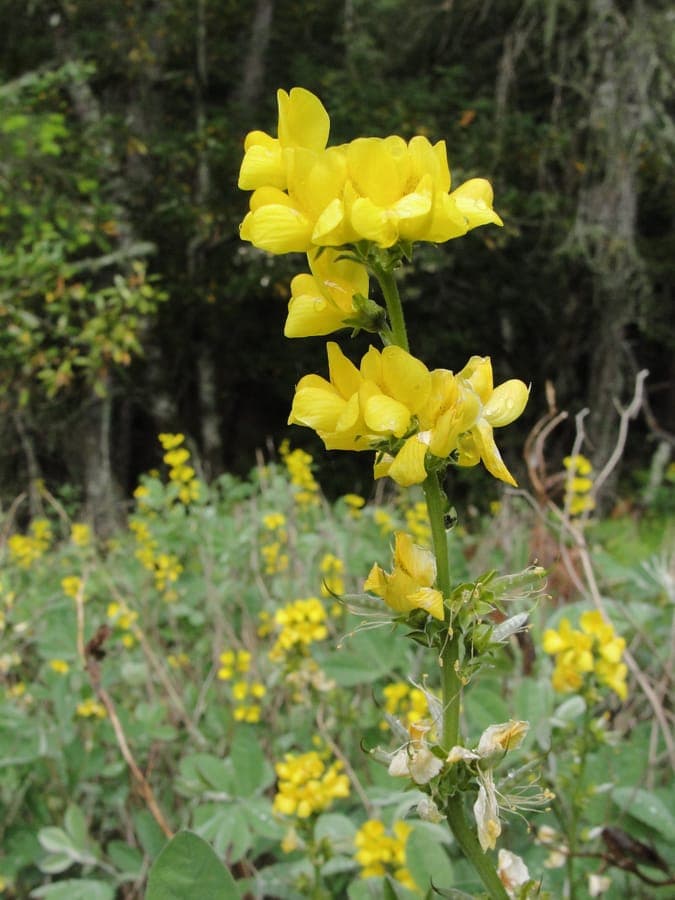
Miguel Vieira from Walnut Creek, CA, USA / CC BY 2.0, via Wikimedia Commons
Thermopsis macrophylla: complete guide
Thermopsis macrophylla
¿Quieres ver Thermopsis macrophylla: complete guide en tu jardín?
1 minuto, sin tarjeta de crédito
Overview
Thermopsis macrophylla, commonly called santa inez goldenbanner, is a striking perennial in the legume family (Fabaceae). Its native range is restricted to the coastal mountains of California, particularly around the Santa Ynez Valley. The plant is stoloniferous, meaning it spreads via underground runners to form gradually expanding clumps over time. If you're planning a dry, sunny front garden, gardenworld.app can show you how this plant fits into a complete design.
The genus Thermopsis contains around 30 species of lupine-like perennials. Thermopsis macrophylla was formally described in 1838 by botanists William Jackson Hooker and George Arnott Walker-Arnott, based on specimens collected during the Beechey Voyage to the Pacific.
Appearance and bloom
The name 'macrophylla' means large-leaved, and the foliage lives up to that. Each leaf is divided into three broad, slightly wavy leaflets with a coarse texture. The stems are upright and can reach 40 to 60 cm tall in full bloom. Flowers are bright yellow, arranged in upright racemes that closely resemble those of lupines. Each individual flower is a classic pea-type bloom with a broad banner petal.
Blooming typically occurs in spring, from May into June depending on local temperatures. After flowering, slender seed pods develop, which are both decorative and attractive to birds. The plant is conspicuous in flower and remains visible all through the growing season due to its large leaves.
Ideal location
Full sun is strongly preferred. In its natural habitat, Thermopsis macrophylla grows on open hillsides and in light oak woodland, but in garden conditions it performs best with at least six hours of direct sun per day. Plants in shade will grow tall and leggy with poor flowering.
A warm, sheltered spot suits this plant well. The south or west side of a house, or a raised bed in the front garden, works perfectly. Because the plant spreads via stolons, give it enough room to expand slightly over the years.
Soil
Thermopsis macrophylla is adaptable but needs well-drained soil above all. It tolerates alkaline pH, performing well in soils with a pH between 7.0 and 8.5. Calcareous or chalky soils are fine. Clay soil can work if grit or coarse sand is incorporated to improve drainage.
Avoid waterlogged spots. Root rot caused by standing moisture is the most common killer of this plant. Lean, slightly poor soil actually produces better flowering than overly rich compost beds. This mirrors the plant's natural habitat on rocky California hillsides.
Watering
Once established, Thermopsis macrophylla is quite drought-tolerant. During the first growing season, water regularly to help roots get established. After that, water deeply once a week during prolonged dry spells in summer, then let the soil dry out completely before watering again.
In typical European garden conditions with winter rain, ensure drainage is good. Mulching the root zone in autumn with bark chips helps regulate moisture and provides light root protection during cold snaps.
Pruning
After flowering, cut back the spent flower stalks to about 10 to 15 cm above the ground. This keeps the plant tidy and encourages a more compact habit. Leave the foliage in place until it dies back naturally in autumn.
Avoid heavy pruning. Thermopsis macrophylla benefits from retaining some above-ground material through winter, which offers a degree of frost protection to the crown. In early spring, just as new shoots become visible, remove all old material entirely to give the fresh growth room to develop.
Diseño gratis
¿Quieres ver Thermopsis macrophylla: complete guide en tu jardín? Crea un diseño gratis ahora.
Maintenance calendar
- February/March: Remove previous year's dead material. Check stolons and contain spread if needed.
- April: Apply a potassium-rich fertiliser. Water lightly if the weather is dry.
- May/June: Bloom period. No intervention needed. Enjoy the yellow flower spikes.
- July: Seed pods ripen. Harvest seeds for propagation or leave them for birds.
- August/September: Possible drought period. Water once a week if no rain for two or more weeks.
- October: Mulch the root zone with coarse bark.
- November to January: Resting period. No action required.
Winter hardiness
Thermopsis macrophylla comes from mild coastal California and is not fully cold-hardy. In Western Europe it generally survives in areas without prolonged hard frosts, corresponding to USDA hardiness zones 7 to 8. In colder continental climates, protect the crown with brushwood or horticultural fleece during sharp winter cold.
The root system is more resilient than the top growth. Even if above-ground parts are killed by frost, the stolons can re-sprout in spring. Keep soil as dry as possible in winter: wet cold is far more damaging than dry cold.
Companion plants
The bright yellow blooms pair well with other drought-tolerant perennials. Salvia species provide contrast in flower form, while Penstemon adds blue-purple tones that complement the yellow beautifully. Low ornamental grasses like Festuca glauca give textural contrast and a clean, modern look.
For rock garden settings, combine with Sedum and Armeria, which share the preference for alkaline, well-drained soil. Avoid pairing with moisture-loving plants like Astilbe or Ligularia, which need opposite conditions.
Propagation
Thermopsis macrophylla can be propagated by seed or by rhizome division. Division is the more straightforward method and gives faster results. In autumn or early spring, carefully dig up sections of the outer stolons, making sure each piece has adequate roots attached, then replant at the desired location. Keep new divisions well watered through their first growing season.
Seed propagation requires more patience. The seeds need a cold stratification period of four to six weeks before they will germinate reliably. Store seeds in a slightly damp cloth in the refrigerator, or sow them in an unheated frame over winter. After stratification, sow at a temperature of 15 to 18 degrees Celsius. Seedlings grow slowly in their first year and the plant will not flower until its second or third season. Seed can sometimes be found through specialist perennial nurseries or online seed exchanges. Specialist garden centres carry related species that give a useful point of comparison when planning a planting scheme.
Closing thoughts
Thermopsis macrophylla is a tough, underused perennial that asks very little but delivers genuine visual impact. For gardeners who want a lupine-like plant with a more unusual character and real drought tolerance, this Californian native is a sound choice. Visit gardenworld.app to discover how this and other interesting species could transform your front garden into something genuinely distinctive.
¿Quieres ver Thermopsis macrophylla: complete guide en tu jardín? Crea un diseño gratis ahora.
Sube una foto, elige un estilo y obtén un diseño fotorrealista con lista de plantas en menos de un minuto.
Más de 10.000 jardines diseñados
Sin tarjeta de crédito


Plantas similares
Tall Silky Lupine: complete guide
Lupinus elatus
Tall silky lupine is a fast-growing Californian perennial with silvery foliage and blue-purple flower spikes, ideal for a prairie-style garden.
Garfield Lupine: complete guide
Lupinus garfieldensis
The Garfield lupine is a rare, fast-growing American perennial for alkaline, dry grassland gardens, with striking blue flower spikes.
Lupinus elegans: complete guide
Lupinus elegans
Lupinus elegans, the elegant lupine, is a spectacular blooming plant from Mexico with blue flower spikes. Care, cultivation and garden use.