
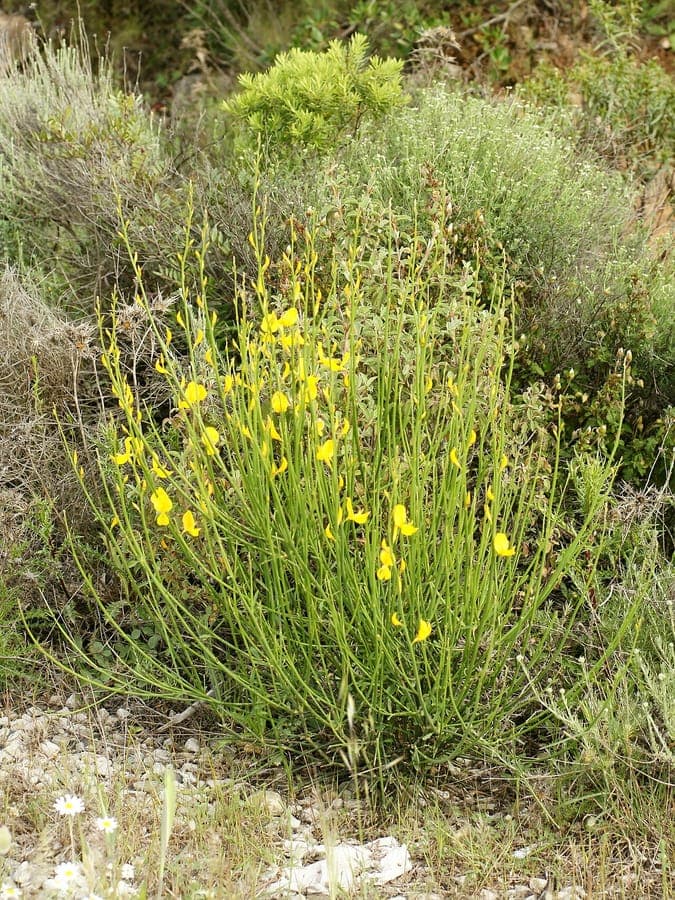
Hans Hillewaert / CC BY-SA 3.0, via Wikimedia Commons
Spanish broom: complete guide
Spartium junceum
¿Quieres ver Spanish broom: complete guide en tu jardín?
1 minuto, sin tarjeta de crédito
Spanish Broom: Complete Guide
Overview
Spanish broom (Spartium junceum), also known as genet or weaver's broom, is a beautiful Mediterranean shrub from the Fabaceae family. This plant naturally grows in Southern Europe, around the Mediterranean region. Spanish broom is renowned for its spectacular, strongly fragrant yellow flowers that unfold throughout summer.
This elegant plant is perfect for sunny gardens in warm climates. Spanish broom offers not only visual beauty but also a pleasant sweet fragrance that fills the garden throughout summer. It is an excellent choice for Mediterranean garden styles and dry areas.
Appearance and Bloom
Spartium junceum is a graceful, upright-growing shrub that can reach 2-3 meters high. The plant has thin, green, almost leafless branches that appear grass-like, hence the name "junceum". The leaves are very small and hidden within the branches.
Blooming is the highlight of this plant with spectacular, golden-yellow flowers appearing from May to September. The flowers are highly fragrant, especially during warm daylight hours. Each flower resembles a small butterfly-like structure. After blooming, seed pods form.
Ideal Location
Spanish broom grows optimally in full sun at warm, sheltered locations. This plant needs at least 8 hours of direct sunlight daily for optimal blooming. In partial shade, the plant grows but does not flower as abundantly.
This plant is perfect for south-facing, heat-trapped garden locations. Protection from strong wind is important. Ideal against walls, fences, or as specimen plants in sunny borders. Avoid wet, shady locations.
Soil Requirements
Spanish broom grows well in poor, well-draining soils with a pH between 5.0 and 8.0. This is a very adaptive plant that also grows in very nutrient-rich soils but doesn't flower better. The plant tolerates calcareous soils well.
The key to success is good drainage; moisture stagnation is harmful. Sand, clay, calcareous soil - all suitable as long as they drain well. Add sand or gravel to heavy soils. Feeding is not necessary in nutrient-rich soils.
Diseño gratis
¿Quieres ver Spanish broom: complete guide en tu jardín? Crea un diseño gratis ahora.
Watering
Spanish broom is a very drought-tolerant plant once established. Regular watering during the growing season (May to September) helps better growth, but the plant tolerates drought well. The plant can endure drought much better than excessive moisture.
After establishment (second season), the plant can survive without regular water in moderate climates. In very hot, dry summers, some water helps. Avoid waterlogging, especially in winter.
Pruning
Spanish broom responds well to pruning after blooming. Pruning in August-September, after blooming ends, helps maintain dense form. Pruning before winter is not recommended as it may stimulate new growth that is frost-sensitive.
Remove dead branches each spring. Light pruning for shape is fine. Heavy pruning can remove old wood, which may be undesirable. The more you prune, the denser the plant.
Maintenance Calendar
March-April: Check for winter damage, prune dead parts. May: Growth starts, provide water during dry periods. June-September: Blooming and regular flower production. October-February: Winter preparation, minimal maintenance.
Ensure new plants receive regular water their first season. After establishment, winter maintenance is minimal.
Winter Hardiness
Spanish broom is moderately winter-hardy, tolerating temperatures to about -10 to -15 degrees Celsius. In temperate climates like Holland, it can suffer in severe winters. Protection from wind and frost helps.
In very cold regions, grow plants against warm walls or in containers placed at sheltered spots. In temperate regions, plants usually overwinter well. Prune frost damage in spring.
Companion Plants
Spanish broom grows well in Mediterranean plant combinations with lavender, rosemary, and other drought-loving plants. Combining with rock geranium and other drought groundcovers creates attractive borders.
Ensure partner plants share the same preference for sun and dry conditions. The yellow flowers contrast beautifully with blue or purple flowers in nearby plants. In large gardens, use it as specimen plantings.
Conclusion
Spanish broom is an excellent choice for gardeners seeking a beautiful, fragrant bloomer for warm, sunny locations. Its beauty, fragrance, and durability make it valuable for Mediterranean garden styles. Start planting today!
For purchasing Spanish broom, consult specialized garden centers. Visit gardenworld.app/en for more Mediterranean garden design inspiration. Expert garden designers help you create a beautiful sunny garden.
¿Quieres ver Spanish broom: complete guide en tu jardín? Crea un diseño gratis ahora.
Sube una foto, elige un estilo y obtén un diseño fotorrealista con lista de plantas en menos de un minuto.
Más de 10.000 jardines diseñados
Sin tarjeta de crédito


Plantas similares
Tall Silky Lupine: complete guide
Lupinus elatus
Tall silky lupine is a fast-growing Californian perennial with silvery foliage and blue-purple flower spikes, ideal for a prairie-style garden.
Garfield Lupine: complete guide
Lupinus garfieldensis
The Garfield lupine is a rare, fast-growing American perennial for alkaline, dry grassland gardens, with striking blue flower spikes.
Lupinus elegans: complete guide
Lupinus elegans
Lupinus elegans, the elegant lupine, is a spectacular blooming plant from Mexico with blue flower spikes. Care, cultivation and garden use.