
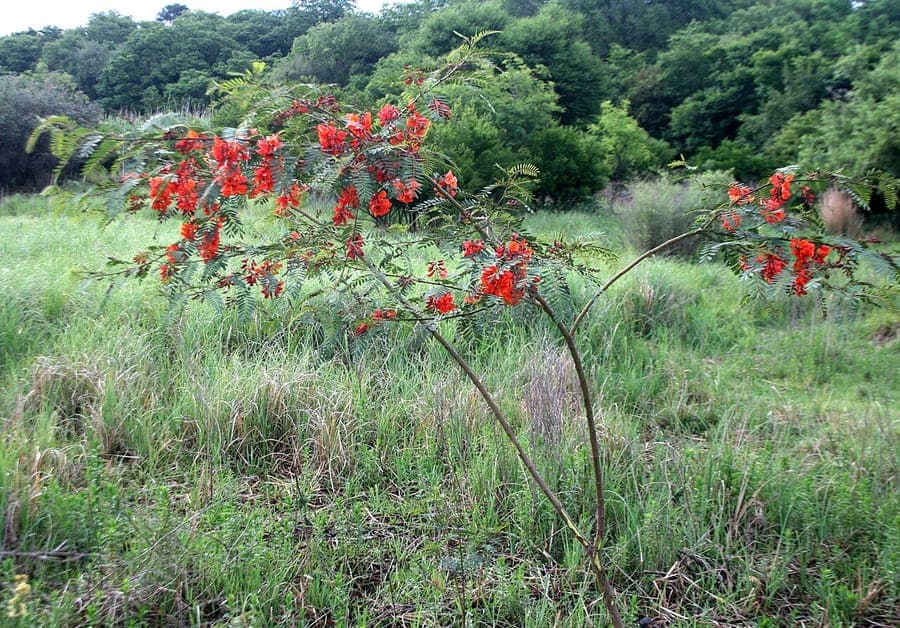
JMK / CC BY-SA 4.0, via Wikimedia Commons
Sesbania punicea: complete guide
Sesbania punicea
¿Quieres ver Sesbania punicea: complete guide en tu jardín?
1 minuto, sin tarjeta de crédito
Overview
Sesbania punicea, commonly known as the Brazilian glory-pea or red sesbania, is a stunning flowering plant from the Fabaceae family. This plant originates from South America, particularly from Brazil and northeastern Argentina. It is renowned for its spectacular red to orange flowers that grow in rich clusters. Thanks to its tropical origin, this plant is best suited to warm climates or container cultivation in temperate regions.
The Brazilian glory-pea earned its name from the brilliant red flowers that grace its stems, making it a striking focal point in any garden design. The plant is cultivated as an ornamental in many countries and can be grown both in open ground and in containers.
Appearance and bloom
Sesbania punicea grows as a shrub to subshrub with moderate growth rate. The plant reaches heights of approximately 1 to 3 meters, depending on growing conditions. The leaves are compound and fine green in color. The flowers are the most remarkable feature: they appear in long, hanging clusters and display an intense red to orange-red color.
The flowering period occurs from May to October in warm climates, giving the plant an extended blooming season. After flowering, seed pods appear that form interesting remains. These pods are striking and persist on the plant for extended periods, offering additional ornamental value.
Ideal location
Sesbania punicea thrives best in a sunny location receiving at least 6-8 hours of direct sunlight daily. A warm spot is essential for optimal flowering. The plant is highly sensitive to frost and must be moved indoors in temperate climates or grown as an annual.
Provide shelter from strong winds, especially in regions with temperate climates. In containers, the plant can be moved outdoors once all frost risk has passed. A sheltered spot against a south-facing wall is ideal for this tropical plant.
Soil quality
The plant prefers well-draining, fertile soil. A mixture of garden soil with sand and organic matter works excellently. A pH level between 6.0 and 7.5 is ideal. Ensure the soil does not retain too much water, as Sesbania punicea is sensitive to root rot.
In container cultivation, well-draining potting soil is essential. Add extra sand and perlite for improved water drainage. The plant appreciates rich soil with organic matter, such as compost or leaf mold.
Diseño gratis
¿Quieres ver Sesbania punicea: complete guide en tu jardín? Crea un diseño gratis ahora.
Watering
Sesbania punicea requires regular watering, especially during the growing season and flowering period. Ensure the soil is moist but not waterlogged. Bottom watering is preferable to overhead spraying.
During the growing period (May to October), the plant should receive water two to three times weekly, depending on temperature and soil type. In winter, when the plant is dormant or indoors, significantly reduce watering. For container-grown plants, regular soil moisture monitoring is essential.
Pruning
Sesbania punicea responds well to pruning and can be cut back in spring. This promotes a more compact growth form and richer flowering. Remove dead branches and aged wood structures. Pruning can be performed just before growth begins in spring.
Indoor-grown plants can be lightly pruned year-round to maintain shape. Remove faded flowers regularly to stimulate further blooming. Heavy pruning may disrupt the flowering pattern, so work carefully.
Maintenance calendar
March to April: Begin pruning and prepare for growing season. Check for pests and diseases.
May to October: Water regularly, feed every two weeks. Remove spent flowers.
November to February: For tropical climates: average maintenance. For temperate climates: bring indoors or treat as annual. Minimal watering.
Winter hardiness
Sesbania punicea is extremely frost-sensitive and cannot tolerate temperatures below 5 degrees Celsius. In temperate climates, the plant must be moved indoors when night temperatures drop below 10 degrees Celsius. In containers, this plant can be overwintered in a protected greenhouse or living room.
Even light frost can cause severe damage. If winter planting is not possible, Sesbania punicea is best grown as an annual and replanted each spring.
Companion plants
Sesbania punicea combines well with other heat-loving plants. Sunflowers, zinnias and other red-flowering plants create beautiful contrast. In container arrangements, the plant pairs well with trailing plants and silver-foliaged specimens.
When planted in warm regions, Sesbania punicea complements other South American plants, such as other Fabaceae species and heat-loving shrubs. The bright red color makes it a striking accent piece in any garden design.
Closing
Sesbania punicea is an excellent choice for gardeners seeking spectacular red flowering color. While the plant is frost-sensitive, it can be successfully grown as an annual or in containers in temperate climates. With proper location, soil and watering, this Brazilian glory-pea will provide beautiful red blooms for years. Visit our site at gardenworld.app for more guides on exotic garden plants. Consider this stunning plant for your next garden design on gardenworld.app!
¿Quieres ver Sesbania punicea: complete guide en tu jardín? Crea un diseño gratis ahora.
Sube una foto, elige un estilo y obtén un diseño fotorrealista con lista de plantas en menos de un minuto.
Más de 10.000 jardines diseñados
Sin tarjeta de crédito


Plantas similares
Tall Silky Lupine: complete guide
Lupinus elatus
Tall silky lupine is a fast-growing Californian perennial with silvery foliage and blue-purple flower spikes, ideal for a prairie-style garden.
Garfield Lupine: complete guide
Lupinus garfieldensis
The Garfield lupine is a rare, fast-growing American perennial for alkaline, dry grassland gardens, with striking blue flower spikes.
Lupinus elegans: complete guide
Lupinus elegans
Lupinus elegans, the elegant lupine, is a spectacular blooming plant from Mexico with blue flower spikes. Care, cultivation and garden use.