
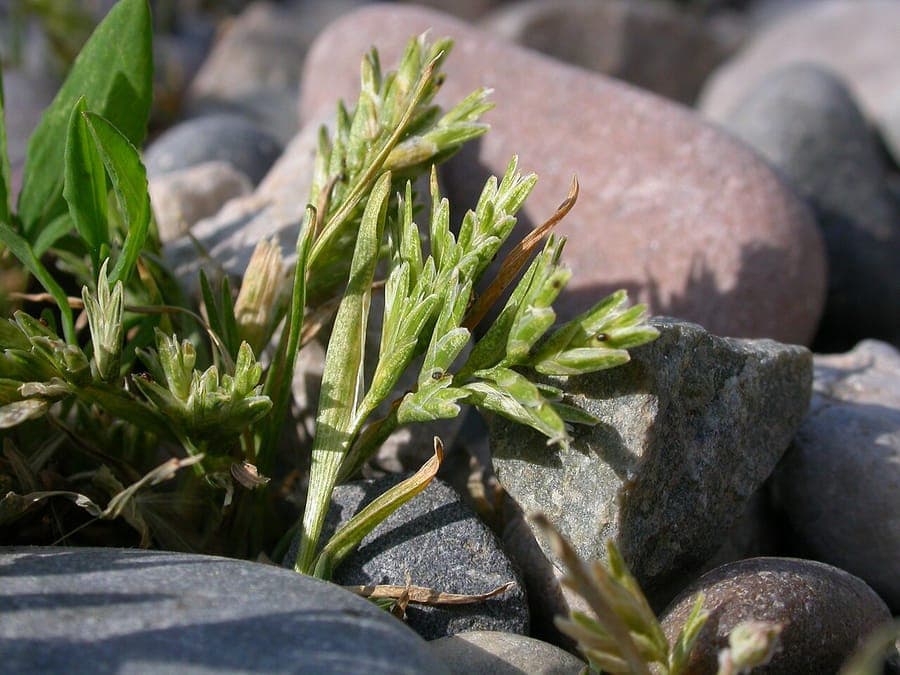
Matt Lavin / CC BY-SA 2.0, via Wikimedia Commons
Common Hardgrass: complete guide
Sclerochloa dura
¿Quieres ver Common Hardgrass: complete guide en tu jardín?
1 minuto, sin tarjeta de crédito
Overview
Common hardgrass (Sclerochloa dura), also called hard grass or hard-meadow grass, is a resilient grass species proven across diverse climate zones. Native from Europe to Xinjiang and the West Himalaya, this grass demonstrates exceptional adaptation to varied growing conditions. Hardgrass offers garden owners a low-maintenance, durable turf option with outstanding traffic tolerance.
Belonging to the Poaceae family, hardgrass is renowned for its remarkable hardness and durability. It withstands foot and vehicle stress exceptionally well, making it ideal for play areas and walkways. The plant is hypoallergenic and provides an aesthetically pleasing green surface throughout the growing season.
Appearance and Bloom
Common hardgrass distinguishes itself through compact growth form with thin, firmly green blades. The plant creates dense mats reaching 5 to 15 centimeters high, depending on mowing and growing conditions. Its dark green foliage remains vital and well-colored throughout the season.
Bloom period extends from April through June, with green flower spikes emerging just above the leaf mass. These flowers are inconspicuous and subtle, giving hardgrass a natural, formless appearance. This makes it excellent for meadows, lawns, and ecologically responsible gardens.
Ideal Location
Common hardgrass thrives in full sunlight locations. The plant prefers at least eight hours of direct sun daily. This promotes dense, healthy foliage and strong roots. Hardgrass also grows reasonably well in partial shade, though growth is somewhat less robust.
The plant is particularly drought-tolerant and suited for slopes, dry lawns, and plateaus where other grasses struggle. This makes it valuable for xeriscape designs and water-efficient landscapes.
Soil
Common hardgrass has moderate soil requirements. It grows well in moderately fertile soils with pH values between 7.0 and 7.5. The plant tolerates chalky soils and clay-based conditions without significant issues.
Good drainage is essential; waterlogged conditions can lead to root rot. Sandy and loamy soils with strong permeability are ideal. Loose, workable soil supports strong root development and provides plant stability against wind stress.
Diseño gratis
¿Quieres ver Common Hardgrass: complete guide en tu jardín? Crea un diseño gratis ahora.
Watering
After sowing, water regularly but not excessively for two to four weeks. Once hardgrass is established (typically after four to six weeks), supplemental water is needed only during extreme drought. The plant's deep root system tolerates dry conditions well.
When irrigating, early morning is optimal to prevent moisture-related diseases. Regular, light watering promotes better root formation than occasional heavy soaking.
Pruning
Common hardgrass requires minimal pruning. Regular mowing (3 to 4 times monthly during growing season) keeps grass in optimal form and prevents thatching. Optimal mowing height is 3 to 4 centimeters.
Mowing promotes compact growth and dense foliage. Never remove more than one-third of blade height at once, as this can damage the plant. Mulch (mowed grass) can remain on the field, returning nutrients to the soil.
Maintenance Calendar
FEBRUARY-MARCH: Prepare seedbed and reseed bare patches. APRIL-MAY: Growth increases; regular mowing begins. JUNE-JULY: Peak growth; intensive mowing frequency. AUGUST-SEPTEMBER: Growth stabilizes; standard mowing schedule. OCTOBER-NOVEMBER: Winter preparation; final mowing cycles. DECEMBER-JANUARY: Rest period; minimal maintenance.
Winter Hardiness
Common hardgrass is exceptionally winter-hardy and overwinters without protection in all European gardens. The plant tolerates temperatures far below freezing. Frost-thaw cycles pose no problem thanks to its flexible cell structure.
The plant does not die back in winter but enters dormancy with minimal growth. This makes hardgrass suitable for all climate zones in the Netherlands, Belgium, and Germany.
Companion Plants
Hardgrass forms a solid foundation for flowering herbs like sunflowers, chamomile, and daisies. It also combines well with other grass species such as fescue and rush. The combination creates interest through texture contrast.
Low-ground covers like sedum and stonecrop can grow between hardgrass areas. These create visual variation and provide shelter for bees and butterflies.
Closing
Common hardgrass is a reliable grass species that serves garden owners for years with minimal effort. It combines drought tolerance, winter hardiness, and low maintenance into an excellent choice for sustainable, ecological gardens. Available at OBI and Hornbach.
Find more at gardenworld.app/nl and gardenworld.app/en.
¿Quieres ver Common Hardgrass: complete guide en tu jardín? Crea un diseño gratis ahora.
Sube una foto, elige un estilo y obtén un diseño fotorrealista con lista de plantas en menos de un minuto.
Sin tarjeta de crédito


Plantas similares
Sporobolus pungens: complete guide
Sporobolus pungens
Sporobolus pungens is a stoloniferous Mediterranean coastal grass with outstanding salt and drought tolerance, perfect for seaside and dry gardens.
Mediterranean aegilops: complete guide
Aegilops biuncialis
Everything about Aegilops biuncialis, a Mediterranean annual grass with ornamental spikes and outstanding drought tolerance for dry gardens.
Silver bluestem: complete guide
Bothriochloa saccharoides
Full guide to Bothriochloa saccharoides (silver bluestem): site, soil, watering, winter hardiness, pruning, and garden companions.