
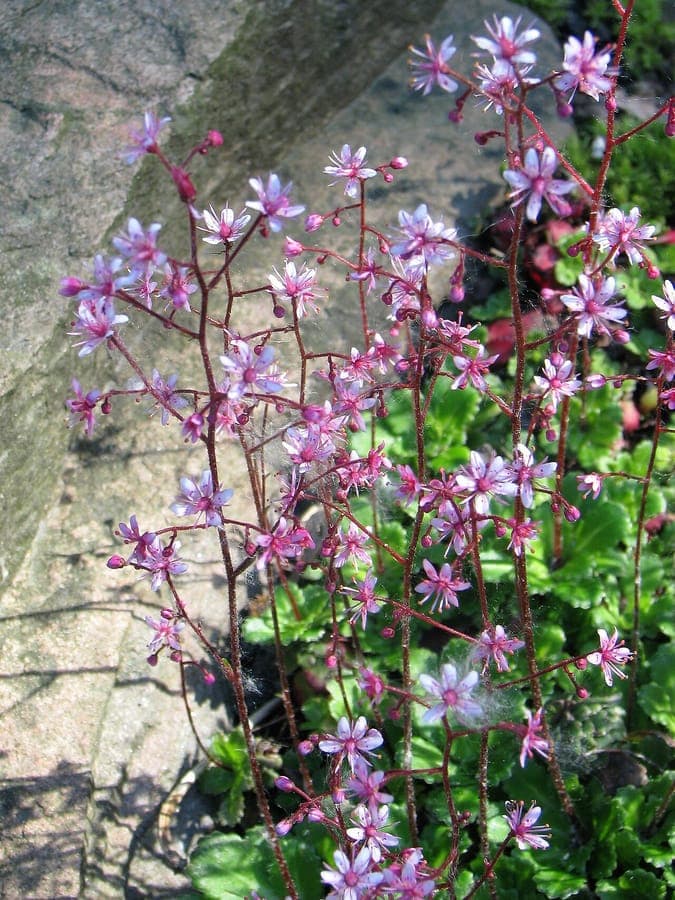
Agnieszka Kwiecień, Nova / CC BY-SA 4.0, via Wikimedia Commons
Saxifraga umbrosa: complete guide
Saxifraga umbrosa
¿Quieres ver Saxifraga umbrosa: complete guide en tu jardín?
1 minuto, sin tarjeta de crédito
Overview
Saxifraga umbrosa, better known as London Pride or Pyrenean Saxifrage, is a classic groundcover that feels at home under trees and in shade. This plant originates from the Pyrenees and has a long history in European gardens, especially British gardens where it has earned the name "London Pride."
If you are looking for an easy-growing, low-maintenance plant for dark corners and shaded areas of your garden, Saxifraga umbrosa is the answer. With its compact, rounded leaves and elegant flowers, it adds much character to difficult growing locations.
Appearance and Bloom
Saxifraga umbrosa forms compact rosettes of round, slightly glossy green foliage with red undersides. The leaves can reach 2-3 centimeters long and form dense, packed cushions. During the full growing season, these leaves can sometimes take on reddish tones, especially if they receive plenty of light.
The flowers are the highlight of this plant. They appear in May through July in fine, branched clusters atop slender, red stems. The small flowers are usually white or very light pink, often with red flecks in the center. Some cultivars have more pink-tinted flowers.
After blooming, seeds form that can result in self-seeding in suitable conditions.
Ideal Location
Unlike many alpine saxifrage species, Saxifraga umbrosa grows much better in shade than in full sun. This may be the most counterintuitive feature of this plant.
Ideal growth occurs in light to moderate shade, under trees, against the north or west wall of your house, or under overhanging shrubs. It can also grow in full shade, though flowering may be lighter.
In very warm climates, even deeper shade can be beneficial. Avoid locations with hot afternoon sun if you live in the south.
Soil
Saxifraga umbrosa prefers rich, humus-rich soil - very different from its alpine relatives. This makes it a plant that grows well under trees where leaves fall and decompose.
Ideal soil composition:
- Compost-rich soil
- Added leaf mold or compost
- Slightly acidic to neutral, pH around 5.5 to 7.0
Drainage is still important, but much less critical than for alpine species. The plant tolerates slightly moist soils well.
Diseño gratis
¿Quieres ver Saxifraga umbrosa: complete guide en tu jardín? Crea un diseño gratis ahora.
Watering
As expected of a shade plant, Saxifraga umbrosa loves regular moisture. During the growing season you should water regularly, but not to the point of waterlogging. In moist, shaded environments you can keep watering low or even provide no additional water outside dry periods.
In drier environments or during dry spells water regularly. Make sure the soil does not dry out completely, especially as your plant roots for the first year.
In winter normally no additional water is needed if rainfall is sufficient.
Pruning
Saxifraga umbrosa requires minimal pruning. If your plant becomes somewhat tall, you can carefully remove older leaves from the outside to encourage new growth.
Dead flower stems can be removed after blooming to direct energy toward vegetative growth, but they can also be left for natural seed dispersal.
Maintenance Calendar
March-April: Growing season begins. Check for snow damage and mulch renewal.
May-June: Full bloom. Enjoy the beautiful flowers. Ensure regular moisture supply.
July-August: Bloom declines. Seeds ripen. Water depending on rainfall.
September-October: Preparation for winter. Regular watering.
November-February: Winter. Normally at rest. Minimal water unless drought occurs.
Winter Hardiness
Saxifraga umbrosa is fully hardy to -20 degrees Celsius and survives much colder. This is a great plant for cold climates.
It may suffer from extremely wet winter conditions. Well-draining soil helps with this.
Companion Plants
This is a classic in shade combinations:
Helxine soleirolii: The fine structure of this mini-plant complements Saxifraga's foliage.
Liriope muscari: This grass introduces texture and color to shade borders.
Astilbe species: Elegant flowers and fine foliage create great contrasts.
Tiarella polyphylla: Marbled leaves and delicate flowers pair perfectly with Saxifraga umbrosa.
Propagation
Propagation via seed is easiest. Seeds can be sown in spring in a seedbed. Germination occurs under cool, moist conditions.
Division of established plants is also possible in spring.
Closing Thoughts
Saxifraga umbrosa is a classic, reliable plant that brings beauty to shaded gardens year after year. With simple care and regular watering, you will have much enjoyment from this elegant plant. This is one of those timeless classics that still deserves its place in modern gardens.
Interested? Visit gardenworld.app for more information. For seedlings and mature Saxifraga umbrosa, check leading garden retailers.
¿Quieres ver Saxifraga umbrosa: complete guide en tu jardín? Crea un diseño gratis ahora.
Sube una foto, elige un estilo y obtén un diseño fotorrealista con lista de plantas en menos de un minuto.
Más de 10.000 jardines diseñados
Sin tarjeta de crédito


Plantas similares
Korean astilbe: complete guide
Astilbe grandis
Discover Korean astilbe (Astilbe grandis): a tall shade plant with elegant flower plumes for pond edges and borders.
Heuchera pilosissima: complete guide to seaside alumroot
Heuchera pilosissima
Seaside alumroot (Heuchera pilosissima), an elegant North American dwarf perennial with hairy red-tinged foliage and red flower spikes.
Starry saxifrage: complete guide
Micranthes stellaris
Full guide to Micranthes stellaris, the starry saxifrage: location, soil, blooming and garden use. A tough alpine plant for moist, shady rock faces and pond margins.