
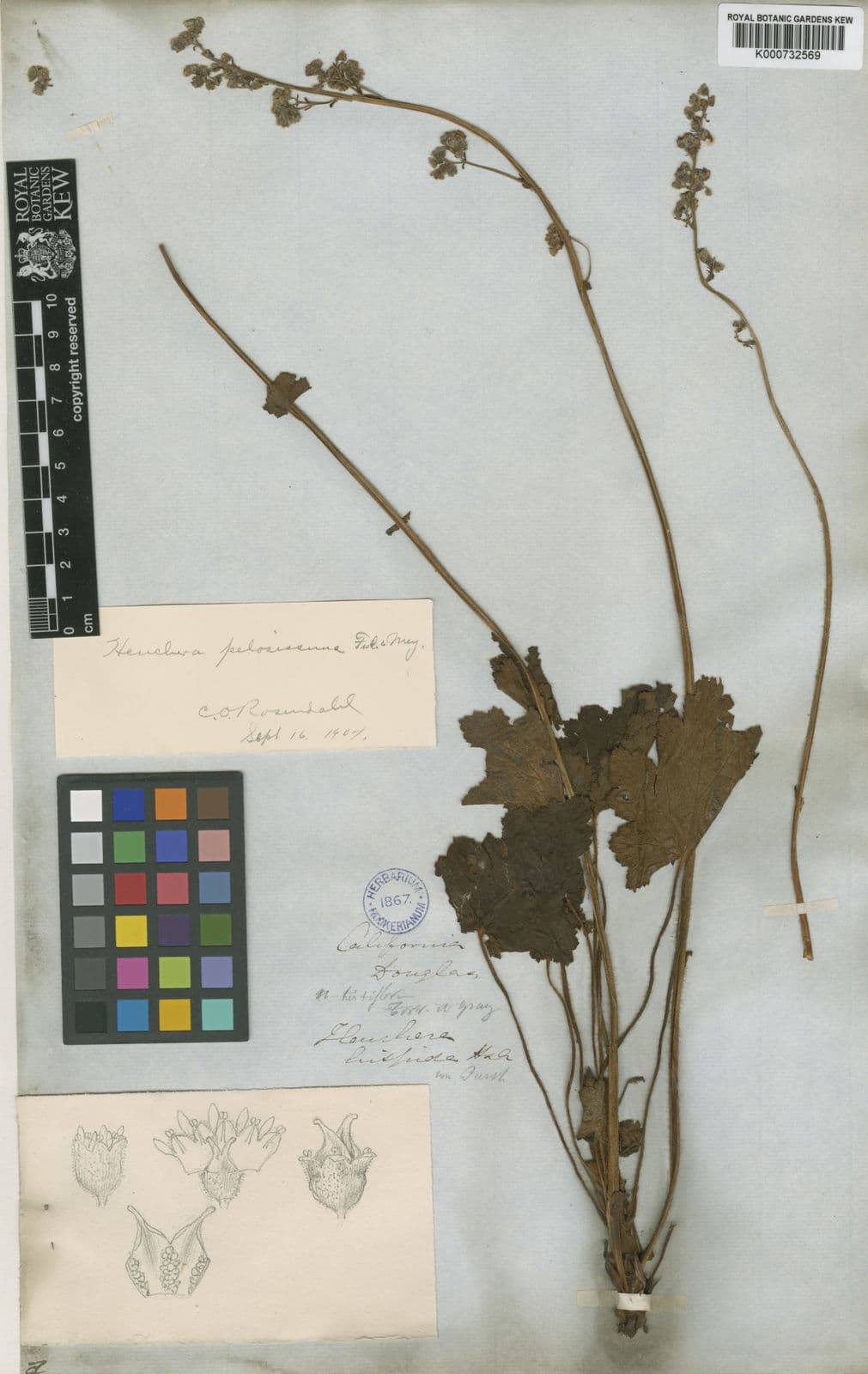
Heuchera pilosissima: complete guide to seaside alumroot
Heuchera pilosissima
¿Quieres ver Heuchera pilosissima: complete guide to seaside alumroot en tu jardín?
1 minuto, sin tarjeta de crédito
Overview
Heuchera pilosissima, commonly called seaside alumroot, is an elegant dwarf perennial native to coastal Oregon and California. This compact, evergreen plant reaches only 15 to 30 centimeters tall and forms attractive, finely hairy foliage rosettes with exceptional texture. Its reddish-purple flower spikes and delicate flower clusters create a beautiful ornament throughout the growing season. On gardenworld.app, discover guides for cultivating North American plants and designing alpine gardens.
This species excels in rock gardens, alpine troughs, and moister mountain locations where many other Heuchera species find conditions too dry. With proper siting, it becomes a reliable, long-lived garden perennial.
Appearance and Bloom
Heuchera pilosissima forms compact rosettes of densely hairy, grey-green foliage with distinct reddish-purple tones at the base. The leaves are finely red-hairy, giving the plant a soft, glowing appearance when backlighting strikes the foliage.
Flower spikes rise erectly from the heart of the rosettes, reaching 20 to 30 centimeters tall and bearing loose clusters of small, pink-to-white flowers. Bloom occurs from April through June, depending on site elevation. The reddish-purple stems remain decorative throughout the entire flowering season.
Ideal Location
Heuchera pilosissima thrives in dappled to light shade. In warm climates, afternoon shade is appreciated. Full sun can stress the plant in very hot summers, though it grows acceptably sunny in temperate zones.
The plant tolerates coastal salt spray well and succeeds on windy mountain exposures. Avoid dense, humid shade where fungal issues multiply.
Soil
Heuchera pilosissima makes modest soil demands. It thrives on well-draining, humus-rich, slightly acidic to neutral soil with pH 6.0 to 7.0. Sand, gravel, and coarse mulch promote drainage.
This species tolerates dry soil less readily than many Heuchera types. Incorporate compost or leaf mold at planting time. Heavy clay must be amended with sand and organic matter.
Watering
After establishment, Heuchera pilosissima requires moderate watering. Keep the soil consistently lightly moist during the growing season. Do not allow the soil to dry out completely, but prevent waterlogging. Water regularly during dry periods.
Avoid overhead watering. Water early in the morning at the plant's base. In winter, minimal watering suffices.
Pruning and Shaping
Heuchera pilosissima requires no pruning. Remove only spent flower spikes after bloom finishes, unless self-seeding is desired. Dead leaves can be carefully removed in spring.
The plant grows naturally compact and shapely without intervention.
Maintenance Calendar
March-April: Weed carefully around young plants. Water as growth resumes. April-May: Water regularly. Enjoy red flower spikes. June-July: Reduce watering as plant enters dormancy. Remove spent flowers. August-October: Minimal watering. Plant quiets. Seed ripens if desired. November-February: Plant is semi-dormant but evergreen. Minimal care needed.
Winter Hardiness
Heuchera pilosissima is hardy to approximately -20 degrees Celsius, making it suitable for many temperate gardens. In very severe winters, some leaf loss may occur, but the plant almost always survives. Dry leaf mulch aids survival in the coldest regions.
The plant grows quickly after winter and rapidly forms new foliage.
Companion Plants
Heuchera pilosissima pairs beautifully with other alpine dwarf plants. Consider Saxifraga, Sedum, Sempervivum, Achillea, dwarf Phlox, alpine Aster, and other ornamental grasses.
Use in rock gardens with grasses like Festuca glauca. Plant in groups of three to five for maximum impact. Silver-leaved plants create effective contrast.
Diseño gratis
¿Quieres ver Heuchera pilosissima: complete guide to seaside alumroot en tu jardín? Crea un diseño gratis ahora.
Propagation
Heuchera pilosissima is most commonly propagated by division of the rootstock, the fastest and most reliable method for producing an identical clone of the parent plant. Carefully dig up the plant in early spring (March) or autumn (September), divide the root clump into sections 5 to 10 centimeters wide with at least 2 to 3 rosettes per division, and replant immediately at the same depth as before.
Seed propagation is also possible, though the seed is extremely fine and should be surface-sown without covering, since light promotes germination. Germination typically takes 3 to 4 weeks at a temperature of 18 to 21 degrees Celsius. Note that seedlings from mixed populations do not always remain true to the parent plant, as Heuchera species hybridize readily.
Cuttings of young rosettes with a small piece of rootstock can also root in a moist sand-perlite mix, though this is less common than division.
Pests and Diseases
The primary pest affecting Heuchera pilosissima is the vine weevil, whose larvae chew on roots and can cause sudden wilting, particularly in container-grown plants. Beneficial nematodes that specifically target vine weevil larvae offer effective, non-chemical control when applied in August or September, while soil temperatures remain sufficiently warm.
Rust (Puccinia heucherae) can cause orange-brown pustules on leaf undersides, especially in humid, poorly ventilated conditions. Remove affected foliage and improve air circulation. Powdery mildew is another common problem in overly moist or overly shaded locations; adequate plant spacing and morning watering at the base significantly reduce risk.
Slugs and snails may nibble young leaves in spring. A ring of crushed eggshells or grit around the plant usually keeps them at bay.
Garden Design and Cultivars
Heuchera pilosissima pairs beautifully with other low, texture-rich perennials in a rock garden or mixed-height border. Space rosettes 20 to 30 centimeters apart for a full, closed carpet effect within two growing seasons.
Although Heuchera pilosissima itself is rarely sold under a trade name, garden centers and specialized perennial nurseries stock numerous popular Heuchera hybrid cultivars with striking foliage colors that combine beautifully in the same border, such as 'Palace Purple' with deep purple leaves, 'Caramel' with amber-orange foliage, or 'Obsidian' with near-black leaves. These cultivars provide additional color contrast alongside the silvery, red-haired foliage of seaside alumroot.
In a mixed border, Heuchera pilosissima works well as edging along pathways, combined with early bulbs such as crocuses that bloom already in February and March before the Heuchera itself gets going.
Frequently Asked Questions
How long does Heuchera pilosissima live? With good care, the plant can live 8 to 10 years or longer, though dividing every 3 to 4 years is recommended to keep rosettes vigorous.
Is Heuchera pilosissima suitable for a full-sun border? In mild coastal climates, yes, but in inland gardens with hot summers, some afternoon shade is recommended to prevent leaf scorch.
Final Thoughts
Heuchera pilosissima is an attractive and reliable plant for rock gardens, alpine troughs, and moister mountain locations. Though less famous than many other Heuchera species, it deserves attention from North American flora and alpine plant enthusiasts.
Looking for comprehensive guides on North American plants and alpine gardens? Visit gardenworld.app for complete cultivation information for unusual plants and mountain garden design. Start by selecting appropriate mountain exposures. Quality nurseries stock Heuchera collections and specimens.
¿Quieres ver Heuchera pilosissima: complete guide to seaside alumroot en tu jardín? Crea un diseño gratis ahora.
Sube una foto, elige un estilo y obtén un diseño fotorrealista con lista de plantas en menos de un minuto.
Más de 10.000 jardines diseñados
Sin tarjeta de crédito


Plantas similares
Korean astilbe: complete guide
Astilbe grandis
Discover Korean astilbe (Astilbe grandis): a tall shade plant with elegant flower plumes for pond edges and borders.
Starry saxifrage: complete guide
Micranthes stellaris
Full guide to Micranthes stellaris, the starry saxifrage: location, soil, blooming and garden use. A tough alpine plant for moist, shady rock faces and pond margins.
Bulbil saxifrage (Saxifraga bulbifera): complete guide
Saxifraga bulbifera
All about Saxifraga bulbifera, the bulbil saxifrage: location, soil, care, propagation via bulbils and use in rock and stone gardens.