
Wikimedia Commons / CC BY-SA 3.0, via Wikimedia Commons
Lifelong saxifrage: complete guide
Saxifraga paniculata
¿Quieres ver Lifelong saxifrage: complete guide en tu jardín?
1 minuto, sin tarjeta de crédito
Overview
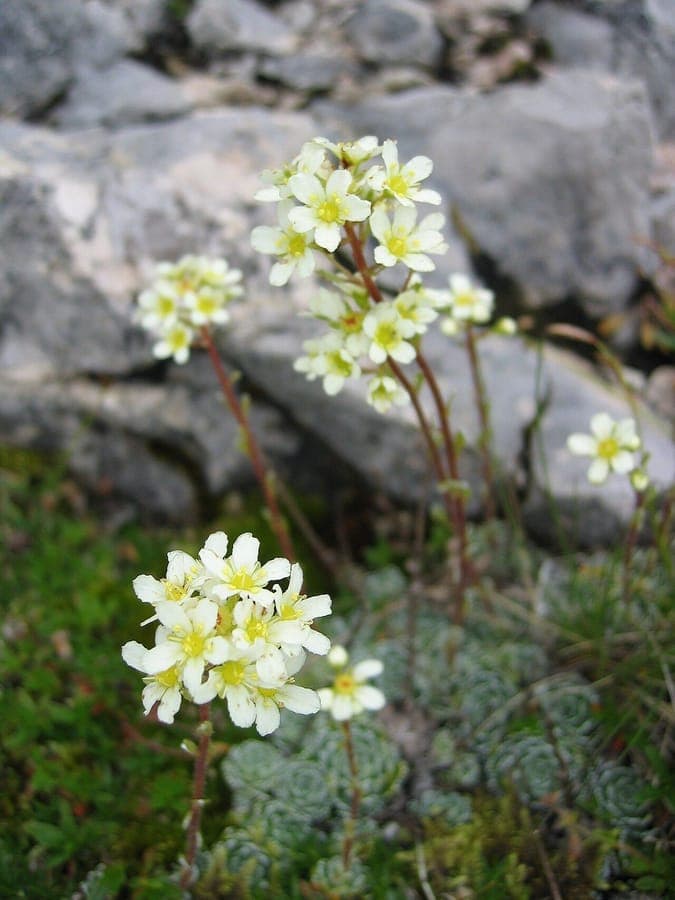
The lifelong saxifrage (Saxifraga paniculata), also called silvery saxifrage or encrusted saxifrage, is an architectural alpine perennial or short-lived monocarp in the family Saxifragaceae. Native to rocky mountain slopes across North America and Europe up to 3500 metres elevation, it is a striking focal point in rock gardens. Standing merely 5-10 centimetres as rosettes but producing flower spikes to 30 centimetres, it offers dramatic seasonal variation. The name paniculata refers to its branching flower spikes.
The common name 'lifelong' relates to its slow but steady growth pattern and remarkable longevity in ideal conditions. The silvery rosettes remain ornamental year-round. On gardenworld.app, you can visualise how this architectural alpine transforms a scree bed or rock garden.
Appearance & bloom cycle
Plants form tight rosettes of thick, blue-green or grey-green leaves coated with lime deposits creating a silvery sheen - this is the plant's calcium excretion mechanism in action. In the second or third year of growth, the plant produces massive flower spikes 20-30 centimetres tall bearing hundreds of minute white flowers, sometimes with pink markings. The inflorescence is a true panicle - a branched spike with many individual flowers.
After flowering, the main rosette dies (monocarpy), but multiple daughter rosettes have usually formed around the base, ensuring the plant's continuation. This multiplication makes it nearly impossible for the colony to disappear entirely.
Ideal location: full sun
Lifelong saxifrage demands full sun - 6+ hours of direct sunlight daily. It struggles in shade. In very hot climates, afternoon shade helps prevent leaf scorch, but west or south exposure with morning sun is preferred. Windy sites are ideal - they encourage sturdy growth.
South-facing full sun: ideal. West with morning sun: good. North-facing or shade: sparse or no flowering.
Soil requirements
This plant demands excellent drainage. Heavy, waterlogged soil will damage it. Mix 40-50% coarse gravel and sand with soil. pH 5.5-7.5 is fine. This plant actually thrives in poor soils - fertility is not critical.
For rockeries: use a 1:1:1 blend of coarse gravel, horticultural sand, and loam-based compost. In containers: use a gritty alpine mix.
Diseño gratis
¿Quieres ver Lifelong saxifrage: complete guide en tu jardín? Crea un diseño gratis ahora.
Watering
Once established, lifelong saxifrage is quite drought-tolerant. During active growth (March-June), water regularly but never allow standing water. After flowering (July onwards), reduce water significantly - this plant tolerates dry spells well. In autumn and winter, water minimally.
Perfect drainage is more important than generous watering.
Pruning
No pruning needed. Leave the flower spike intact until seeds have been shed, then remove if desired. Daughter rosettes can be carefully detached and replanted to propagate the colony.
Maintenance calendar
- Jan: Check drainage; very little water.
- Feb: Prepare for growth; still keep dry.
- Mar: Growth begins; light watering.
- Apr: Active growth phase; regular watering.
- May: Growth peak; possible flowering preparation.
- Jun: Flowering begins; normal watering.
- Jul: Peak bloom; maintain watering.
- Aug: Flowering ends; reduce water.
- Sep: Daughter rosettes expanding; minimal water.
- Oct: Prepare dormancy; very little water.
- Nov: Dormancy; minimal water.
- Dec: Winter; keep dry.
Winter hardiness
Hardy to USDA zone 2 (-45°C). In the UK and Benelux (zones 7-8), no winter protection is necessary. In wet climates, protection from excessive moisture is beneficial - place under an eave or in a cold frame.
Companion plants
Pair with other spiky or sculptural alpines: Sempervivum, Sedum, Armeria maritima, Dianthus petraeus, Erinus alpinus. Lifelong saxifrage serves as an excellent focal plant among lower groundcovers.
Closing
Lifelong saxifrage is a reliable, architectural alpine for the dedicated gardener. Its silvery rosettes and dramatic flower spikes make it invaluable. Source young plantlets from specialist alpine nurseries. Once established, it will thrive indefinitely. This is a plant that propagates itself and can persist for decades. Use gardenworld.app to design rock gardens centred around this striking alpine specimen.
¿Quieres ver Lifelong saxifrage: complete guide en tu jardín? Crea un diseño gratis ahora.
Sube una foto, elige un estilo y obtén un diseño fotorrealista con lista de plantas en menos de un minuto.
Más de 10.000 jardines diseñados
Sin tarjeta de crédito


Plantas similares
Korean astilbe: complete guide
Astilbe grandis
Discover Korean astilbe (Astilbe grandis): a tall shade plant with elegant flower plumes for pond edges and borders.
Heuchera pilosissima: complete guide to seaside alumroot
Heuchera pilosissima
Seaside alumroot (Heuchera pilosissima), an elegant North American dwarf perennial with hairy red-tinged foliage and red flower spikes.
Starry saxifrage: complete guide
Micranthes stellaris
Full guide to Micranthes stellaris, the starry saxifrage: location, soil, blooming and garden use. A tough alpine plant for moist, shady rock faces and pond margins.