
Wikimedia Commons / CC BY-SA 3.0, via Wikimedia Commons
Purple mountain saxifrage: complete guide
Saxifraga oppositifolia
¿Quieres ver Purple mountain saxifrage: complete guide en tu jardín?
1 minuto, sin tarjeta de crédito
Overview
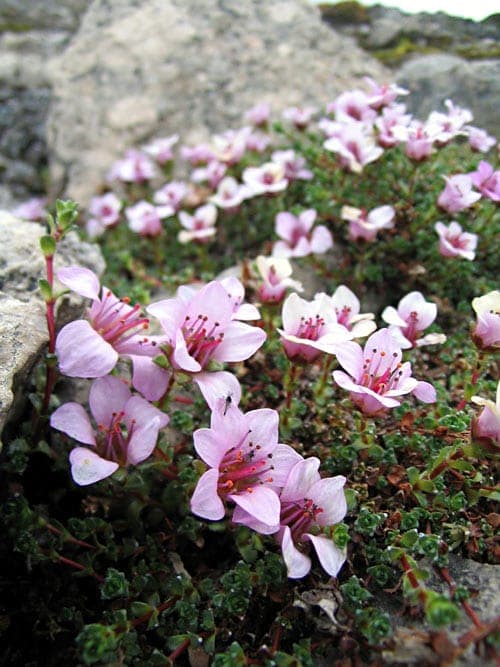
The purple mountain saxifrage (Saxifraga oppositifolia), also called red alpine saxifrage or purple saxifrage, is a legendary alpine perennial in the family Saxifragaceae. This true arctic plant grows naturally on the highest mountain plateaus of northern Europe, Russia, and Canada above 3000 metres elevation. Standing just 2-5 centimetres tall with a spread to 15 centimetres, it is one of the smallest and most stunning Saxifraga species. The name oppositifolia refers to the paired opposite leaves along compact stems.
Purple mountain saxifrage is the 'holy grail' for dedicated alpine gardeners. It is legendary for its extremely early, deep magenta-purple flowers that sometimes break through lingering snow. On gardenworld.app, you can visualise incorporating this arctic treasure into a specialist alpine collection.
Appearance & bloom cycle
Plants form extremely tight, cushion-like mats of microscopic, opposite leaves. Foliage is dark green to nearly black-green, tightly packed. In March-April, sometimes while snow still lies, flowers emerge directly from the cushion with no visible stems. Blooms are intense magenta to deep purple, four-petalled, minute but numerous - hundreds of flowers blanket the plant simultaneously. The display is stunning but fleeting.
After flowering, the plant withdraws and focuses on foliage development. Overwintering is achieved through extreme mat density.
Ideal location: full sun to light shade
Purple mountain saxifrage requires 6+ hours of direct sunlight daily, ideally more. It prefers open, windy sites mimicking its alpine habitat. In hot climates, afternoon shade from intense midday sun can help. Even north or east-facing spots work if adequate sun hours are provided.
Full south-facing exposure: ideal. Sheltered spot: suboptimal (plants may become lank). Warm southern exposure: acceptable if afternoon shade is arranged.
Soil requirements
This plant demands exceptional drainage. Heavy, moisture-retentive soil will kill it. Mix 50% coarse gravel and sand with compost. pH should be acidic (5.0-6.5). This is absolutely a plant for gritty alpine potting mix or specially prepared scree beds. Organic matter must be minimal.
In pots: use true alpine gritty mix (70% grit/sand, 30% loam-based seed compost). In scree beds: mostly gravel/shale with thin layer of poor compost.
Diseño gratis
¿Quieres ver Purple mountain saxifrage: complete guide en tu jardín? Crea un diseño gratis ahora.
Watering
Watering is critical and counter-intuitive. Purple mountain saxifrage requires regular moisture during growth (March-May) but MUST dry out after flowering. Summer period: minimal water. Autumn/winter: almost bone dry. A wet plant in July-December will certainly rot.
This is a plant for containers with perfect drainage and air flow below. Overwintering in a cold frame is recommended in warm regions.
Pruning
No pruning needed. Remove only dead foliage very carefully, without disturbing the cushion structure.
Maintenance calendar
- Jan: Check drainage and moisture; keep very dry.
- Feb: Bone dry; prepare for flowering.
- Mar: Flowering begins; light watering.
- Apr: Flowering peak; regular watering.
- May: Flowering ceases; reduce water drastically.
- Jun: Summer begins; practically dry.
- Jul: Extremely dry; keep from wilting if possible.
- Aug: Very arid conditions; this is natural for the plant.
- Sep: Prepare dormancy; keep dry.
- Oct: Winter dormancy; minimal water only.
- Nov: Dormancy; keep dry.
- Dec: Winter; very little water.
Winter hardiness
Hardy to USDA zone 2 (-45°C). In the UK and Benelux (zones 7-8), no winter cold protection is needed. The true enemy is autumn-winter wetness, not cold! In wet climates, protection from rain is essential: place under an eave or in a cold frame with proper drainage.
Companion plants
Purple mountain saxifrage pairs well with other extreme alpines: Androsace species, Silene acaulis, Draba species, Minuartia, Dianthus petraeus. Isolation or very small groupings work better than mixing with other plants.
Closing
Purple mountain saxifrage is not for beginners but for committed alpine gardeners. It demands perfect drainage, cool winters, and dry summers. Source plants from specialist alpine nurseries only. Once in suitable conditions, it can live for decades. This is a plant that rewards perfection and punishes neglect. Use gardenworld.app to plan an alpine collection around this arctic masterpiece.
¿Quieres ver Purple mountain saxifrage: complete guide en tu jardín? Crea un diseño gratis ahora.
Sube una foto, elige un estilo y obtén un diseño fotorrealista con lista de plantas en menos de un minuto.
Más de 10.000 jardines diseñados
Sin tarjeta de crédito


Plantas similares
Korean astilbe: complete guide
Astilbe grandis
Discover Korean astilbe (Astilbe grandis): a tall shade plant with elegant flower plumes for pond edges and borders.
Heuchera pilosissima: complete guide to seaside alumroot
Heuchera pilosissima
Seaside alumroot (Heuchera pilosissima), an elegant North American dwarf perennial with hairy red-tinged foliage and red flower spikes.
Starry saxifrage: complete guide
Micranthes stellaris
Full guide to Micranthes stellaris, the starry saxifrage: location, soil, blooming and garden use. A tough alpine plant for moist, shady rock faces and pond margins.