
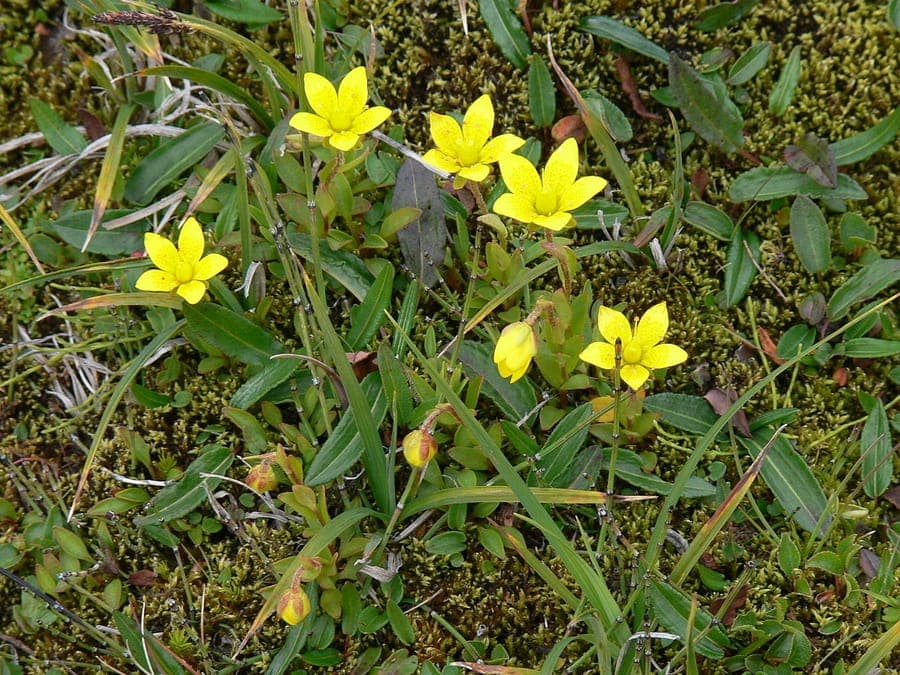
Wolfgang Sauber / CC BY-SA 3.0, via Wikimedia Commons
Marsh saxifrage: complete guide
Saxifraga hirculus
¿Quieres ver Marsh saxifrage: complete guide en tu jardín?
1 minuto, sin tarjeta de crédito
Overview
The marsh saxifrage (Saxifraga hirculus), also called bog yellow saxifrage, is a diminutive alpine perennial belonging to the family Saxifragaceae. Native to subarctic and subalpine wetlands across the northern hemisphere - Scandinavia, Russia, Canada - it thrives in cold, waterlogged conditions that would kill most garden plants. Standing merely 10-20 centimetres tall with slender, upright stems, it is a jewel for gardeners blessed with boggy ground or willing to create wet habitat. The name hirculus possibly derives from the Latin hircius (goat-like), alluding to a faint, distinctive odour.
Marsh saxifrage is increasingly rare in the wild and is therefore both horticulturally rewarding and botanically valuable. It blooms late (July-August), when most alpines have finished, extending the season. On gardenworld.app, you can design water margins and bog gardens that feature this arctic gem.
Appearance & bloom cycle
Plants form neat rosettes of narrow, hairless, somewhat fleshy leaves. From July to September, erect flower stems rise 15-20 cm, each bearing gleaming golden-yellow, five-petalled flowers that glow against the green foliage and dark soil. Blooms are conspicuous and attract moths and other pollinators. After fertilisation, capsules develop containing numerous microscopic seeds.
The plant persists in harsh conditions via underground rhizomes and crowns that can survive waterlogging and freezing.
Ideal location: full sun to partial shade
Marsh saxifrage prefers 4-6 hours of sunlight daily, with preference for morning sun. Given its subarctic heritage, it appreciates afternoon shade in warmer climates. Plant it along pond margins, in bog gardens, or in wet ditches. In cool maritime zones, full sun is acceptable. In hot, dry regions, afternoon shade is essential to prevent wilting during peak summer.
West or northwest exposures: ideal. Boggy woodland with dappled shade: excellent. Full south-facing sun in a rain shadow: difficult without supplementary watering.
Soil requirements
This is a true bog plant. Soil must be perpetually moist to waterlogged. Stand it in 5-10 cm of water without ill effect. Mix clayey loam or peat-substitute with coarse sand at a 2:1 ratio. Add 2-3 cm of compost annually. Avoid free-draining soils entirely - this plant will wilt.
For bog gardens: use clay subsoil mixed with peat or coir. For pond edges: plant directly in boggy clay margins. In containers: use a waterlogged potting medium of loam, peat, and sand in equal parts.
Diseño gratis
¿Quieres ver Marsh saxifrage: complete guide en tu jardín? Crea un diseño gratis ahora.
Watering
Marsh saxifrage requires perpetually moist soil, bordering on waterlogged. In the growing season (May-September), water generously every 2-3 days. Shallow standing water of a few centimetres is ideal - this mimics its natural bog habitat. During dormancy (October-March), reduce watering but never allow soil to dry out.
Rain-fed bog gardens or seepage areas are perfect. In containers, use a saucer beneath the pot to maintain constant moisture.
Pruning
No pruning needed. Remove dead leaves gently in autumn. Spent flower stems can be cut back after seed ripens, usually in September.
Maintenance calendar
- Jan: Monitor moisture; remove dead foliage.
- Feb: No action; maintain constant wetness.
- Mar: Early growth; ensure soil stays wet.
- Apr: Growth begins in earnest; increase watering frequency.
- May: Active growth phase; maintain bog-like wetness.
- Jun: Peak growth; soil should stay moist constantly.
- Jul: Flowering begins; keep consistently moist.
- Aug: Flowering peaks; continue generous watering.
- Sep: Flowering ends; water normally.
- Oct: Enter dormancy; maintain light moisture.
- Nov: Dormancy deepens; keep lightly moist.
- Dec: Rest; avoid becoming excessively wet.
Winter hardiness
Hardy to USDA zone 2 (-45°C). In the UK and northern Europe (zones 5-8), no winter protection is necessary. Young plants may benefit from a mulch of dry leaves, but permanently wet soil is the priority. Frozen bog is fine - the ice layer actually insulates the plant.
Companion plants
Combine with other wetland species: Primula japonica, Astilbe x arendsii, Filipendula rubra, Gunnera, Iris ensata. In shallower bog: Mentha aquatica, Lythrum salicaria, Caltha palustris. Marsh saxifrage works beautifully as an accent among taller bog plants or as a massed groundcover on wet slopes.
Closing
Marsh saxifrage is a singular plant for the turf gardener with wet ground or the ambition to build a bog garden. Its late golden blooms are a surprise and delight. Source plants from specialist alpine nurseries or wetland suppliers. Once in consistently wet soil, it thrives indefinitely with little care. Use gardenworld.app to design bog margins and wetland borders where this arctic specialist can display its charms.
¿Quieres ver Marsh saxifrage: complete guide en tu jardín? Crea un diseño gratis ahora.
Sube una foto, elige un estilo y obtén un diseño fotorrealista con lista de plantas en menos de un minuto.
Más de 10.000 jardines diseñados
Sin tarjeta de crédito


Plantas similares
Korean astilbe: complete guide
Astilbe grandis
Discover Korean astilbe (Astilbe grandis): a tall shade plant with elegant flower plumes for pond edges and borders.
Heuchera pilosissima: complete guide to seaside alumroot
Heuchera pilosissima
Seaside alumroot (Heuchera pilosissima), an elegant North American dwarf perennial with hairy red-tinged foliage and red flower spikes.
Starry saxifrage: complete guide
Micranthes stellaris
Full guide to Micranthes stellaris, the starry saxifrage: location, soil, blooming and garden use. A tough alpine plant for moist, shady rock faces and pond margins.