
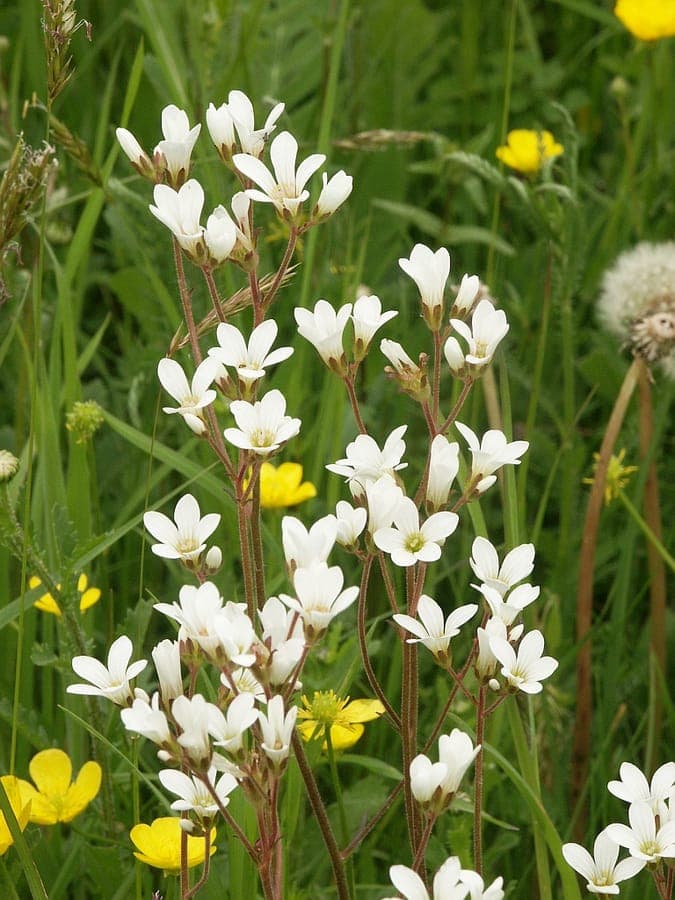
Bernd Haynold / CC BY-SA 3.0, via Wikimedia Commons
Meadow saxifrage: complete guide
Saxifraga granulata
¿Quieres ver Meadow saxifrage: complete guide en tu jardín?
1 minuto, sin tarjeta de crédito
Overview
The meadow saxifrage (Saxifraga granulata), also known as fair-maids-of-france or bulbous saxifrage, is a charming alpine perennial in the family Saxifragaceae. Native to European meadows and mountain ranges from sea level to 2000 metres, it is hardwired for cool climates. Standing only 15-25 centimetres tall, it is a superb groundcover for rock gardens, alpine troughs, and woodland edges. The name granulata refers to the small, grain-like bulbils (tuberoid buds) that form beneath the soil and help the plant survive harsh winters and propagate vegetatively.
Meadow saxifrage is a cottage garden classic, treasured for over three centuries in English and Scottish gardens. It is robust once established, asks little maintenance, and rewards with sprightly spring blooms. On gardenworld.app, you can visualise how this dainty plant clusters between stones and softens borders.
Appearance & bloom cycle
Plants form tight rosettes of narrow, hairy leaves that stay at or near ground level. From April to June, slender flower stems rise to 20-25 cm, each topped with loose sprays of small, pale white blooms tinged yellow at the base. Flowers are five-petalled and highly attractive to early bees. After pollination, capsules develop containing tiny seeds.
Under the soil and between leaf bases, bulbils form - small starch-filled tubers. These are the plant's life insurance, allowing dormancy in summer heat and providing rapid regrowth each spring.
Ideal location: sun to light shade
Choose a spot with 4-6 hours of direct sunlight daily. Morning sun and afternoon shade is ideal in warmer regions (southern England, Benelux). In cool maritime climates, full sun is fine. Avoid fully shaded spots - flowering will be sparse. Good air movement helps prevent mildew on damp days.
Stunning between stones on south or west-facing rockeries. Less effective on a damp, north-facing slope.
Soil requirements
This plant is unforgiving of heavy soil. It demands sharp drainage - clay is a death sentence. Mix gritty sand, perlite, or scree at 50% by volume with loam. pH range 5.5-7.5 is fine. Do not add much organic matter; these plants thrive on lean, fast-draining substrates.
For rockeries: use a 1:1:1 blend of grit, horticultural sand, and loam-based seed compost. In containers: alpine potting mix plus extra perlite or grit.
Diseño gratis
¿Quieres ver Meadow saxifrage: complete guide en tu jardín? Crea un diseño gratis ahora.
Watering
During the growing season (March-May), water moderately. After blooming (June onwards), reduce dramatically. Bulbils need a dry spell to form properly. In autumn and winter, water only if the top 2 cm of soil is bone dry - overwintering bulbs must stay dry or they rot.
Always use rainwater when possible. Hard tap water can cause lime buildup on leaves.
Pruning
No pruning required. Deadhead spent flower stems once petals fall, but be careful not to damage the compact base. Remove any dead foliage gently before winter.
Maintenance calendar
- Jan: Check drainage of pots; remove dead foliage carefully.
- Feb: No action needed.
- Mar: Water sparingly as growth resumes; apply sand mulch.
- Apr: Blooming begins; water carefully.
- May: Peak bloom; continue careful watering.
- Jun: Flowering fades; reduce water significantly.
- Jul-Aug: Minimal watering; shade during heatwaves to prevent leaf scorch.
- Sep: Water only if soil dries completely.
- Oct-Dec: Keep bulbils dry to prevent rot.
Winter hardiness
Hardy to USDA zone 3 (-40°C). In the UK and Benelux (zones 7-8), no winter protection is necessary. Mature plants are bulletproof. Potted specimens can be moved to a cold frame or under cover in the wettest regions to prevent bulbil rot.
Companion plants
Combine with other alpines: Pulsatilla vulgaris, Armeria maritima, Sempervivum species, Sedum acre, Saponaria ocymoides. In damp shade: Helleborus niger, Hepatica nobilis. In full sun: Dianthus deltoides, Aubrieta, Erinus alpinus. Meadow saxifrage nestles beautifully between tufa blocks and in crevice gardens.
Closing
Meadow saxifrage is a reliable, easy alpine that asks little and gives much. Its dainty blooms bring spring cheer to rock gardens and alpine troughs. Buy healthy plantlets from good garden centres - look for compact, dark-green rosettes. Once established in gritty soil, it thrives for years with almost no maintenance. Use gardenworld.app to plan alpine plantings where this charmer shines.
¿Quieres ver Meadow saxifrage: complete guide en tu jardín? Crea un diseño gratis ahora.
Sube una foto, elige un estilo y obtén un diseño fotorrealista con lista de plantas en menos de un minuto.
Más de 10.000 jardines diseñados
Sin tarjeta de crédito


Plantas similares
Korean astilbe: complete guide
Astilbe grandis
Discover Korean astilbe (Astilbe grandis): a tall shade plant with elegant flower plumes for pond edges and borders.
Heuchera pilosissima: complete guide to seaside alumroot
Heuchera pilosissima
Seaside alumroot (Heuchera pilosissima), an elegant North American dwarf perennial with hairy red-tinged foliage and red flower spikes.
Starry saxifrage: complete guide
Micranthes stellaris
Full guide to Micranthes stellaris, the starry saxifrage: location, soil, blooming and garden use. A tough alpine plant for moist, shady rock faces and pond margins.