
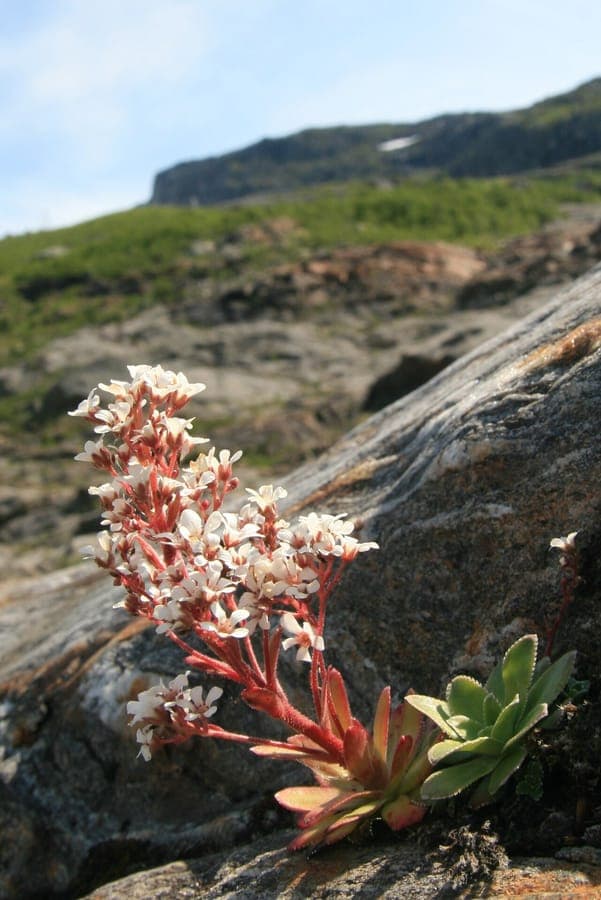
Banangraut / CC BY-SA 3.0, via Wikimedia Commons
Pyramidal saxifrage: complete guide
Saxifraga cotyledon
¿Quieres ver Pyramidal saxifrage: complete guide en tu jardín?
1 minuto, sin tarjeta de crédito
Saxifraga cotyledon, known as pyramidal saxifrage or silver saxifrage, is an impressive alpine plant from the Saxifragaceae family. This plant is native to the mountains of Northern Europe, especially in the Pyrenees and Alps. The plant is known for its characteristic pyramidal flower clusters with white blooms. As a lover of alpine plants, you will greatly appreciate the elegance and robustness of this saxifrage.
Pyramidal saxifrage is a perennial plant that adapts perfectly to rock gardens and steep mountain slopes. The plant forms dense, characteristic rosettes of thick, grayish-green leaves. After several years, it produces spectacular flower clusters with hundreds of small white flowers. This article covers all aspects of Saxifraga cotyledon, from morphology to care.
Overview
Saxifraga cotyledon is a monocarpic plant, meaning it flowers only once before dying. The plant builds a thick rosette mat over several years, which eventually (usually in the third to fourth year) produces a spectacular flower spike. This inflorescence can reach up to 40 centimeters tall and carries hundreds of small, white flowers. Without bloom, the plant usually reaches 5 to 10 centimeters in height.
Appearance and bloom
The leaves of pyramidal saxifrage are the most striking feature of the plant. They are thick, compact, linear, and grayish-green in color. The leaves have a characteristic surface coating of white lime deposits that give the plant a silvery sheen. The leaves are compactly arranged in dense rosettes.
The flowers are very small, approximately 1 centimeter in diameter, and pure white. They are five-petaled and appear in dense, pyramidally constructed flower clusters. A mature plant can produce 200 to 300 flowers. The bloom usually appears in July and August. After flowering, the mother plant dies, but leaves many young plantlets (offsets) behind.
Ideal location
Saxifraga cotyledon grows best on steep rock faces in full sun to half-shade. The plant prefers locations where water drains quickly and where rocks provide shelter. In the garden, it is best to use a steep rock garden or stone trough. The plant tolerates some shade but blooms better in full sun.
Soil
Pyramidal saxifrage requires excellent drainage. A mixture of rocks, gravel, and sand is ideal. Add some composted leaf material for moisture, but ensure drainage is excellent. The plant does not like rich soils. pH can be acidic to neutral.
Watering
Pyramidal saxifrage loves moderate moisture. The plant can survive dry conditions but grows better with regular watering. However, wet feet are absolutely not desired. Water only when the soil feels dry. More water during the growing season, but reduce this in winter.
Pruning
Pruning is not necessary. After blooming, the mother plant dies. The young rosettes (offsets) that form around the center can be carefully removed and replanted in well-draining soil.
Maintenance calendar
Spring: Young plants grow actively. Provide regular watering. Summer: Mature plants reach their bloom. Provide extra water during extreme heat. Autumn: After blooming, mother plants die. Remove dead material. Winter: Plant is dormant. Minimal water, excellent drainage is essential.
Winter hardiness
Saxifraga cotyledon is very cold-hardy and can survive extreme cold. The plant is endemic to alpine areas and adapted to snow and frost. No winter protection needed in most temperate climates.
Companion plants
Pyramidal saxifrage combines beautifully with other alpine plants such as dianthus, phlox, and other saxifrage species. Use it in steep rock gardens alongside other mountain plants. The plant also fits well in stone troughs and alpine garden tables.
Closing
Pyramidal saxifrage is a beautiful and interesting plant for lovers of alpine and rock gardens. Although it requires patience (it takes years to flower), the spectacle when it finally blooms will certainly reward you. With the right drainage and location, this plant will grow with minimal care. Find more plant advice and garden inspiration on gardenworld.app/en. Enjoy growing this unique alpine plant in your garden on gardenworld.app/en!
¿Quieres ver Pyramidal saxifrage: complete guide en tu jardín? Crea un diseño gratis ahora.
Sube una foto, elige un estilo y obtén un diseño fotorrealista con lista de plantas en menos de un minuto.
Más de 10.000 jardines diseñados
Sin tarjeta de crédito


Plantas similares
Korean astilbe: complete guide
Astilbe grandis
Discover Korean astilbe (Astilbe grandis): a tall shade plant with elegant flower plumes for pond edges and borders.
Heuchera pilosissima: complete guide to seaside alumroot
Heuchera pilosissima
Seaside alumroot (Heuchera pilosissima), an elegant North American dwarf perennial with hairy red-tinged foliage and red flower spikes.
Starry saxifrage: complete guide
Micranthes stellaris
Full guide to Micranthes stellaris, the starry saxifrage: location, soil, blooming and garden use. A tough alpine plant for moist, shady rock faces and pond margins.