
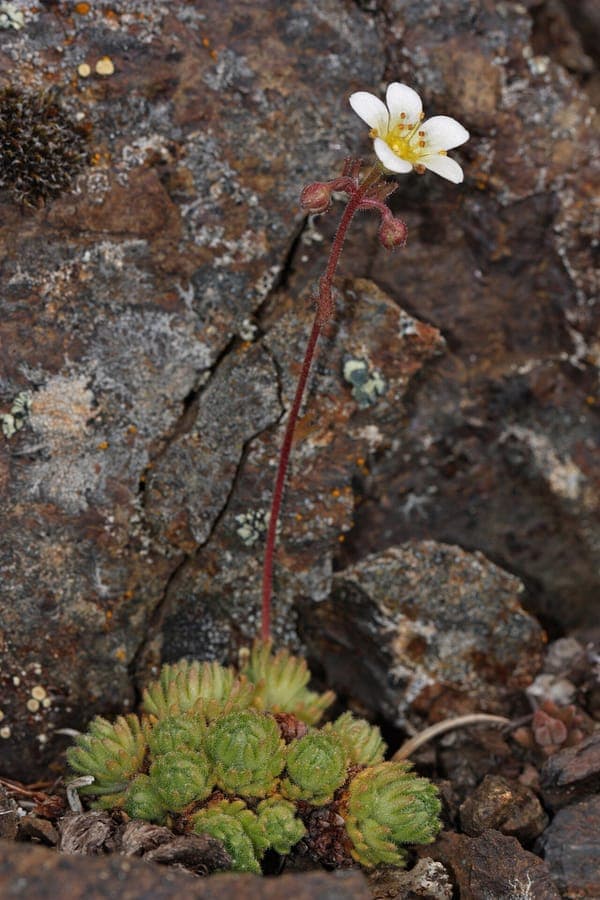
Walter Siegmund (talk) / CC BY-SA 3.0, via Wikimedia Commons
Tufted alpine saxifrage: complete guide
Saxifraga cespitosa
¿Quieres ver Tufted alpine saxifrage: complete guide en tu jardín?
1 minuto, sin tarjeta de crédito
Overview
The Tufted alpine saxifrage (Saxifraga cespitosa) is a magnificent alpine plant from the Saxifragaceae family. This extraordinary plant grows in arctic and subarctic regions from North America to Europe. With its dense, cushion-forming growth pattern and white flowers, it's a true jewel for rock gardens and alpine collectors. This is a plant for dedicated plant enthusiasts who love extreme alpines.
Appearance and Bloom
Saxifraga cespitosa grows in extremely dense, compact cushions or mats of minute leaves. The plant forms thick, swollen mats 15-30 centimeters across and 5-10 centimeters high. From June to July, very numerous tiny white flowers appear on extremely short stems, creating a spectacular white cushion. The flowering is abundant and continuous over several weeks. After flowering, seed capsules form. The mats themselves are attractive year-round.
Ideal Location
Saxifraga cespitosa grows in very sunny locations in rock gardens. At least 7-8 hours of full sun daily is essential for optimal flowering and compact growth. Wind is not a problem - arctic plants are adapted to windy environments. Place on elevated rock crevices or crevasses. Shade leads to longer, less compact growth.
Soil
Excellent drainage is absolutely crucial. Saxifraga cespitosa does not grow in standard garden soil. Use a mixture of sharp sand, perlite, and gravel (70 percent) with minimal organic matter (30 percent). The pH range is 6.5-7.0. In rock crevices, you can use pure gravel. Water must never accumulate around the rosettes.
Watering
Minimal watering is required. Water very sparingly, only during dry periods. Too much water is very harmful. Ensure water absolutely never collects in the rosettes. Good ventilation is essential to prevent fungal infections. In very dry climates, slightly more water during growing period.
Diseño gratis
¿Quieres ver Tufted alpine saxifrage: complete guide en tu jardín? Crea un diseño gratis ahora.
Pruning and Maintenance
No pruning is needed. The plant forms itself in perfect cushions. Very old, exhausted mats can be carefully removed. Dead leaves can be gently removed. Generally, minimalist treatment is best.
Maintenance Calendar
Spring: Begin very careful watering. Check drainage. Summer: Minimal watering; enjoy flowering. Fall: Further reduce water. Winter: Almost no water; ensure ventilation. Protect from rot.
Winter Hardiness
Saxifraga cespitosa is fully hardy to USDA zone 1 (-50 degrees Celsius). The plant tolerates extreme cold and frost without any problem. However, winter wet conditions are very harmful. Ensure excellent drainage and ventilation. Snow protection is not needed.
Companion Plants
Good in specialized alpine rock gardens with similarly demanding species. Other Saxifraga species, minute sedums, and small Dianthus. Avoid competition from larger growing plants. This plant is for collectors with rock gardens.
Conclusion
The Tufted alpine saxifrage is a spectacular plant for dedicated alpine collectors. With extremely well-drained soil and minimalist care, this arctic jewel will provide years of beauty. This is a plant for enthusiastic collectors. Find seeds or small specimens from specialized arctic/alpine nurseries. Discover more on gardenworld.app about arctic alpines.
Extra Culture Points
Seed sowing is the easiest method. Seed requires cold stratification and grows slowly. Careful potting - this plant dislikes frequent disturbance. Growing from seed to flowering takes 3-5 years. Perfect for alpine collections and trough culture.
¿Quieres ver Tufted alpine saxifrage: complete guide en tu jardín? Crea un diseño gratis ahora.
Sube una foto, elige un estilo y obtén un diseño fotorrealista con lista de plantas en menos de un minuto.
Más de 10.000 jardines diseñados
Sin tarjeta de crédito


Plantas similares
Korean astilbe: complete guide
Astilbe grandis
Discover Korean astilbe (Astilbe grandis): a tall shade plant with elegant flower plumes for pond edges and borders.
Heuchera pilosissima: complete guide to seaside alumroot
Heuchera pilosissima
Seaside alumroot (Heuchera pilosissima), an elegant North American dwarf perennial with hairy red-tinged foliage and red flower spikes.
Starry saxifrage: complete guide
Micranthes stellaris
Full guide to Micranthes stellaris, the starry saxifrage: location, soil, blooming and garden use. A tough alpine plant for moist, shady rock faces and pond margins.