
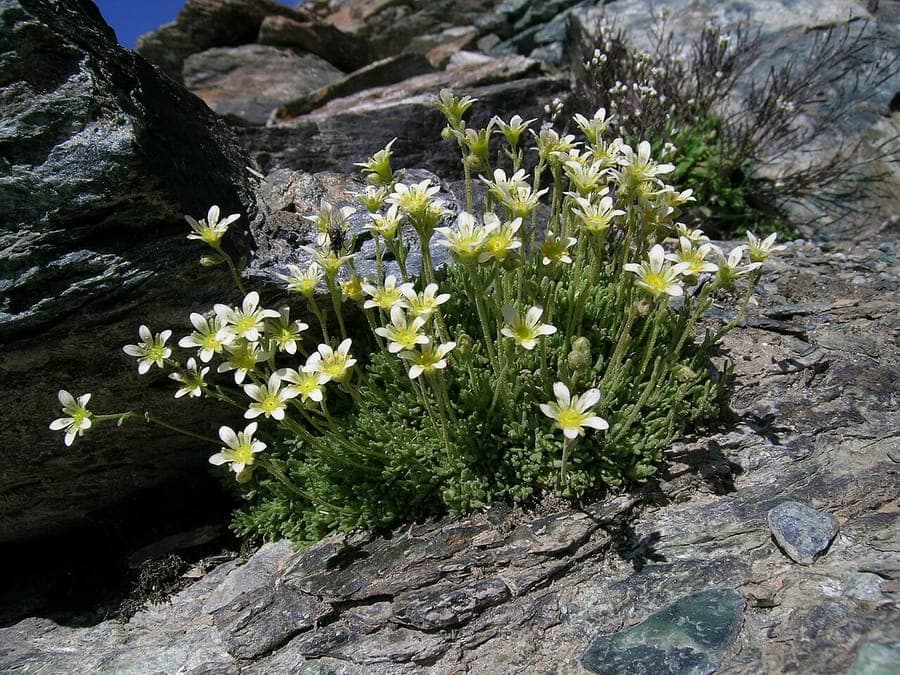
No machine-readable author provided. Thommybe assumed (based on copyright claims). / CC BY-SA 3.0, via Wikimedia Commons
Moss saxifrage: complete guide
Saxifraga bryoides
¿Quieres ver Moss saxifrage: complete guide en tu jardín?
1 minuto, sin tarjeta de crédito
Overview
Moss saxifrage (Saxifraga bryoides) is an extremely small, hardy alpine plant from the European mountain ranges. This plant grows in very specific habitats: rocky mountain slopes and alpine scree at elevations of 1500 to 2000 meters and higher. The plant is renowned for its extremely compact growth, often no larger than 2 to 5 centimeters, and beautiful white flowers.
Moss saxifrage is a specialist plant for rock gardens and alpine troughs. The plant requires very specific growing conditions with perfectly draining soil and cool temperatures. In temperate regions, it can be grown in rocky alpine gardens, especially in northern areas or at high altitudes.
On gardenworld.app, you'll find expert advice on growing very small alpine plants.
Appearance and Bloom
Moss saxifrage forms extremely low, tight cushions of succulent, small leaves. The leaves are usually green, sometimes reddish, very tightly packed. The plant looks remarkably like moss, hence its common name.
Flowers appear from July to August, white or very light pink, approximately 1 centimeter in diameter. The flowers are very abundant and cover the tiny plant completely. After flowering, small seed pods form.
The plant rarely exceeds 3 to 5 centimeters in height and width. Growth is very slow, with only a few millimeters per year.
Ideal Location
Moss saxifrage requires full sun with at least 5 to 6 hours of direct sunlight. The plant also grows in very light shade in mountainous areas. The plant prefers cool, windy locations.
The plant thrives best on very exposed rocky locations in alpine gardens. In regular gardens, it can be grown in a stone trough or alpine bed at very high elevation.
Ensure wind can circulate well to prevent fungal problems.
Soil
Moss saxifrage requires extremely well-draining soil. A mixture of very coarse gravel (50 percent), small stone chippings (30 percent), and sand (20 percent) is ideal. No organic matter or garden soil.
PH can range from 6.0 to 7.0. The plant grows in very poor soils in nature. Nutrients are not necessary.
The soil must dry as quickly as possible without any water accumulation.
Diseño gratis
¿Quieres ver Moss saxifrage: complete guide en tu jardín? Crea un diseño gratis ahora.
Watering
Moss saxifrage requires careful watering. During the growing period (May to August), water very lightly, approximately once every two weeks. The plant obtains much water from air humidity.
In winter (October to April), practically do not water. Snow provides sufficient moisture for this plant.
The greatest cause of death is too much water. Be very careful with watering during wet seasons.
Pruning
Moss saxifrage requires no pruning. The plant grows very slowly and naturally forms a perfect shape. Any intervention can be harmful.
Always carefully remove dead leaves with tweezers. Never handle the plant roughly.
Maintenance Calendar
January-February: Plant is sensitive to wet snow. Protect from water. Inspect for fungal growth.
March-April: First growth begins. Very minimal water. Inspect for insects.
May-June: Growth accelerates carefully. Flowering approaches. Light water. Enjoy first flowers.
July-August: Flowering past. Seed setting. Minimal water. Very careful.
September-October: Plant closes growth. Gradually stop watering. Prepare for winter.
November-December: Plant is dormant. Protect from wet snow. Evaluate location.
Winter Hardiness
Moss saxifrage is extremely frost-hardy to below -30 degrees Celsius. The plant grows in its natural habitat above the snowline. Frost is not a problem.
The major problem is wet, damp conditions in winter, especially wet snow. Protection from snow and rain is essential. The plant must never sit in stagnant water.
In dry, cold winters, the plant needs no protection.
Companion Plants
Moss saxifrage grows well with other ultra-dwarf alpine plants:
- Androsace helvetica
- Armeria alpina nana
- Sedum alpestre
- Sempervivum arachnoideum
Perfect in alpine troughs and very specialized rock crevice gardens.
Closing
Moss saxifrage is a plant for very advanced alpine gardeners. It requires perfect drainage, very careful watering, and patience with extremely slow growth. But for those who master the art, it offers rare beauty and the satisfaction of cultivating a very difficult plant. Via gardenworld.app, you obtain advice from alpine specialists. A true challenge for experts!
Available through highly specialized alpine plant nurseries throughout Europe.
¿Quieres ver Moss saxifrage: complete guide en tu jardín? Crea un diseño gratis ahora.
Sube una foto, elige un estilo y obtén un diseño fotorrealista con lista de plantas en menos de un minuto.
Más de 10.000 jardines diseñados
Sin tarjeta de crédito


Plantas similares
Korean astilbe: complete guide
Astilbe grandis
Discover Korean astilbe (Astilbe grandis): a tall shade plant with elegant flower plumes for pond edges and borders.
Heuchera pilosissima: complete guide to seaside alumroot
Heuchera pilosissima
Seaside alumroot (Heuchera pilosissima), an elegant North American dwarf perennial with hairy red-tinged foliage and red flower spikes.
Starry saxifrage: complete guide
Micranthes stellaris
Full guide to Micranthes stellaris, the starry saxifrage: location, soil, blooming and garden use. A tough alpine plant for moist, shady rock faces and pond margins.