
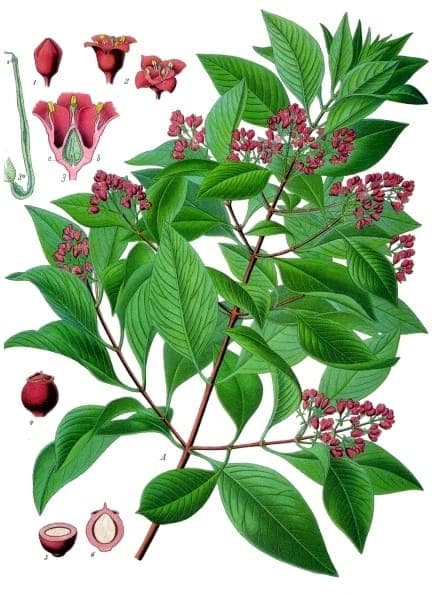
Franz Eugen Köhler, Köhler's Medizinal-Pflanzen / Public domain, via Wikimedia Commons
East Indian Sandalwood: complete guide
Santalum album
¿Quieres ver East Indian Sandalwood: complete guide en tu jardín?
1 minuto, sin tarjeta de crédito
Overview
Santalum album is a valuable semi-parasitic tree from the Santalaceae family. It grows slowly but produces important wood and aromatic compounds. Native to Java and Australia. Only suitable for conservatories in Europe.
Appearance and Bloom
Indian sandalwood is a slow-growing tree reaching up to 10 meters with gray bark. Leaves are small, lance-shaped, and light green. In September-October, yellow flowers appear in small clusters. These are followed by red fruits that turn black when ripe.
Ideal Location
Position sandalwood in a warm, well-ventilated conservatory or greenhouse. Maintain 18-25 degrees Celsius year-round. Requires 8+ hours of sunlight daily. Indoor cultivation only possible in temperate Europe.
Soil
Indian sandalwood grows in well-drained, sandy to loamy soil. pH 6.0-7.5 is preferred. Pot or large container cultivation recommended. Its semi-parasitic nature requires careful potting soil.
Diseño gratis
¿Quieres ver East Indian Sandalwood: complete guide en tu jardín? Crea un diseño gratis ahora.
Watering
Keep soil evenly moist during growing season, less in winter. Excellent drainage is essential. Overwatering causes root rot. Regular misting during warm periods helps.
Pruning
Prune carefully for shape. Remove dead branches. Sandalwood grows slowly so limit pruning. Light shaping prevents leggy growth.
Maintenance Calendar
Spring: Apply fertilizer, monitor fungal issues. Summer: Regular watering, high humidity. Fall: Reduce feeding. Winter: Minimal watering, maintain 18+ degrees.
Winter Hardiness
Indian sandalwood is not frost-hardy. Minimum 10 degrees required. In the Netherlands, suitable only in heated conservatories. In southern Europe, possible outdoors in very protected locations.
Companion Plants
In conservatories, combine with other tropical plants: Plumeria, Frangipani, Tamarind. Works well in containers with complementary plants.
Conclusion
Sandalwood is a fascinating tree with a long history in traditional medicine. In Europe, it is a careful addition to conservatory collections. Patience is required as growth is slow.
¿Quieres ver East Indian Sandalwood: complete guide en tu jardín? Crea un diseño gratis ahora.
Sube una foto, elige un estilo y obtén un diseño fotorrealista con lista de plantas en menos de un minuto.
Más de 10.000 jardines diseñados
Sin tarjeta de crédito


Plantas similares
Juniper Dwarf Mistletoe: complete guide
Arceuthobium oxycedri
Full profile of Arceuthobium oxycedri, the juniper dwarf mistletoe: biology, host range, identification, and garden management advice.
Meadow Flax: complete guide
Thesium pyrenaicum
Cultivate Meadow Flax (Thesium pyrenaicum): delicate alpine plant, white flowers, acid soil preference, sparse nutrition, and Pyrenean mountain garden care.
Thesium humile: complete guide
Thesium humile
Discover Low Bastard Toadflax, a modest herb with fine foliage and tiny white flowers. Perfect wild plant for Mediterranean drought gardens.