
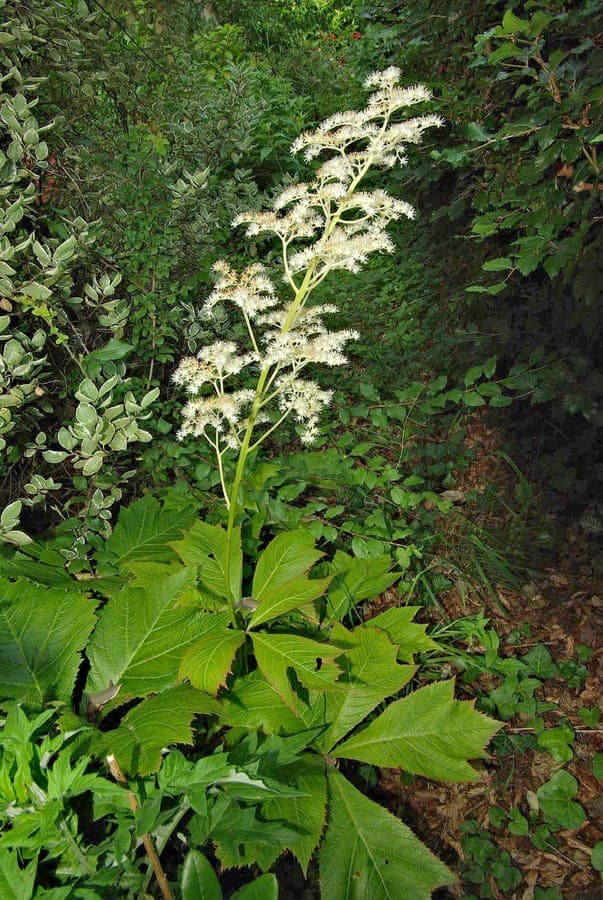
Velela / CC BY 2.5, via Wikimedia Commons
Rodgersia: complete guide
Rodgersia podophylla
¿Quieres ver Rodgersia: complete guide en tu jardín?
1 minuto, sin tarjeta de crédito
Overview
The Rodgersia, botanically known as Rodgersia podophylla, is a spectacular, large foliage plant native to the mountains of Japan, Korea, and Manchuria. This plant belongs to the Saxifragaceae family and is renowned for its massive, palmate leaves resembling those of Aesculus (chestnut) leaves - hence the botanical name "podophylla" (foot-leaf). Rodgersia is a true show-stopper in shaded corners of large gardens, especially where dramatic foliage and vertical structure are desired. In the Netherlands and Belgium, this plant grows well in suitable shaded locations.
For those seeking dramatic shade planting with impressive architecture and seasonal interest, Rodgersia is an indispensable choice. At gardenworld.app, you can design shade gardens centered around this architectural masterpiece. This is a plant for those thinking boldly about shade plantings.
Appearance & Bloom Cycle
The Rodgersia is a very large, ornamental perennial that typically grows 60 to 120 centimeters tall, sometimes taller. The most striking feature is the enormous, palmate leaves that grow at the base of the plant in large, impressive rosettes. The leaves can be 30 to 45 centimeters long and wide, deeply lobed into 5 to 7 parts, forming a giant "hand". The foliage is glossy dark green in summer, and turns bronze to red in autumn, providing dramatic color changes.
The flowers appear in early summer on tall, elegant flower stalks that rise well above the foliage. The flowers are very small, creamy white to soft pink, densely packed in vertical plumes that can be 20 to 30 centimeters long. The flowering period is May to July. Although individual flowers are inconspicuous, the massive plumes create a very attractive effect against the dark foliage. After flowering, decorative seed pods form.
Ideal Location: Sun, Shade, or Partial Shade
The Rodgersia is absolutely a shade-lover and grows best in partial to full shade. A minimum of 2 to 4 hours of indirect light daily is essential, though more light (but not full sun) is also acceptable. Full sun will scorch foliage, especially in warm climates. In very deep shade (such as direct tree canopy), the plant will grow reasonably but foliage may become spindly and less impressive.
Ideal is partial shade under deciduous trees where morning and afternoon sun are present but midday sun is avoided. In pond or fountain corners with moist, lightly shaded situations, Rodgersia grows spectacularly.
Soil & Underground Requirements
The Rodgersia has very specific soil requirements. This is a moisture-loving plant that thrives in rich, humus-containing soils. The plant grows best in slightly acidic to neutral soil (pH 5.5-7.0), well-draining yet moisture-retentive. This is not a plant for dry soils or poor, mineral soils. The plant prefers soils rich in decomposed organic matter, such as old leaf mold.
For planting, add abundant compost, peat, or other organic material to constitute 50 percent of the volume. This ensures proper moisture retention and nutrient availability. Rodgersia's shallow root systems utilize the rich surface layer of the soil.
Diseño gratis
¿Quieres ver Rodgersia: complete guide en tu jardín? Crea un diseño gratis ahora.
Watering: When and How Much
The Rodgersia is a moisture-lover and this plant must never completely dry out. The soil should feel permanently slightly moist. Water when the top centimeter of soil feels dry. During growing seasons (April to October), this may be needed daily. This is very important - water shortage can be severely damaging.
Ensure consistent moisture through mulching. Adding 5 to 10 centimeters of bark mulch protects roots and maintains moisture. Rainwater is preferable to tap water. In winter, watering can be minimal, but soil should never completely dry out.
Pruning: When and How
Pruning Rodgersia is minimal. Remove only dead leaves and faded flower stalks if desired. The plant grows naturally compact and attractive. Once flowers are past (July/August), you can remove flower stalks to emphasize the magnificent foliage. In autumn, you might clean up dying material before it damages the plant in winter.
The plant needs no cutting back. Old leaves dying from the outside is natural and decorative.
Maintenance Calendar
- January - February: Frost damage unlikely. Gently remove dead leaf litter from previous season. Check moisture levels in rarely wet soils.
- March - April: Plant prepares for growth. Ensure regular moisture - this is the most critical period. Consider adding mulch for moisture retention.
- May - June: Active growth and flowering. Regular watering is essential. Admire the spectacular blooms.
- July - August: Past flowering. Remove flower stalks if desired. Continue regular watering.
- September - October: Plant prepares for winter. Foliage colors to attractive shades. Watering can be slightly reduced.
- November - December: Plant goes dormant. No fertilizing. Minimal watering, but prevent desiccation.
Winter Hardiness & Protection
The Rodgersia is very winter-hardy to temperatures of -25 to -30 degrees Celsius (USDA zones 4-5). In the Netherlands and Belgium, no winter protection is needed. The plant does not die back - leaves disappear in late autumn, but roots sleep and emerge next spring.
In extremely cold areas, extra mulching can be useful, especially for young plants. In the first year after planting, young Rodgersia can carefully be wrapped in burlap in very severe winters, but this is rarely needed.
Companion Plants & Combinations
The Rodgersia combines beautifully with other large shade plants:
- Astilbe (Astilbe): Finer, feathery flowers form nice contrast with Rodgersia's massive form.
- Hosta (Hosta): Complementary leaf shapes and large color grouping.
- Carex (Sedge): Vertical grasses provide movement against Rodgersia's static structure.
- Helleborus (Hellebore): Low advance flowering under large Rodgersia leaves.
- Heuchera (Coral Bells): Interesting foliage colors for underlayering.
All are available at local garden centers. gardenworld.app can design complete shade gardens centered around this architectural plant.
Conclusion
The Rodgersia (Rodgersia podophylla) is one of the most dramatic shade plants that can grow in temperate-climate gardens. The enormous, architectural foliage, delicate flowers, and spectacular seasonal interest make this an absolute must-have for shade-planting enthusiasts. With proper attention to moisture and correct shade, Rodgersia grows into a monumental work of art in the garden.
¿Quieres ver Rodgersia: complete guide en tu jardín? Crea un diseño gratis ahora.
Sube una foto, elige un estilo y obtén un diseño fotorrealista con lista de plantas en menos de un minuto.
Más de 10.000 jardines diseñados
Sin tarjeta de crédito


Plantas similares
Korean astilbe: complete guide
Astilbe grandis
Discover Korean astilbe (Astilbe grandis): a tall shade plant with elegant flower plumes for pond edges and borders.
Heuchera pilosissima: complete guide to seaside alumroot
Heuchera pilosissima
Seaside alumroot (Heuchera pilosissima), an elegant North American dwarf perennial with hairy red-tinged foliage and red flower spikes.
Starry saxifrage: complete guide
Micranthes stellaris
Full guide to Micranthes stellaris, the starry saxifrage: location, soil, blooming and garden use. A tough alpine plant for moist, shady rock faces and pond margins.