
Pollinator at English Wikipedia / CC BY-SA 3.0, via Wikimedia Commons
Black locust: complete guide
Robinia pseudoacacia
¿Quieres ver Black locust: complete guide en tu jardín?
1 minuto, sin tarjeta de crédito
Overview
Black locust or false acacia (Robinia pseudoacacia) is an elegant tree in the Fabaceae family (legumes), native to eastern United States. Despite its name, it is not a true acacia but a related legume. This tree is renowned for its white, drooping flower clusters that appear in May-June.
The black locust grows to 15-25 meters tall and forms an elegant, open canopy. It is excellently suited to large gardens and commonly appears in parks and along waterways. Its deep-rooting system makes it stable and drought-resistant.
Appearance and Bloom
The tree grows with a narrow to medium-broad canopy featuring light, greenish trunk that darkens over time. Foliage is compound and fern-like, light green, creating elegant filtered light.
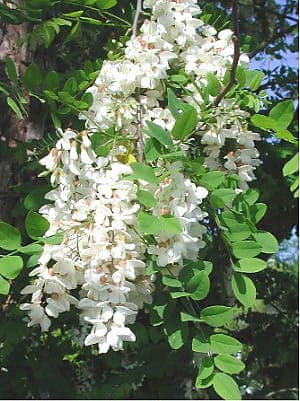
The bloom is truly spectacular. From May to June, white, fragrant drooping flower clusters hang downward, full of nectar and highly attractive to bees. The fragrance is sweet and pleasant. After flowering, brown seed pods form and remain on the tree long afterward.
Ideal Location
Black locust demands full sun. At least 6-8 hours of direct sunlight daily is essential. In shade, growth is poor and flowering diminishes.
Wind-resistance is fairly good, thanks to its strong trunk. However, in younger years, branches can break. A slightly sheltered spot is therefore beneficial. The tree also tolerates urban air pollution well and grows in contaminated environments.
Soil
As a legume, black locust requires minimal feeding due to nitrogen-fixing root nodules. It grows on virtually any soil, from acidic to alkaline, poor to moderately fertile.
Prevent waterlogging; well-drained soils are essential. Heavy clay should be worked with sand. The tree is highly adaptable to various soils.
Diseño gratis
¿Quieres ver Black locust: complete guide en tu jardín? Crea un diseño gratis ahora.
Watering
After planting, water regularly initially (1-2 years). Mature trees are extremely drought-resistant and essentially need no supplementary water. In extremely dry summers, some watering can help but is not essential.
Young container plants require more water; ensure good drainage.
Pruning
Pruning is needed only for shaping and removing deadwood. In younger years, training to a single trunk can be beneficial. Later, minimal pruning is best; the tree naturally assumes an attractive form.
Wound dressing is not necessary. Pruning wood can be chipped, though not always needed.
Maintenance Calendar
April-May: Flowers appear. Enjoy the fragrance. May-June: Full bloom. Bees busy at work. July-September: Seed pod development. Normal care. October-November: Foliage yellows and falls. Pods remain. December-March: Winter dormancy. Minimal care needed.
Winter Hardiness
Very hardy, to -20 degrees Celsius or lower. Growing naturally in USA to Canada, thus extremely robust in Europe. Frost is absolutely no concern. Young branches may break in extremely severe winters, but the tree recovers easily.
Companion Plants
Black locust combines beautifully as a specimen tree, but also well with:
- Underplanting with shade-tolerant plants
- Hedera (climbing ivy within crown)
- Clematis (flowering climbers)
- Other light, airy foliage plants
Final Thoughts
Black locust is a gem for those with space and who wish to enjoy beautiful spring light and fragrance. The tree is widely planted in parks and along waterways. It is standard stock at tree nurseries.
For large gardens and landscapes, this is a top choice. Use gardenworld.app to easily design a garden where this impressive tree stands central as the structural plant. A tree for generations.
¿Quieres ver Black locust: complete guide en tu jardín? Crea un diseño gratis ahora.
Sube una foto, elige un estilo y obtén un diseño fotorrealista con lista de plantas en menos de un minuto.
Más de 10.000 jardines diseñados
Sin tarjeta de crédito

