
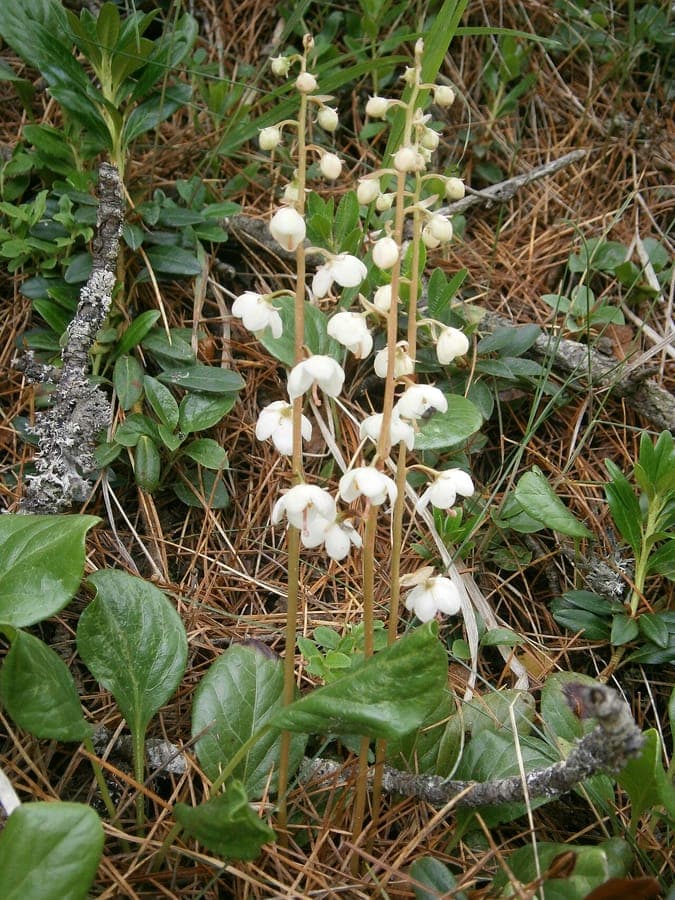
Meneerke bloem / CC BY-SA 4.0, via Wikimedia Commons
Intermediate wintergreen: complete guide
Pyrola media
¿Quieres ver Intermediate wintergreen: complete guide en tu jardín?
1 minuto, sin tarjeta de crédito
Overview
Pyrola media, commonly called intermediate wintergreen, is a delicate woodland gem from the Ericaceae family. Scientifically documented since 1804, it thrives in coniferous and mixed forests across northern Europe to the Mediterranean. The name "wintergreen" refers to its persistent evergreen foliage that remains green throughout winter, making it a subtle year-round presence in shaded gardens.
This understated plant produces elegant, nodding clusters of white to pale pink flowers during summer months. In natural ecosystems, it plays an important role as a food source for insects and forms crucial mycorrhizal relationships with soil fungi. The wintergreen represents a quiet beauty ideal for gardeners seeking the peaceful presence of true forest plants in their landscape.
While not commonly found in mass-market nurseries, Pyrola media deserves recognition for its ecological value and exceptional suitability for deep shade environments. Its stable, long-term growth habits make it an excellent choice for naturalistic woodland gardens.
Appearance and bloom
Pyrola media forms low, compact rosettes with elegant, leathery leaves that remain glossy dark green year-round. The leaves are elliptical to rounded, approximately 2-4 centimeters long, with a distinctive shiny surface characteristic of this species.
Flowers appear from June through August in delicate, one-sided racemes held on slender, leafless stems. Each bloom measures about 1 centimeter across, featuring five white to pale pink petals that create striking contrast against the dark foliage. The flowers are lightly fragrant and attract small pollinators.
Following bloom, small egg-shaped seed capsules develop and ripen slowly. These capsules contain thousands of minute wind-dispersed seeds, allowing the plant to colonize new territories over time. This natural dispersal mechanism supports woodland regeneration in suitable habitats.
Ideal location
Pyrola media thrives in deeply shaded locations beneath dense tree canopies or shrub understory. The plant tolerates as little as 4 hours of dappled indirect light daily but prefers complete shade where soil temperature remains stable and moderate.
This wintergreen feels at home in Atlantic coniferous and mixed forest habitats. In gardens, place it beneath azaleas, rhododendrons, or other woodland shrubs with similar moisture requirements. Position Pyrola media where direct sunlight cannot reach it, particularly on north-facing walls or beneath thick tree canopies.
The plant appreciates stable, fungal-rich soil with abundant organic matter. Seek locations where forest floor material and leaf mold are continuously present, as these support the mycorrhizal fungi essential to plant growth.
Soil requirements
Pyrola media prefers acidic, humus-rich soil with pH between 5.5 and 6.5. The plant thrives best on woodland soils rich in incorporated organic material, deadwood, leaf mold, and natural humus buildup developed over decades.
The ideal soil mixture consists of 40% peat or high-moor peat, 30% fine sawdust or tree bark material, 20% sand, and 10% forest-floor compost. This composition mimics natural woodland soil and promotes essential mycorrhizal associations.
Drainage is crucial: the plant cannot tolerate waterlogging but prefers constantly moist, well-draining soil. Avoid compacted ground and annually add 3-5 centimeters of leaf mold to the surface around the plant to simulate natural forest floor conditions.
Mixing with acidifying soil amendments like sour sand or acid peat helps maintain the ideal pH. Yearly additions of acidic leaf mold or pine needles support the acidic environment this plant requires.
Diseño gratis
¿Quieres ver Intermediate wintergreen: complete guide en tu jardín? Crea un diseño gratis ahora.
Watering
Pyrola media prefers consistently moist soil, especially during the growing season from April through September. However, the plant dislikes waterlogged conditions; moist, well-draining soil is optimal.
Water deeply but infrequently. Ensure soil remains moist 10 centimeters deep. During dry periods without rain, provide water twice weekly, while wet winters may require improved drainage.
Use soft water, preferably rainwater, as hard, calcareous water can harm the plant by interfering with its preference for acidic soil. If rain is scarce, collect rainwater in a barrel and use it for irrigation. A thick layer of leaf mold helps retain moisture around plant roots.
Pruning
Pyrola media requires minimal pruning. The plant grows slowly and remains naturally compact. Remove only dead or damaged leaves to maintain perfect health.
Flowering stems can be removed after blooming (August-September) for neater appearance, though this is optional. Never damage the central rosette growth.
Manage inter-plant competition by carefully removing surrounding weeds without disturbing wintergreen roots. Use gentle garden tools and avoid intensive soil disturbance.
Maintenance calendar
April-May: Remove winter mulch, monitor new growth for fungal issues. Add organic humus through leaf mold applications.
June-August: Observe blooms, ensure consistent moisture during dry periods. Study pollinators visiting flowers.
September-October: Seeds ripen; leave seed capsules in place if natural seeding is desired. Add more leaf mold as autumn approaches.
November-March: Winter dormancy requires minimal activity, though moisture monitoring remains important. Protect from snow damage by gently brushing accumulated snow away.
Winter hardiness
Pyrola media is fully hardy in temperate European climates to at least -15 degrees Celsius. The plant overwinters successfully in northern European open gardens, adapting to extreme seasonal fluctuations.
In temperate maritime climates (Netherlands, Belgium, France), winter protection is rarely needed. In continental regions (Germany), a protective 5-10 centimeter leaf mold layer helps insulate the plant.
Companion plants
Pyrola media grows well alongside other woodland flora such as wild European orchids (Dactylorhiza), clubmosses (Lycopodium), and bladderworts (Vaccinium).
Combine with other acid-loving plants like heathers (Calluna), heath (Erica), and rhododendrons for harmonious woodland assemblages.
Ensure companions share Pyrola media's moisture requirements. Avoid aggressive growers that could overwhelm this delicate plant.
Closing thoughts
Pyrola media embodies the quiet elegance of forest ecosystems. With persistent evergreen foliage and delicate summer flowers, it offers valuable low-maintenance additions to shade gardens. For those drawn to natural woodland flora and ecological gardening, this plant deserves recognition. Simply provide appropriate acidic, moist conditions, and it will bloom softly for years, unobtrusive yet perfect.
Available at specialty garden centers like Dutch retailers offering woodland and alpine plants under the names wintergreen or Pyrola media.
Extraordinary durability combined with elegant presentation makes this plant excep
¿Quieres ver Intermediate wintergreen: complete guide en tu jardín? Crea un diseño gratis ahora.
Sube una foto, elige un estilo y obtén un diseño fotorrealista con lista de plantas en menos de un minuto.
Más de 10.000 jardines diseñados
Sin tarjeta de crédito


Plantas similares
Zenobia pulverulenta: complete guide
Zenobia pulverulenta
Everything about Zenobia pulverulenta (honeycup): siting, acid soil, pruning and the fragrant white bells, in this complete care guide.
Dwarf huckleberry: complete guide
Gaylussacia dumosa
Everything about dwarf huckleberry (Gaylussacia dumosa): acidic soil, partial shade, pruning and care for this compact North American berry shrub.
Drooping leucothoe: complete guide
Leucothoe fontanesiana
Everything about drooping leucothoe (Leucothoe fontanesiana): shade tolerance, soil, watering, pruning, hardiness and companion plants.