
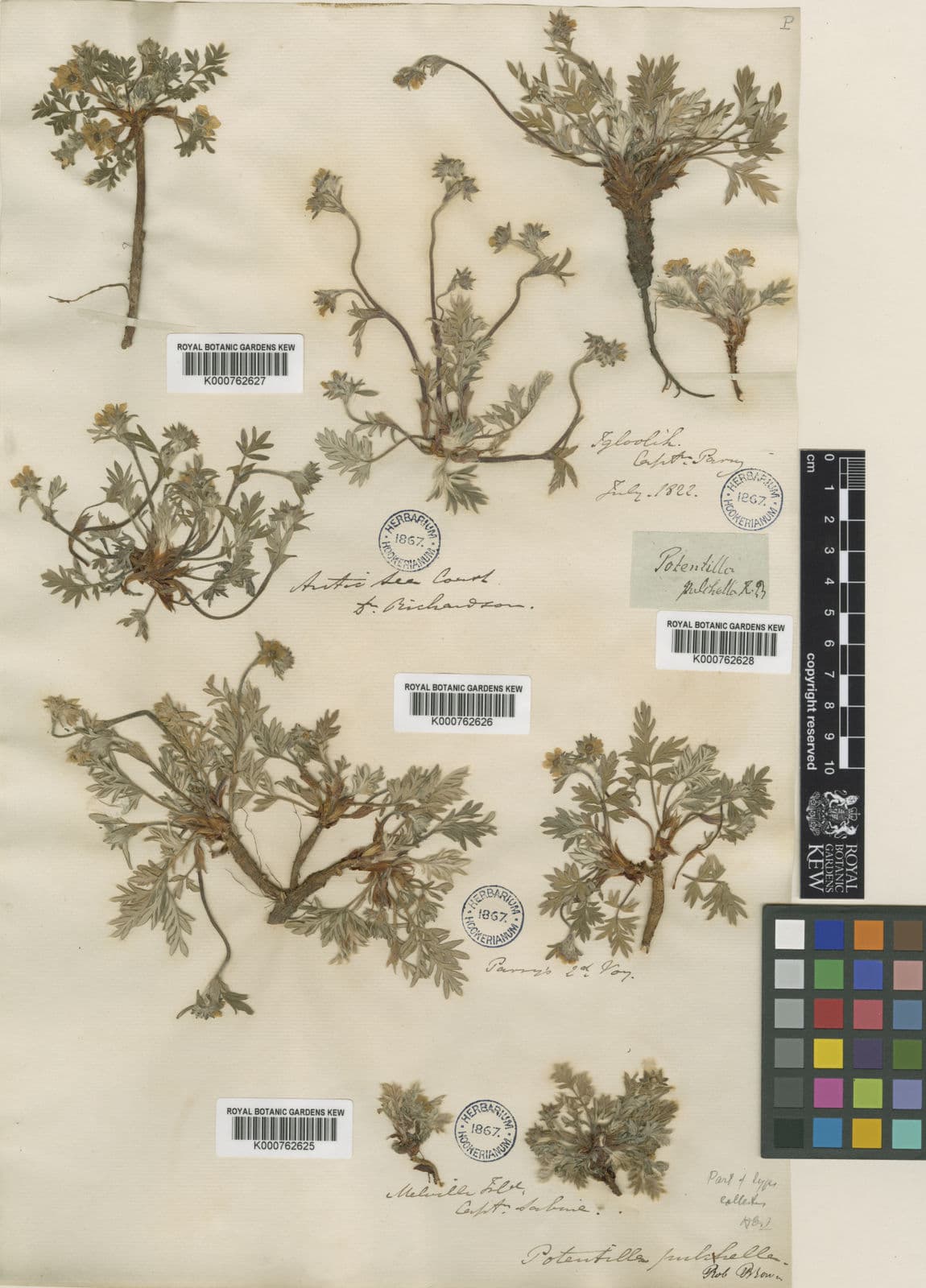
Potentilla pulchella: complete guide
Potentilla pulchella
¿Quieres ver Potentilla pulchella: complete guide en tu jardín?
1 minuto, sin tarjeta de crédito
Overview
Potentilla pulchella, commonly known as pretty cinquefoil, is a truly Arctic alpine perennial from the North Atlantic mountain regions, including Greenland, Arctic Russia, and Canada's Arctic territories. This member of the rose family (Rosaceae) is a champion in extreme cold and thrives even beyond the treeline.
This is not merely a mountain plant: this is a polar plant. The name "pulchella" means literally "very pretty," which this delicate yet robust plant well deserves. For those in very cold regions, this is a plant that feels at home where other species surrender.
Appearance and Bloom
Potentilla pulchella forms extremely tight, densely growing mats of incredibly finely divided, silvery-green foliage. The leaves are deeply compound, with five to seven very small leaflets per leaf. In fall and winter, the foliage can take on purplish tints.
Flowers are small but exquisitely delicate: bright yellow, approximately one-half to three-quarters inch in diameter, appearing June to July in polar regions or May through August in temperate climates. They're borne on very short stems, almost sessile within the leaf mass. Bloom is always magical: this Arctic plant flowers even during Arctic summer's nearly continuous daylight.
Following bloom, small achenes develop. In very cold regions, foliage may persist through winter, providing extra visual interest.
Ideal Location
Pretty cinquefoil demands full sun to very lightly shaded spots. In Arctic regions (where solar angle is always low), it still performs excellently. In temperate climates: minimum four to six hours of direct sunlight daily.
Ideally suited to alpine rock gardens, rocky peaks, in alpine troughs, on rooftops, and in containers. Equally at home on mountains as in polar regions. Wind tolerance is exceptional: this plant grows on windy polar coasts.
Suitable for those in USDA zones 1-3 or very high in mountains.
Soil
Exceptionally well-draining soil is absolutely mandatory. This plant grows on very poor Arctic tundra soils with low nutrient content. Heavy clay means certain death. Ideal composition: gravel, grit, very coarse sand, minimal humus.
In very heavy soils: a mixture of 60% grit/gravel, 30% coarse sand, 10% garden soil. pH: neutral to slightly acidic (6.5-7.5).
This plant tolerates and actually prefers very poor soils. Fertilization is rarely needed; indeed, excess feeding can be harmful.
Watering
Minimal watering, even less than other Potentilla species. This plant is built for dry Arctic conditions. During normal rainfall, no supplemental water is needed. During drought: very limited watering.
In container culture: water only when the top two to three inches are completely dry. In Arctic regions where meltwater is continually available, this plant may essentially water itself.
Less water is always preferable to too much.
Pruning
Scarcely any pruning. The plant grows naturally extremely compact. Dead foliage may be gently removed in early spring, but this is optional.
Yellowed or damaged leaves may be carefully combed out. Deadheading is unnecessary.
Maintenance Calendar
January-February (Arctic summer = June-July): Plant blooms! Moisture monitoring essential.
March-April: Remove old foliage. Growing season begins.
May-June: Plant grows actively, preparing for bloom.
June-July: Peak bloom in Arctic regions. In temperate zones: May-August bloom period.
July-October: Plant prepares for winter dormancy. In Arctic regions: plant enters long winter sleep.
November-December: Dormancy. No water needed.
Diseño gratis
¿Quieres ver Potentilla pulchella: complete guide en tu jardín? Crea un diseño gratis ahora.
Winter Hardiness
Potentilla pulchella is exceptionally cold-tolerant, withstanding temperatures to -50°C (-58°F) without any protection. This plant thrives in USDA zones 1-2 and colder. This is a true polar plant.
Companion Plants
Attractive combinations with:
- Other Arctic plants: Silene acaulis, Saxifraga species
- Arctic grasses
- Other extremely hardy Potentilla species
- Low Dryas varieties
- Stone and gravel as sculptural elements
Propagation
Potentilla pulchella propagates from seed, cuttings, or division, with seed being the most natural route for this polar plant. Collect the small fruits in August once they turn ripe and dark, and sow immediately in a mix of 60% grit and 40% seed compost. Because this species hails from extremely cold regions, it needs a longer cold period (stratification) than temperate alpines: ten to twelve weeks outdoors at temperatures just above and below freezing, before bringing trays indoors in March. Germination takes three to six weeks at 15-18°C (59-64°F).
Cuttings can be taken in July, at the peak of the short Arctic summer. Take semi-ripe shoots 1 to 2 inches (3 to 5 cm) long, dip the cut end in rooting hormone, and insert into a mix of coarse sand and perlite. Rooting takes four to six weeks in a cool, bright spot.
Division suits plants at least three to four years old, given this species' slow growth rate. Lift the clump in May once frost has fully passed, divide into small sections 3 to 4 inches (8 to 10 cm) across with at least one growth point each, and replant immediately 6 inches (15 cm) apart.
Pests and Diseases
Potentilla pulchella has virtually no natural pest problems in cultivation, thanks to its origin in extremely harsh conditions. Aphids can occasionally appear on young shoots during the short growing season; a water spray or insecticidal soap usually suffices. Spider mites are rare on this species but can appear during unusually hot, dry summers.
The greatest risk in container culture remains vine weevil larvae, which feed unnoticed on the roots. A nematode treatment in August-September works well as prevention.
Root rot from wet, poorly draining soil is by far the greatest threat to this plant, far more dangerous than any frost damage. Symptoms include yellowed foliage and a soft, dark root mass; there is no cure. Always ensure excellent drainage, even more critical here than for other Potentilla species.
Cultivars and Related Varieties
Potentilla pulchella is almost never offered as a cultivar; it remains a true wild species for specialists. Gardeners wanting more choice within the genus Potentilla for ordinary garden soil can look to the shrubby Potentilla fruticosa, with well-known cultivars such as 'Goldfinger', 'Abbotswood', and 'Tilford Cream'. These cultivars are no substitute, however, for the authentic polar charm of Potentilla pulchella, which is found only through specialist Arctic-alpine seed suppliers.
Closing
Potentilla pulchella is for those seeking Arctic or extreme alpine character. This pretty cinquefoil is not for every garden, but for those in zone 1-3 or high mountains: this is a jewel. This is a plant that grows on polar islands and Greenlandic peaks. Perfect for those with extreme climates or seeking Nordic authenticity.
Find seedlings from specialized Alpine or Arctic plant nurseries. For more advice on polar or extreme conditions, visit gardenworld.app where experts in Arctic/alpine plants can help - gardenworld.app also provides selection for extreme climates and very high zones. This is truly a polar beauty!
¿Quieres ver Potentilla pulchella: complete guide en tu jardín? Crea un diseño gratis ahora.
Sube una foto, elige un estilo y obtén un diseño fotorrealista con lista de plantas en menos de un minuto.
Más de 10.000 jardines diseñados
Sin tarjeta de crédito


Plantas similares
Potentilla bipinnatifida: complete guide
Potentilla bipinnatifida
The tansy cinquefoil is a robust flowering plant from North America's mountains. Discover cultivation details, ideal locations, and care essentials.
Potentilla effusa: complete guide
Potentilla effusa
The branched cinquefoil is an elegant, versatile groundcover from North America. Learn cultivation and care essentials.
Potentilla hookeriana: complete guide
Potentilla hookeriana
Hooker's cinquefoil is a compact alpine plant perfect for rock gardens. Learn cultivation of this specialist mountain beauty.