
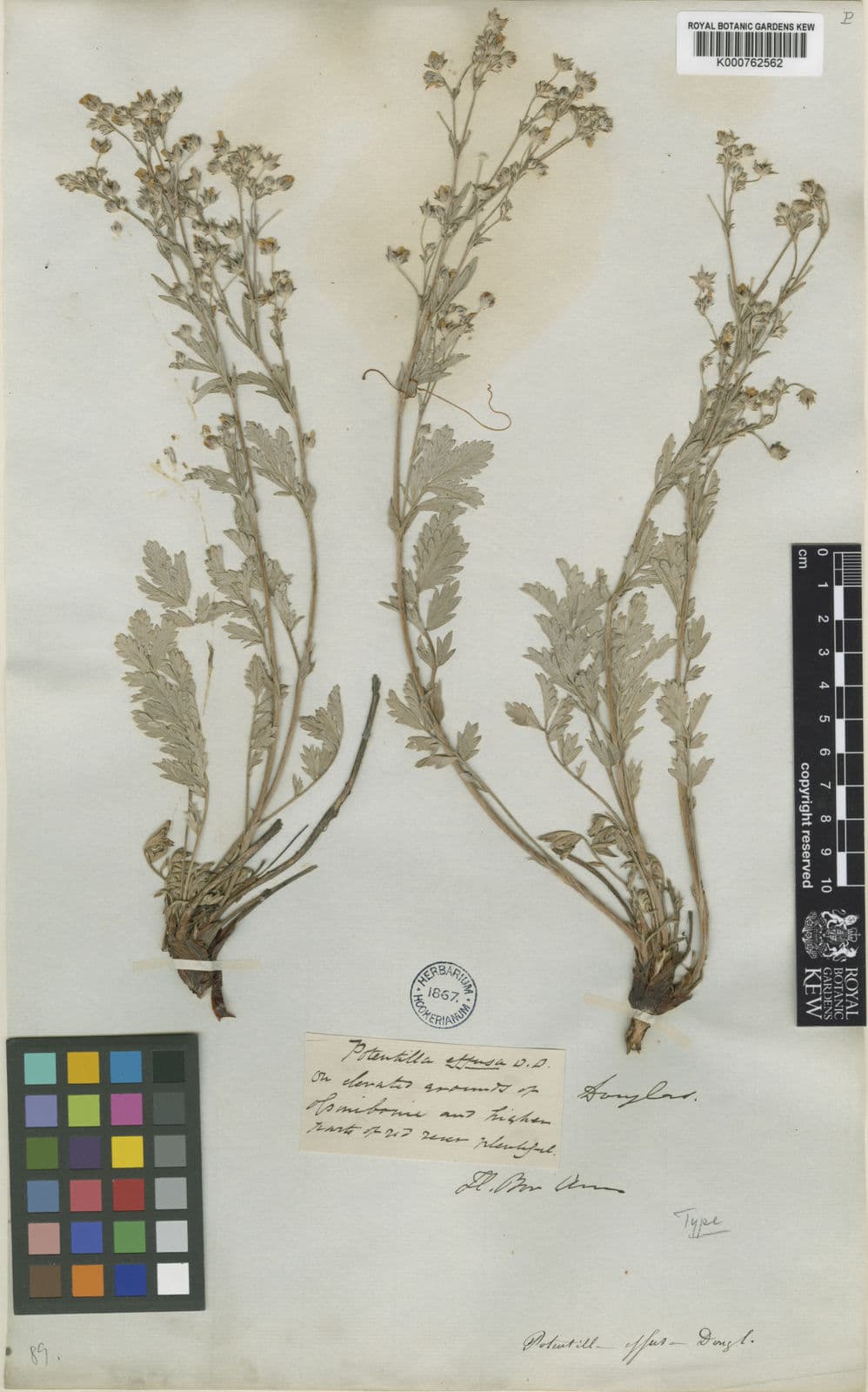
Potentilla effusa: complete guide
Potentilla effusa
¿Quieres ver Potentilla effusa: complete guide en tu jardín?
1 minuto, sin tarjeta de crédito
Overview
Potentilla effusa, commonly known as branched cinquefoil, is a graceful, spreading perennial from the dry regions of central and western North America. This member of the rose family (Rosaceae) creates loose, dispersed mats of finely divided, green foliage with prolific yellow flowers that bloom for months. The plant is remarkably versatile: equally at home in rock gardens, dry borders, under-plantings beneath shrubs, or in containers.
The name "effusa" references the plant's spreading, outward-flowing growth habit. This is an elegant plant that thrives on neglect and rewards you with years of reliable, carefree performance.
Appearance and Bloom
Potentilla effusa grows as a loose, spreading mat of fine-textured, grayish-green foliage. The leaves are compound, with three to five leaflets per leaf, each leaflet bearing soft, rounded teeth. This creates a delicate, lacy appearance throughout the growing season.
Flowers are the plant's main ornamental feature: numerous yellow blooms (occasionally with orange tinges) about one inch in diameter, profusely produced from June through September, often extending into October in favorable years. Because they're held well above the foliage, they create strong visual impact despite their small size.
Following bloom, inconspicuous achenes develop. In mild winters, the plant maintains green foliage year-round in frost-free zones; in cold climates, it dies back partially or completely depending on winter severity.
Ideal Location
Branched cinquefoil performs best in full sun to dappled light. Ideally six to eight hours of direct sunlight daily, though it tolerates some afternoon shade, especially in hot climates where such relief is beneficial.
The plant fits beautifully in dry borders, alpine gardens, between pavers, along pathways, in scree gardens, and in containers (with excellent drainage). It's quite wind-tolerant and isn't harmed by moderate wind exposure.
Avoid dense shade and persistently wet locations. This is fundamentally a plant of open, well-lit spaces.
Soil
Similar requirements to other Potentilla species: gently draining, not overly moist soil. Heavy clay is problematic; sandy loam to gravelly loam is ideal. pH range 6.0-7.5.
If your soil is very heavy, incorporate a mixture of 40% coarse sand, 30% gravel or grit, and 30% garden soil or loam. Avoid water-retentive amendments like peat moss or coir moss.
Soil should be moderately fertile but not over-rich; over-fertile soil promotes excessive foliage at the expense of flowers. Minimal annual feeding or no feeding at all is appropriate.
Watering
Once established (six to eight weeks after planting), watering can be substantially reduced. During normal rainfall periods, no supplemental water is needed. During extended drought (more than three weeks without rain), provide deep watering, then allow soil to dry again.
In container culture, monitor moisture carefully: water only when the top inch of soil becomes dry. In very hot weather, containers may require daily watering.
Excessive moisture is the plant's primary killer: err on the dry side rather than the wet side.
Pruning
Remove dead or yellowed stems in early spring (March-April). Optionally, you may deadhead faded flowers for neater appearance, but this is not essential for plant health or vigor.
In fall (October-November), carefully comb or prune out dead foliage to improve appearance and air circulation. The plant grows naturally compact and requires no heavy pruning.
Diseño gratis
¿Quieres ver Potentilla effusa: complete guide en tu jardín? Crea un diseño gratis ahora.
Maintenance Calendar
January-February: Monitor for frost damage after severe cold. Protection against freeze injury is rarely necessary but may be beneficial in very harsh climates.
March-April: Remove dead stems. Growing season begins.
May-June: First flowers appear. Ensure soil doesn't dry completely if spring drought occurs.
July-September: Peak blooming period. Monitor for drought stress; water as needed.
October-November: Blooming decreases; plant prepares for dormancy.
December-January: Dormant period. No watering or feeding required.
Winter Hardiness
Potentilla effusa is moderately cold-hardy, tolerating temperatures to -30°C (-22°F) in USDA zones 4-8. This means it survives most North American winters without special protection. Severe winters may cause partial leaf loss, but plants typically recover in spring.
In wet winter conditions, root rot is possible; excellent drainage is the best insurance against winter loss.
Companion Plants
This plant creates attractive combinations with:
- Other drought-tolerant perennials: Artemisia, Dianthus, Salvia
- Low-growing conifers: Juniperus horizontalis species
- Ornamental grasses: Festuca ovina, Stipa varieties
- Low aromatic herbs: Creeping thyme, Santolina
- Stonecrop (Sedum) varieties
- Rock and gravel as contrast
Propagation
Potentilla effusa can be propagated by division or by seed. Division is best carried out in early spring (March-April) or in fall (September-October), when the plant isn't in full bloom. Dig up the plant, split the root mass into sections 5 to 10 centimeters across with adequate roots, and replant immediately.
Seed is collected in late summer once the small fruits ripen. Sow into a light, free-draining seed mix; germination typically takes three to five weeks at 15 to 20 degrees Celsius. Young seedlings grow slowly in their first season and usually don't flower until the second year.
Because few named cultivars of this species are commercially available, the straight botanical species is what's typically sold. Garden centers may carry young plants in 9 to 11 centimeter pots, especially in spring.
Pests and Diseases
Potentilla effusa is a tough plant that rarely suffers seriously from pests or diseases. Aphids occasionally appear on young shoots in spring (April-May), usually well controlled with a strong jet of water or by letting natural predators such as ladybirds do their work.
Powdery mildew can develop in humid, stagnant conditions with poor air circulation, recognizable by a white, powdery coating on the leaves. Ensure adequate spacing between plants (at least 30 to 40 centimeters) to promote air circulation, and remove affected leaves promptly.
The biggest threat remains root rot in constantly moist, poorly drained soil. Always ensure excellent drainage, especially in heavy clay soil, and avoid overwatering, particularly during the winter months.
For persistent aphid problems, a light neem oil treatment applied in the early morning or evening helps while sparing beneficial insects such as ladybirds. Check plants regularly in May and June, when bloom peaks, to catch issues early before they spread.
Closing
Potentilla effusa is an underrated beauty offering remarkable returns for minimal investment. This branched cinquefoil blooms abundantly, fits into multiple garden styles, and asks very little. Perfect for those seeking naturalistic, relaxed garden aesthetics. Find young plants at quality nurseries.
For optimal cultivation advice and region-specific recommendations, consult gardenworld.app where experts provide personalized design guidance - gardenworld.app helps ensure this plant thrives in your specific climate zone. Give it a try and discover why this plant deserves wider recognition.
¿Quieres ver Potentilla effusa: complete guide en tu jardín? Crea un diseño gratis ahora.
Sube una foto, elige un estilo y obtén un diseño fotorrealista con lista de plantas en menos de un minuto.
Más de 10.000 jardines diseñados
Sin tarjeta de crédito


Plantas similares
Potentilla bipinnatifida: complete guide
Potentilla bipinnatifida
The tansy cinquefoil is a robust flowering plant from North America's mountains. Discover cultivation details, ideal locations, and care essentials.
Potentilla hookeriana: complete guide
Potentilla hookeriana
Hooker's cinquefoil is a compact alpine plant perfect for rock gardens. Learn cultivation of this specialist mountain beauty.
Potentilla ovina: complete guide
Potentilla ovina
The sheep cinquefoil is a robust alpine perennial from mountain meadows. Learn its culture and care essentials.