
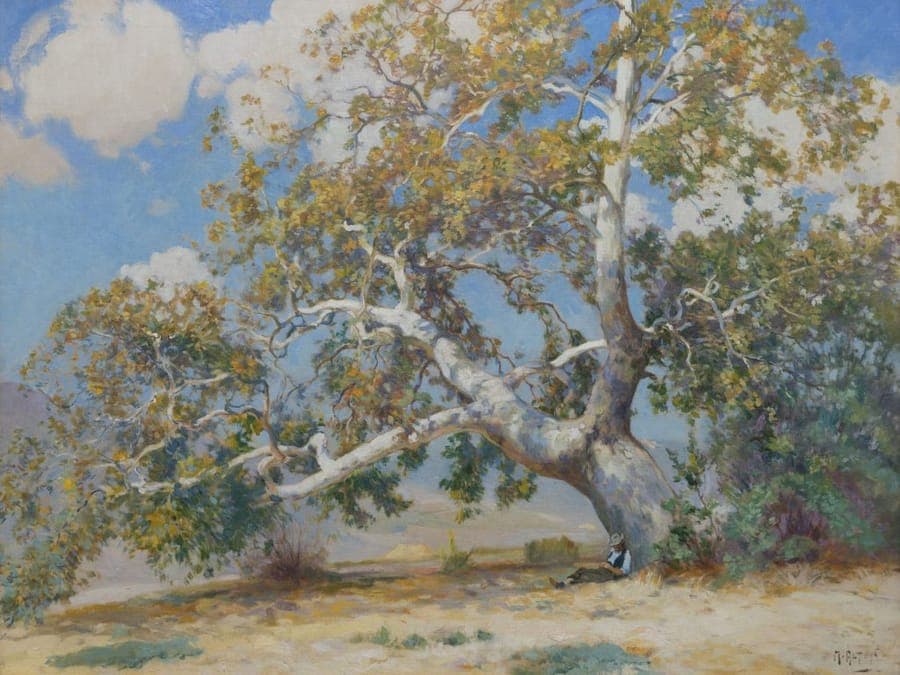
Mathias Alten / Public domain, via Wikimedia Commons
Platanus racemosa: complete guide
Platanus racemosa
¿Quieres ver Platanus racemosa: complete guide en tu jardín?
1 minuto, sin tarjeta de crédito
Overview
Platanus racemosa, commonly known as California sycamore or Western sycamore, is a large, majestic deciduous tree native to California and northern Mexico. Part of the Platanaceae family, it's renowned for its striking, scaly bark that sheds in flakes, revealing a patchwork of white, gray, and brown. This tree reaches 15-25 meters tall and is excellent for landscape planting in Mediterranean climates, providing excellent shade.
Appearance and Bloom
Platanus racemosa is a large, sturdily built deciduous tree with a rounded crown and thick branches. The leaves are deeply lobed, approximately 10-15 centimeters, with fresh green appearance and coarse texture. The tree is deciduous and displays attractive autumn coloring. The flowers are small and inconspicuous, but the seed balls are striking brown spheres, about 2-3 centimeters in diameter, hanging from long stalks and persisting long on the tree. The bark is the most distinctive feature, exfoliating in irregular patches.
Ideal Location
Platanus racemosa grows best in full sun locations with at least six hours of direct sunlight daily. The tree tolerates partial shade but grows more compactly in full sun. This tree is highly adaptable to various conditions and withstands strong winds well. Planting positions in open spaces with good air circulation are ideal. The tree grows well in urban environments where it tolerates pollution.
Soil
Platanus racemosa grows in virtually all soil types, including heavy clay and sandy soils. The tree prefers moist soils but becomes fairly drought-tolerant once established. Good drainage is important, especially at planting; avoid completely waterlogged conditions. The tree grows in poor to fertile soils. Neutral to slightly alkaline pH is fine. The tree is highly adaptable to urban soil and pollution.
Watering
Once planted, this tree needs regular water until well-established, usually two seasons. Keep soil moist the first year and gradually reduce. Mature trees are fairly drought-tolerant once rooted, especially in the western US where it naturally occurs. In dry years, extra watering helps growth. Avoid waterlogging. Newly planted trees benefit from mulching.
Diseño gratis
¿Quieres ver Platanus racemosa: complete guide en tu jardín? Crea un diseño gratis ahora.
Pruning
Pruning is minimal for health but can be done to maintain shape. Remove dead or diseased branches immediately. The tree forms a natural attractive shape. Heavy pruning during growth can be done in winter. For urban planting, low pruning of lower branches can be valuable for sight lines and foot traffic. Avoid pruning in warm weather when disease spores are active.
Maintenance Calendar
Spring (March-May): Plant young trees preferably in early spring. Provide plenty of water and mulch. Summer (June-August): Water regularly during dry periods. Maintain mulch. Autumn (September-October): Gradually reduce watering. Collect seed balls if desired. Winter (November-February): Tree is dormant. Light pruning possible.
Winter Hardiness
Platanus racemosa is hardy to approximately minus 8 degrees Celsius. In zones 8-11 it grows without protection. In zone 7 it can grow in sheltered locations. In cold regions this tree should not be planted. The tree tolerates frost periods well but prefers milder climates where it naturally occurs.
Companion Plants
Platanus racemosa works beautifully as a solitary specimen or as group planting. Underplanting can be done with drought-tolerant groundcovers like arctostaphylos and salvias. The tree combines well with other native California plant species. Partner with other large canopy trees for dramatic effect in large landscapes.
Summary
Platanus racemosa is a spectacular native tree that adds majesty and character to any garden. With its striking patterned bark, fine foliage, and dramatic seed balls, this tree deserves a prominent place. Perfect as a shade tree in Mediterranean climates, this tree promises decades of growth and beauty. For lovers of native plants and nature-friendly gardens, this California sycamore is essential.
Find sycamore trees at specialty tree nurseries. Consult gardenworld.app/en for tree advice. Visit gardenworld.app/en for daily garden inspiration.
¿Quieres ver Platanus racemosa: complete guide en tu jardín? Crea un diseño gratis ahora.
Sube una foto, elige un estilo y obtén un diseño fotorrealista con lista de plantas en menos de un minuto.
Más de 10.000 jardines diseñados
Sin tarjeta de crédito


Plantas similares
Mexican Plane: complete guide
Platanus mexicana Moric.
Discover the Mexican Plane (Platanus mexicana), a magnificent shade tree with striking bark and broad canopy. Learn cultivation, care and landscape use.
Buttonball: complete guide
Platanus occidentalis
Platanus occidentalis is a colossal tree famed for its enormous leaves and distinctive marbled bark. Learn cultivation and maintenance tips for this giant specimen.
London planetree: complete guide
Platanus acerifolia
A full guide to growing and caring for the London planetree: ideal conditions, pruning, soil, and companion plants for this majestic urban tree.