
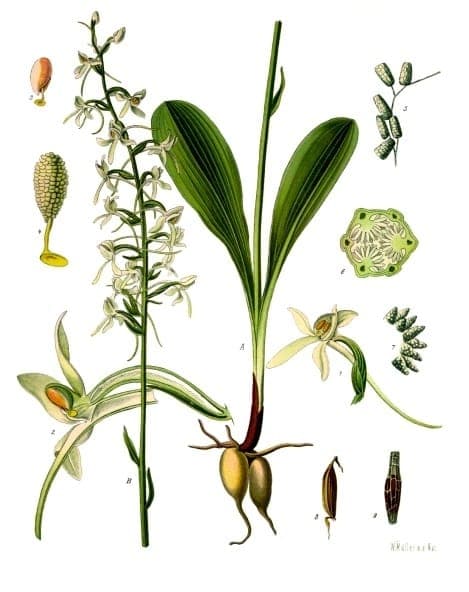
Franz Eugen Köhler, Köhler's Medizinal-Pflanzen / Public domain, via Wikimedia Commons
Lesser Butterfly-Orchid: complete guide
Platanthera bifolia
¿Quieres ver Lesser Butterfly-Orchid: complete guide en tu jardín?
1 minuto, sin tarjeta de crédito
Overview
Lesser butterfly-orchid (Platanthera bifolia) is a captivating, protected orchid thriving from Europe to Mongolia in natural woodland edges, moist meadows, and damp woodlands. This plant enchants orchid enthusiasts: with two characteristic basal leaves and fragrant white flowers, it's a classic natural beauty. Cultivation in gardens requires patience and knowledge, but rewards are rare and precious.
Appearance and Bloom
Lesser butterfly-orchid forms two large, green basal leaves (10-20 cm long) from which a slender flower stem rises to 25-40 cm. From May to July, characteristic white flowers appear in a dense spike - small yet powerfully fragrant, especially evenings. Each floret has two long, thin spurs underneath, giving the plant its common name. After flowering, seed pods form containing extremely fine seeds. The plant dies back after seed-set and re-emerges from small tubers next spring.
Ideal Location
Lesser butterfly-orchid wants partial shade - about 3-4 hours of gentle morning sunlight, no harsh midday sun. In full shade it grows but won't flower. In full sun foliage scorches. Ideally plant under light deciduous trees (elm, birch) with dappled light. The plant tolerates windy spots if moisture remains adequate. Very dry, windy locations are unsuitable.
Soil
This is crucial: lesser butterfly-orchid demands very well-draining, moist to normally moist soil rich in organic matter. The plant grows best in humus-rich woodland soil with high moss and leaf litter content. pH should be slightly acidic to neutral (5.5-7.0). In gardens, amend regular soil with up to 50% rotted leaves, birch bark, or orchid mix. Avoid heavy clay or pure sand. Good drainage is essential - stagnation causes root disease and fungal issues. Add no artificial fertilizers.
Watering
Moisture is critical and must be constantly monitored. During growth (April-May), soil must stay evenly moist, not waterlogged. Water carefully, preferably with rainwater, so moisture penetrates uniformly. In summers (June-July after blooming) slightly drier is acceptable, but never completely dry. In containers monitor regularly - keep growing medium consistently moist. In very dry summers, one weekly watering helps. However, stagnation is equally harmful as drought - always ensure drainage.
Diseño gratis
¿Quieres ver Lesser Butterfly-Orchid: complete guide en tu jardín? Crea un diseño gratis ahora.
Pruning
No pruning applies. Leave flower stems after blooming so seed ripens and falls. In August-September when foliage dies back, gently remove it. Damaged leaves may be removed immediately. Faded flower stems can be cut in September. Ensure underground tubers remain intact.
Maintenance Calendar
January-February: Plant dormant; check drainage. March-April: Plant from pots; intensively monitor moisture. May-June: Monitor moisture; allow flowers to develop. July-August: Seeds ripen; gradually reduce watering. August-September: Remove dead foliage; seeds fall. October-November: Plant dormant; maintain light moisture. December: Protect container tubers against frost.
Winter Hardiness
Lesser butterfly-orchid is very hardy to -15 to -20 degrees Celsius in well-drained soil. In pots be more cautious - ensure somewhat drier winter conditions and protect against prolonged wet periods. Snow isn't problematic. In very dry winters, tubers may desiccate - add minimal, careful moisture. Young plants in first two years deserve protection with dry leaf mulch.
Companion Plants
Lesser butterfly-orchid fits shade borders with other delicate flowers: dwarf daffodils, scilla, chionodoxa, and other woodland flora. In woodland edges combine with native humus-rich groundcovers: wood sorrel, ivy, evergreen ferns. Avoid vigorous spreaders claiming space - lesser butterfly-orchid is delicate and needs quiet companions.
Closing Thoughts
Lesser butterfly-orchid isn't for beginner gardeners, but for patient ones who enjoy delicate natural beauty. This protected orchid proves wild, valuable flowers can be cultivated with patience and care. Obtaining seeds or plants can be challenging - work with specialty orchid retailers or conservation groups. Gardenworld.app helps design shade-border combinations. Give lesser butterfly-orchid a safe place in your garden and you'll be rewarded with fragrant, delicate blooms that countless insects will visit.
¿Quieres ver Lesser Butterfly-Orchid: complete guide en tu jardín? Crea un diseño gratis ahora.
Sube una foto, elige un estilo y obtén un diseño fotorrealista con lista de plantas en menos de un minuto.
Más de 10.000 jardines diseñados
Sin tarjeta de crédito


Plantas similares
Greater Butterfly-Orchid: complete guide
Platanthera chlorantha
Greater butterfly-orchid is impressive woodland orchid with green-yellow flowers and fragrance. Thrives in partial shade and humus-rich forest soils. Learn cultivation, positioning, and protection of this rare plant.
Orchis militaris: complete guide
Orchis militaris
Military orchid with rosy-pink flowers blooming May-June. Extremely hardy and ideal for sunny grassland.
Broadleaf helleborine: complete guide
Epipactis helleborine
Everything you need to grow Epipactis helleborine: ideal conditions, watering, soil needs, and companion plants. Perfect for shaded, moist garden spots.