
Debate / PD, via Wikimedia Commons
Pittosporum undulatum: complete guide to Australian cheesewood
Pittosporum undulatum
¿Quieres ver Pittosporum undulatum: complete guide to Australian cheesewood en tu jardín?
1 minuto, sin tarjeta de crédito
Overview
Pittosporum undulatum, commonly known as Australian cheesewood or wave-leaf pittosporum, is an elegantly growing shrub to small tree originating from southeastern Australia. This species belongs to the Pittosporaceae family and is highly valued for its glossy, decoratively wavy foliage and subtle, fragrant white flowers. With its natural grace and versatility in Mediterranean and temperate climates, Pittosporum undulatum is a popular choice for modern, low-maintenance gardens throughout Europe.
This plant grows continuously during the growing season, forming a full, compactly built shrub that becomes increasingly elegant as it matures. It's particularly attractive in small to medium gardens where vertical structure or privacy screening is desired. Pittosporum undulatum offers both functional advantages (windbreak, bird food) and aesthetic value (fragrant flowers, interesting foliage).
Appearance and Bloom
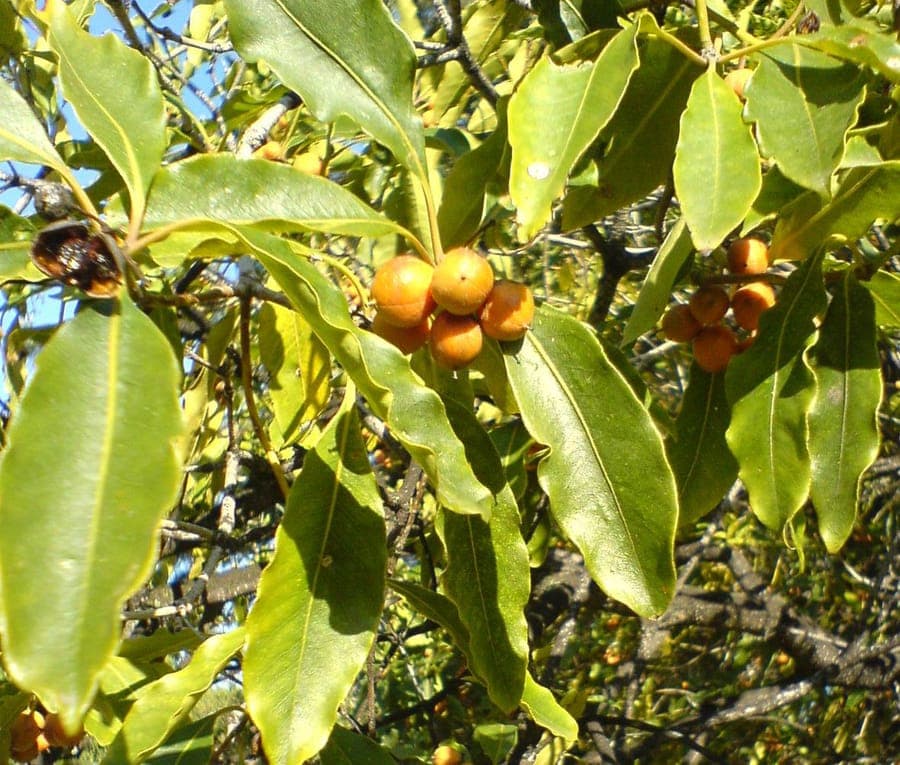
Pittosporum undulatum possesses arguably the most interesting foliage of all pittosporum species. The leaves are lance-shaped to reverse lance-shaped, approximately 5-10 cm long and notably wavy along the margins, hence the name 'undulatum'. The foliage is dark green, almost glossy, offering striking contrast with lighter-colored new growth. This leaf structure makes Pittosporum undulatum immediately recognizable in the garden.
Flowers appear in dense clusters at the tips of young branches in spring through early summer. These are small, approximately 0.5-1 cm in diameter, and white to creamy yellow colored. Their primary attraction is their strong, honey-like fragrance, which is particularly intense in the evening. This scent attracts bees and other pollinators, making this plant valuable for pollinator-friendly gardens.
Following bloom, small orange to yellow fruits develop that persist on the plant for extended periods, providing bird food value. These fruits ripen slowly and provide winter ornamental interest.
Ideal Location
Pittosporum undulatum thrives in full sun to half-shade, with minimum 4-6 hours of direct sun for optimal growth and flowering. In deeper shade, the plant grows more slowly and flowering may be less prolific. Sun exposure also helps achieve deeper foliage coloration.
Wind tolerance is a major strength. Pittosporum undulatum is far more wind-resistant than many other Mediterranean shrubs, making it a preferred choice for coastal gardens and windswept locations. The plant tolerates both coastal salt winds and mountain winds exceptionally well.
Beyond wind situations is moisture excellence. This plant performs superbly in dry summers once established and tolerates moderate drought readily. This makes it ideal for water-conscious gardens and areas with limited rainfall.
Soil
Pittosporum undulatum is not particularly fussy about soil types but performs best in well-drained, lightly acidic to neutral soils with pH 5.5 to 6.5. The plant tolerates poor soils well and requires no rich feeding. Improvement of soil qualities is, however, rewarded with better growth and fuller foliage.
Drainage is critical. Poorly drained soils can cause root rot, especially during winters with significant rainfall. Heavy clay soil can be improved with organic matter prior to planting, but sandy and loamy soil work perfectly. The plant is extremely salt-tolerant, making it suitable for coastal gardens.
Diseño gratis
¿Quieres ver Pittosporum undulatum: complete guide to Australian cheesewood en tu jardín? Crea un diseño gratis ahora.
Watering
Once established (after 12-18 months), Pittosporum undulatum requires minimal water. For newly planted specimens, however, regular water is essential, especially in the first season. Provide approximately 1-2 inches (2.5-5 cm) of water weekly in warmer seasons, less in cold winters.
Mature plants tolerate moderate drought well. During normal rainfall, supplemental irrigation is rarely needed, except in exceptionally dry years. In Mediterranean summers, limited watering can promote flowering.
Mulching with 3-4 inches (7.5-10 cm) of organic material around the base helps moisture retention and promotes healthier root environment. Leave 2-3 inches clear around the stem to prevent rot.
Pruning
Pittosporum undulatum naturally develops an attractive, full form and therefore requires little formative pruning. The plant, however, tolerates pruning exceptionally well and is even improved by light pruning work.
Light pruning in late spring (May-June) after flowering helps keep the plant compact and encourages denser foliage for future seasons. Remove all dead, diseased, or damaged branches at any time. If formation of height limitation is needed (for example, to train a shrub into tree form), conduct this gradually.
Pittosporum undulatum tolerates heavy pruning well and can even be cut back to the ground and will resprout vigorously; this makes it suitable for intensive pruning programs where other plants would not be appropriate.
Maintenance Calendar
Spring (March-May): Light pruning after bloom. Check for insect damage. Replenish mulch.
Summer (June-August): Water during dry periods. Deadheading spent flowers encourages further bloom. Monitor for mealybugs and other scale insects.
Fall (September-October): Prepare for winter. No feeding usually needed. Rain harvesting can help if drought occurs.
Winter (November-February): Protection in very cold regions may be needed. In temperate climates minimal maintenance. Prune damaged branches as needed.
Winter Hardiness
Pittosporum undulatum is suitable for temperate climates but not extremely frost-resistant. It grows best in USDA zones 9 to 11, though young plants can overwinter in protected zone 8. In cold zone 7, winter protection against northeast exposure and windy situations is essential.
Frost damage manifests typically as leaf margin burn and twig death. Very young transplants are more frost-sensitive; establishment after one month of planting helps hardiness. Avoid planting just before hard frost periods.
Companion Plants
Pittosporum undulatum combines well with other Mediterranean shrubs such as Rosmarinus officinalis (rosemary) and Cistus species (rock rose). Complementary partners include Arbutus unedo (strawberry tree) for red foliage contrast, Olearia paniculata (daisy bush) for white flowers, and Choisya ternata (Mexican orange blossom) for aromatic foliage.
Full-sun groundcovers such as Thymus vulgaris (garden thyme) and Lithodora diffusa fit perfectly. For foliage contrast, try feathery Artemisia species or structural Phormium tenax (New Zealand flax).
Closing
Pittosporum undulatum deserves recognition as a versatile, maintenance-friendly shrub for Mediterranean gardens and coastal situations. With its elegantly wavy foliage, fragrant spring flowers, and minimal water needs once established, it offers years of beauty with minimal input. Seek inspiration on gardenworld.app for more Mediterranean planting schemes. Visit your local garden center for quality plants and expert advice on your garden project.
Whether you seek a privacy screen, bird food source, or pure aesthetic value, Pittosporum undulatum delivers all. Head to gardenworld.app and start your garden transformation today.
¿Quieres ver Pittosporum undulatum: complete guide to Australian cheesewood en tu jardín? Crea un diseño gratis ahora.
Sube una foto, elige un estilo y obtén un diseño fotorrealista con lista de plantas en menos de un minuto.
Más de 10.000 jardines diseñados
Sin tarjeta de crédito


Plantas similares
Pittosporum eugenioides: complete guide
Pittosporum eugenioides
Pittosporum eugenioides (lemonwood) is a New Zealand hedging plant with glossy leaves. Learn siting, pruning and winter protection.
Pittosporum phillyreoides: complete guide
Pittosporum phillyreoides
Pittosporum phillyreoides is an Australian weeping tree for dry gardens. Discover siting, soil needs and winter protection tips.
Pittosporum senacia: complete guide
Pittosporum senacia
Pittosporum senacia is a glossy-leaved evergreen from the Mascarene Islands. Learn its location, soil and container overwintering needs.