
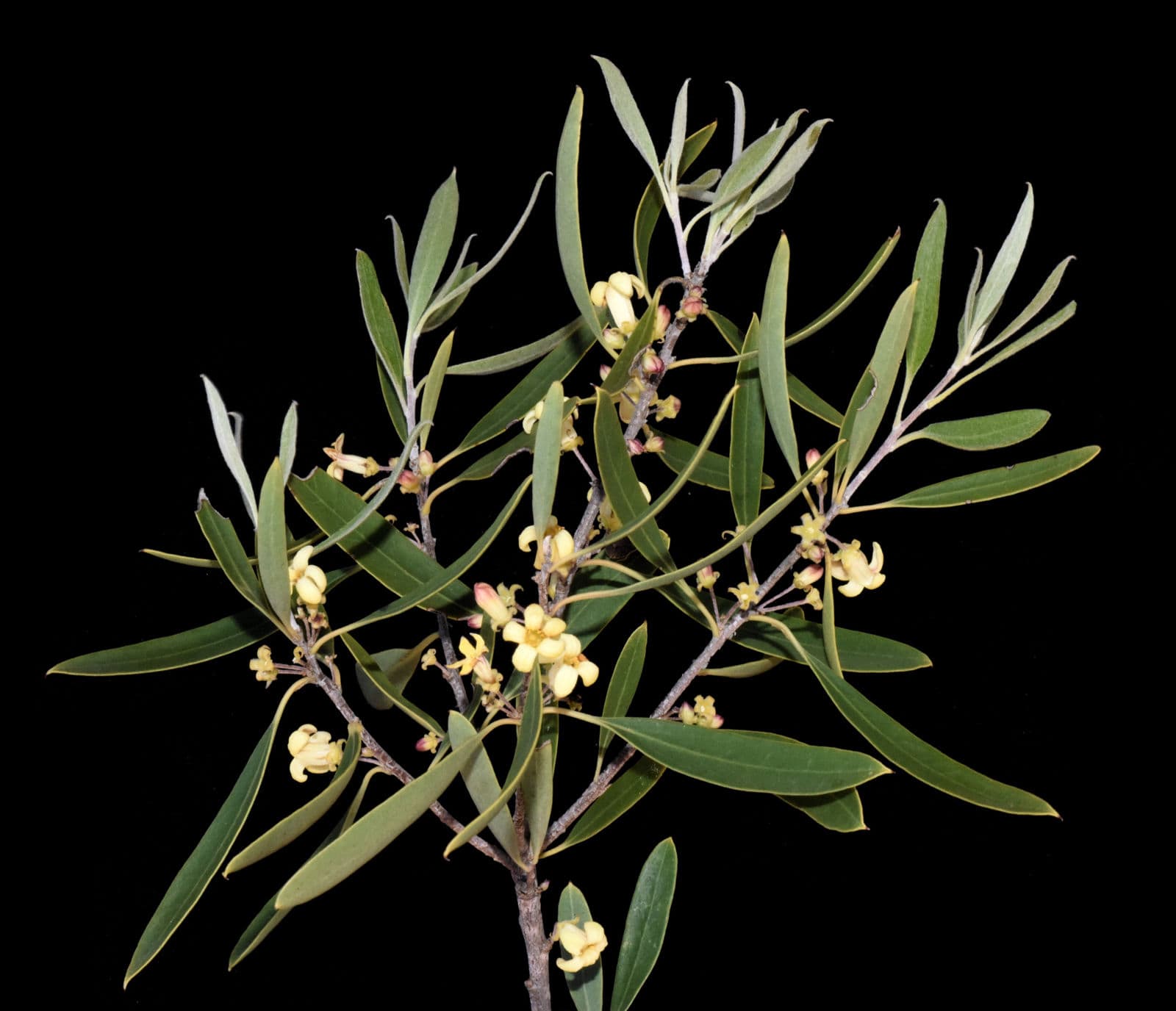
Pittosporum phillyreoides: complete guide
Pittosporum phillyreoides
¿Quieres ver Pittosporum phillyreoides: complete guide en tu jardín?
1 minuto, sin tarjeta de crédito
Overview
Pittosporum phillyreoides, commonly known as desert willow or willow pittosporum, is an evergreen small tree or large shrub in the family Pittosporaceae. The species is native to the arid interior of Australia, growing across New South Wales, the Northern Territory, Queensland, South Australia, Victoria and Western Australia in places where few other woody plants survive.
The tree has a strikingly weeping, willow-like growth habit that explains the common name desert willow, though the plant bears no botanical relation to true willows. On gardenworld.app, this species is often recommended for gardens embracing xeriscaping: water-conscious, drought-resilient garden design.
Appearance and bloom
The narrow, linear leaves are 5 to 10 cm long, light green to grey-green, hanging gracefully from drooping, weeping branches. This gives the tree a soft, almost ethereal appearance that contrasts strongly with the plant's tough, drought-resistant nature.
In spring, from September through November in Australia (corresponding to March through May under greenhouse cultivation in Europe), small, fragrant yellow flowers appear. Following bloom, woody orange seed capsules develop that split open to reveal sticky, orange-red seeds, explaining the botanical name Pittosporum, meaning pitch seed.
Ideal location
Pittosporum phillyreoides requires a very sunny, warm spot. The plant is ideally suited to dry gardens, gravel gardens and Mediterranean-style planting schemes where little water is available.
In the Netherlands, Belgium and Germany, this tree is almost exclusively grown in large containers or in a sheltered, exceptionally well-drained border. In the south of France, with its drier, Mediterranean climate, a permanent outdoor position is more feasible.
Soil
This Pittosporum tolerates exceptionally poor, rocky and even slightly saline soil, with a pH between 6.0 and 8.5. Good drainage is the single most important requirement: the plant develops a deep taproot that absolutely cannot tolerate stagnant water.
Avoid rich, moisture-retentive potting soil; instead, mix a growing medium with 40 to 50 percent coarse sand or grit. Additional fertilizing is rarely needed and can even weaken growth.
Watering
Young plants need moderate, regular watering during their first year after planting to develop a strong root system. Let the soil dry out well between waterings.
Once established, Pittosporum phillyreoides is extremely drought-tolerant and needs almost no supplemental water, even in hot summers. Overwatering is the leading cause of death for this species, especially in heavy or moisture-retentive soil.
Pruning
This tree naturally needs little pruning thanks to its elegant, weeping form. Remove dead or damaged branches as needed, preferably in late winter (February) before new growth begins.
Young specimens can be lightly shaped to encourage a desired trunk height or crown form. The plant tolerates renovation pruning reasonably well, though growth is slow, so recovery after heavy pruning takes several seasons.
Maintenance calendar
February: possible formative pruning and removal of dead branches.
March-May: flowering with fragrant yellow blooms (under greenhouse cultivation in Europe).
June-August: active growth period; minimal watering during extreme drought.
September-October: seed capsules ripen and split open.
November-January: dormant period; protect container plants against frost.
Diseño gratis
¿Quieres ver Pittosporum phillyreoides: complete guide en tu jardín? Crea un diseño gratis ahora.
Winter hardiness
Pittosporum phillyreoides is less winter hardy than its cousin Pittosporum eugenioides, with a limit of roughly USDA zone 9, or briefly down to about -5 to -7C. In the Netherlands, Belgium and most of Germany, the plant overwinters best in a frost-free conservatory or greenhouse.
Only in the very mildest, driest regions of southern France is a permanent outdoor position with winter fleece and shelter against a south-facing wall feasible. For gardeners in colder regions, growing the tree in a large terracotta or plastic pot with wheels is a practical solution: the tree can then stand outside on the patio in summer and be easily moved to a frost-free garage or conservatory in winter. This approach is widely used for Mediterranean container gardens in the Netherlands and Belgium, where olive trees and citrus plants overwinter the same way.
Companion plants
In dry, gravel-based garden design, Pittosporum phillyreoides pairs beautifully with Olearia phlogopappa, rock rose (Cistus) and ornamental grasses. Other Australian native species such as Eucalyptus and Acacia reinforce the theme of a drought-resilient, Mediterranean-style garden.
Specialty nurseries focused on Mediterranean and Australian plants are the easiest place to find this species; standard garden centers such as Intratuin or Gamma rarely stock the plant.
Garden uses
Pittosporum phillyreoides plays an important ecological role in its natural habitat. The sticky, resinous seeds and foliage provide food for various bird species and insects across the arid Australian interior. Aboriginal communities traditionally used parts of the tree for various purposes, including using the soft wood for tools.
In modern, water-conscious garden design, the tree is especially valued for its sculptural, weeping silhouette, which forms an interesting element in the border year-round even without bloom. As a specimen in a gravel garden, the tree often draws all the attention, particularly when positioned against a light-colored wall or open sky.
Combine the tree with other structural plants such as agave, opuntia or ornamental grasses for a contemporary, drought-resilient garden design. Because growth is slow, the tree remains compact enough for smaller gardens, and even large containers on a sunny patio, for many years.
Propagation
In practice, Pittosporum phillyreoides is propagated almost exclusively from seed, since cuttings of this species root poorly. Soak the seed in warm water for 24 hours or lightly treat it with sandpaper (scarification) to break the hard seed coat. Sow in a well-draining seed mix of sand and compost at 18 to 22 degrees Celsius; germination usually takes 3 to 6 weeks but can be erratic. Young seedlings grow slowly during their first two years and should only be permanently transplanted to their final sunny position after this period.
Pests and diseases
Pittosporum phillyreoides is an exceptionally robust species with virtually no significant diseases, thanks to its adaptation to extreme, dry conditions. The greatest risk is root rot in overly moist or poorly drained soil; this is almost always preventable with the right, exceptionally well-draining soil. Scale insects can occasionally occur on young shoots under greenhouse cultivation, recognizable by small brown scales; a paraffin-oil-based insecticide usually resolves this quickly. In its natural, arid environment, the plant has virtually no significant natural enemies.
Closing
With its graceful, weeping branches and exceptional drought tolerance, Pittosporum phillyreoides is a unique choice for the water-conscious garden. On gardenworld.app you can explore how this Australian tree fits within a drought-resilient garden design, alongside other xeriscaping plants. For anyone seeking a low-maintenance, characterful specimen for a sunny, dry spot, this desert willow is a surprisingly elegant option.
¿Quieres ver Pittosporum phillyreoides: complete guide en tu jardín? Crea un diseño gratis ahora.
Sube una foto, elige un estilo y obtén un diseño fotorrealista con lista de plantas en menos de un minuto.
Más de 10.000 jardines diseñados
Sin tarjeta de crédito


Plantas similares
Pittosporum eugenioides: complete guide
Pittosporum eugenioides
Pittosporum eugenioides (lemonwood) is a New Zealand hedging plant with glossy leaves. Learn siting, pruning and winter protection.
Pittosporum senacia: complete guide
Pittosporum senacia
Pittosporum senacia is a glossy-leaved evergreen from the Mascarene Islands. Learn its location, soil and container overwintering needs.
Pittosporum crassifolium: complete guide to Karo
Pittosporum crassifolium
Karo is a New Zealand shrub with thick leaves and dark foliage. Discover cultivation, care and shaping possibilities.