
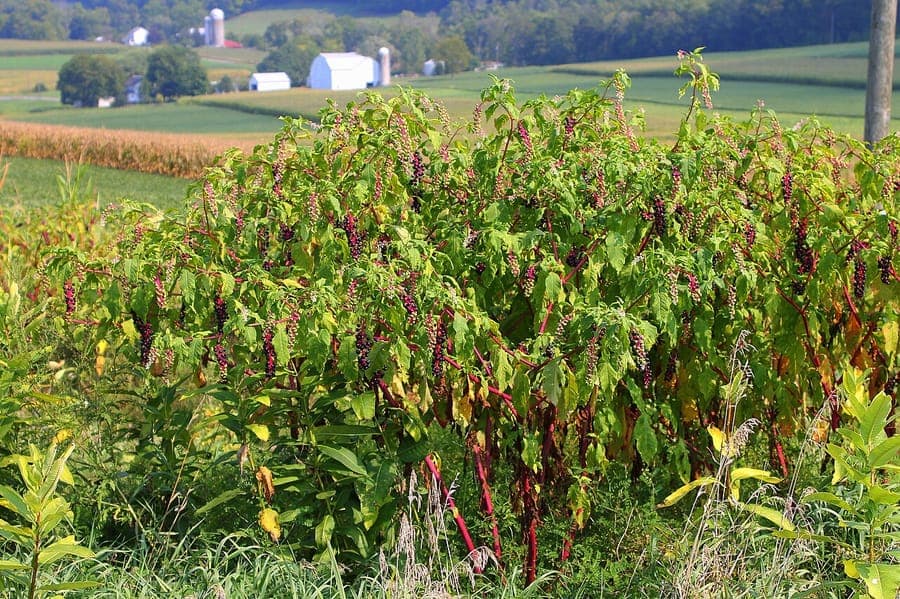
Jakec / CC BY-SA 4.0, via Wikimedia Commons
Phytolacca americana: complete guide
Phytolacca americana
¿Quieres ver Phytolacca americana: complete guide en tu jardín?
1 minuto, sin tarjeta de crédito
Overview
Phytolacca americana, also known as Pokeberry, Pokewood, Pigeonberry, or American Pokeweed, is a highly distinctive perennial plant from eastern North America. This is a botanical spectacle plant for gardeners seeking boldness in their front garden. The plant is a genuine attention-getter due to its massive growth and spectacular purple-black berries.
The plant is celebrated for its vigorous growth (reaching 2-3 meters in height), large greenish-red foliage, and especially its striking clusters of red fruit that gradually turn purple-black. Phytolacca americana is somewhat "wild" in appearance, but this is precisely its charm. The plant attracts birds and is botanically fascinating.
From gardenworld.app: A front garden featuring Phytolacca americana gains immediate drama and visual impact. This is not a subtle plant - this is a statement.
Appearance and Bloom
The leaves of Pokeberry are large, oblong-ovate, 8-15 centimeters long, glossy green, with distinctly visible red veins, particularly in young stages. Leaves grow alternately along thick, red-green stems. In autumn, foliage colors yellow to red.
Flower clusters appear from May through June in striking, slender racemes at the ends of branches. Flowers are small, approximately 5-8 millimeters across, white to pinkish colored. These flowers are quickly followed by the spectacular fruit.
Fruit forms rapidly after flowering. They start green, then turn red, and finally mature to deep purple-black. These berries grow in hanging clusters that are highly decorative. The fruit persists on the plant for extended periods.
Ideal Location
Phytolacca americana grows best in full sun locations, though the plant also performs well in half-shade. At least 4-5 hours of direct sunlight daily is ideal for maximum fruiting and foliage coloration.
The plant is highly adaptable and grows well in diverse environments. However, avoid very wet, boggy corners. The plant is not frost-sensitive and is very winter hardy. Protect against very strong wind that can damage large foliage.
Phytolacca americana works well as a background accent in borders, as a solo specimen in larger gardens, or as a dramatic accent in plantings.
Soil Requirements
Phytolacca americana is very flexible regarding soil types. The plant grows well in sand, loam, clay - as long as it's reasonably well-draining. Ideal pH ranges between 4.5 and 7.5. The plant tolerates mildly acidic to neutral soil.
Provide moderately fertile soil. The plant grows well in less fertile soils, though richer soil promotes larger growth. Add organic material when planting to improve water retention.
The plant also tolerates dry soil once established, so it is highly adaptable.
Diseño gratis
¿Quieres ver Phytolacca americana: complete guide en tu jardín? Crea un diseño gratis ahora.
Watering
Phytolacca americana requires moderate water during the growing season (March through October). Water regularly when soil feels dry, especially during very dry periods. Young plants in their first season need more regular watering.
In winter (November through February) watering can be drastically reduced. The plant is relatively drought-tolerant once established and can survive long dry periods.
Excessive water in winter is detrimental and can cause rot. Ensure good drainage.
Pruning
Phytolacca americana requires minimal pruning. The plant is used with full foliage as a statement plant.
Remove only dead, damaged, or drooping branches when they appear withered. You can also prune selectively in early spring (March) to maintain plant shape or limit growth.
Remove self-sown seedlings around the plant's base (birds scatter the seeds and young plants can grow anywhere).
Maintenance Calendar
March: Clean up front garden, remove all fallen branches. Check optional shaping. April-May: Foliage growth accelerates, water regularly. Flowering appears. June-August: Fruit formation peaks, continue regular watering for best fruit production. September-October: Fruit ripens to deep purple-black. Autumn foliage coloration appears. Reduce watering. November-February: Winter dormancy. Complete leaf drop. Plant dies back to ground in cold regions.
Winter Hardiness
Phytolacca americana is very winter hardy down to -15 to -20 degrees Celsius. In the Netherlands (USDA zone 8a) the plant is usually winter hardy, though aerial portions may die back in very severe winters. However, the plant usually regrows from the roots in spring.
In very cold regions the plant dies back completely and regrows the following season from the roots.
Companion Plants
Phytolacca americana combines well with:
- Other vigorous growers: Fuchsia, Helianthus, or large perennials
- Dark-foliaged growth for contrast: Heuchera, Carex, or dark grasses
- Autumn-flowering plants: Aster, Rudbeckia, or Helenium for extended season interest
- Large ornamental grasses: Miscanthus or Panicum for textural contrast
- Groups of the same Phytolacca for dramatic effect
Avoid very delicate, tender plants that might be damaged by the large foliage.
Conclusion
Phytolacca americana is not for everyone - it is a bold, dramatic plant requiring significant space and commanding attention. But for gardeners seeking boldness and visual drama, it is undoubtedly a success. The combination of vigorous growth, large glossy foliage, and spectacular purple-black berries makes for botanical theater.
Seeking more inspiration for dramatic, large-scale plantings? Visit gardenworld.app for professional garden designs. Phytolacca americana is available at most garden centers and nurseries.
Note: The fruit is toxic to humans and pets in large quantities. Young birds can eat the fruit without immediate problems, but long-term consumption is not recommended. Many wild birds consume the fruit without issue.
¿Quieres ver Phytolacca americana: complete guide en tu jardín? Crea un diseño gratis ahora.
Sube una foto, elige un estilo y obtén un diseño fotorrealista con lista de plantas en menos de un minuto.
Más de 10.000 jardines diseñados
Sin tarjeta de crédito


Plantas similares
Phytolacca dioica: complete guide
Phytolacca dioica
The Ombu is a spectacular South American tree with massive proportions, remarkable drooping foliage and beautiful flowers. Discover cultivation and care tips for success.
Phytolacca esculenta: complete guide
Phytolacca esculenta
Indian pokeweed is an impressive shrub with black fruits and interesting shapes. Learn everything about growing and maintaining this Asian plant.
Indian pokeweed: complete guide
Phytolacca acinosa
Discover Phytolacca acinosa, the Indian pokeweed. Learn cultivation tips, care requirements and how to incorporate this Asian plant into your garden.