
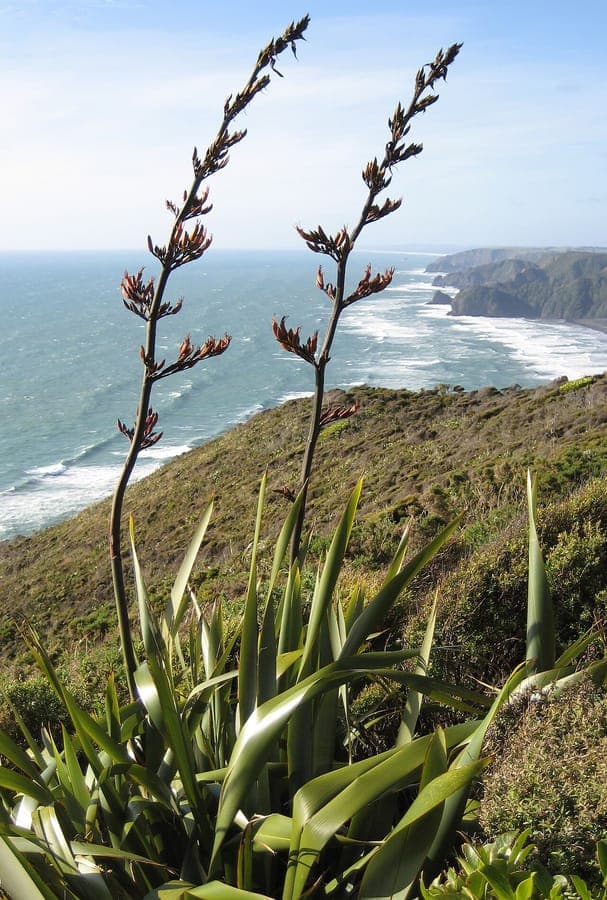
Kahuroa / Public domain, via Wikimedia Commons
New Zealand flax: complete guide
Phormium tenax
¿Quieres ver New Zealand flax: complete guide en tu jardín?
1 minuto, sin tarjeta de crédito
Overview
New Zealand flax (Phormium tenax) is a spectacular structural foliage plant native to New Zealand and Norfolk Island. This robust specimen can reach 2-3 meters in height and forms a dramatic, striking presence in any contemporary garden. Its long, stiff, sword-shaped leaves in green or red/gold tints bring vertical lines and architectural importance to landscape design.
Appearance and flowering
Phormium tenax grows in an upright, columnar form with long, rigid, sword-like leaves reaching up to 2 meters in length. The basal leaves are deep green (or colored in cultivars), with a rough texture. In summer (July-August), tall flower spikes emerge bearing small, dark red flowers in dense, upright inflorescences. The flowers are highly ornamental and attract hummingbirds and native birds to the garden.
Ideal location
This plant thrives in full sun to partial shade. For more intensely colored foliage, full sun is essential. In partial shade, the green deepens and remains vigorous. Place it against warm walls, in open gardens, or as a solitary accent plant. The plant is extremely wind-tolerant and grows even in windy coastal climates without stress. Wind actually strengthens the leaves.
Soil
Phormium tenax is not fussy about soil types. Ordinary garden soil works fine as long as it is not permanently waterlogged. Sandy, clayey, or loamy soils are all tolerated. Excellent drainage is essential. On heavy clay, adding sand helps drainage. The plant even tolerates slightly saline soils, useful in coastal settings.
Watering
Once established in the garden, Phormium tenax requires minimal water. Water regularly during dry periods, but the plant is drought-tolerant once well-rooted. In containers, more attention is needed: water when the top inch dries out. In winter, water minimally. Container over-wintering requires caution; prefer dry to waterlogged.
Diseño gratis
¿Quieres ver New Zealand flax: complete guide en tu jardín? Crea un diseño gratis ahora.
Pruning
Pruning is not strictly necessary, but remove dead outer leaves to maintain a neat appearance. Pruning does not blunt sharp leaf edges; the plant simply continues growing. Remove discolored or damaged leaves from the base. Some gardeners remove flower spikes after blooming, though this is optional.
Maintenance calendar
- March-April: Check drainage, remove dead leaves
- May-June: Growing period, water during dry spells
- July-August: Flowering, no special measures
- September-October: Gradually reduce watering
- November-February: Minimal care
Winter hardiness
Phormium tenax is moderately hardy and survives to about -5C with good drainage. In southern regions, it can remain outdoors. In northern areas, grow in containers and bring indoors for winter (or protect under eaves). Wet winters are more dangerous than cold winters.
Companion plants
Phormium combines beautifully with other structural plants like bamboo, dierama, and ornamental grasses. Silver-foliaged plants such as Senecio, Artemisia, and other silvery plants provide lovely contrast. In modern gardens, it works well with Eryngium, Calamagrostis, and dark-foliaged Heuchera varieties.
Conclusion
New Zealand flax is an essential structural plant for contemporary garden design. With minimal care and dramatic presence, it adds year-round interest to any landscape. For more information on structural plants and garden design, visit gardenworld.app/en.
Looking for inspiration with architectural plants? Discover gardenworld.app/en for modern garden designs!
¿Quieres ver New Zealand flax: complete guide en tu jardín? Crea un diseño gratis ahora.
Sube una foto, elige un estilo y obtén un diseño fotorrealista con lista de plantas en menos de un minuto.
Más de 10.000 jardines diseñados
Sin tarjeta de crédito


Plantas similares
Aloe castanea: complete guide
Aloe castanea
Discover Chestnut aloe, a South African succulent. Growth, nutrition, and garden integration for warm climates and container culture.
Aloe pratensis: complete guide
Aloe pratensis
Learn how to grow Meadow aloe, a South African succulent. Nutrition, propagation, and front yard integration for warm climates or containers.
Pretoria aloe: complete guide
Aloe pretoriensis
Discover Aloe pretoriensis, an elegant South African succulent with striking red blooms. Learn care tips, ideal conditions, and companion planting for this hardy, drought-tolerant plant.