
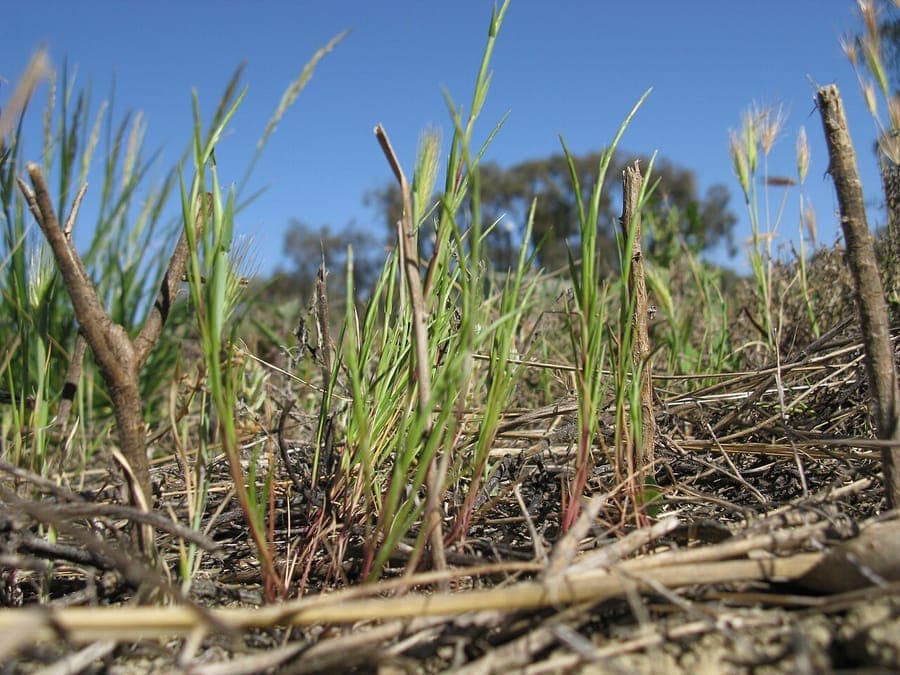
Macleay Grass Man / CC BY 2.0, via Wikimedia Commons
Curved sicklegrass: complete guide
Parapholis incurva
¿Quieres ver Curved sicklegrass: complete guide en tu jardín?
1 minuto, sin tarjeta de crédito
Overview
The curved sicklegrass (Parapholis incurva) is a distinctive salt-loving grass species found in coastal regions of Western Europe, the Mediterranean, and North Africa. This compact grass adapts excellently to harsh saline conditions and forms an important component of coastal vegetation. It is a pioneer species that often colonizes salt-affected soils first.
Appearance and bloom
Curved sicklegrass grows as a dense tuft reaching 15-30 centimetres in height. The characteristic curved flower spikes give the plant its common name. The spikelets are green to grey-green in color. The plant flowers from April to July when the grain-bearing structures form. The overall growth pattern is compact and robust, adapted to rough coastal conditions.
Ideal location
Curved sicklegrass prefers salt marshes directly along sea coasts, on saline grasslands and at the edges of salt-affected wetlands. The plant thrives in open, sunny locations where competition from other plants is minimal. In botanical gardens it grows best near coastal conditions.
Soil
Curved sicklegrass is a true salt-lover and grows optimally on soils with high salt content and pH 7.0-7.5. This grass tolerates salt much better than most other plants. The soil can be sandy or clayey, as long as it contains salt. Normal, freshwater soils are unsuitable.
Diseño gratis
¿Quieres ver Curved sicklegrass: complete guide en tu jardín? Crea un diseño gratis ahora.
Watering
Fresh water is needed for curved sicklegrass, but the plant is very drought-tolerant and can survive long periods without water. In coastal regions it typically receives sufficient moisture from seawater intrusion or rainfall. In cultivation, regular watering with fresh water is necessary.
Pruning
Pruning is not necessary for curved sicklegrass. The plant is largely self-maintaining and dies back after seed production. In gardens, dead material can be removed in spring.
Maintenance calendar
April-July: Growth and flowering; July-August: Seed ripening; September-March: Dormancy, remove dead plant material in spring.
Winter hardiness
Curved sicklegrass is fully winter-hardy to -10 degrees Celsius. It is an annual grass in many regions but can overwinter in favorable years. Along coasts south of Great Britain it occurs as a more or less permanent population.
Companion plants
Curved sicklegrass grows alongside other salt-loving grasses and low-growing herbs such as glasswort, sea-lavender and salt-tolerant species. These associations form characteristic coastal vegetation patterns.
Closing remarks
Curved sicklegrass is a specialist in extreme conditions and demonstrates the resilience of coastal vegetation. For coastal gardeners it offers an interesting choice. Want to know more about coastal plants? Visit gardenworld.app/en for more inspiration. Discover more at gardenworld.app/en!
¿Quieres ver Curved sicklegrass: complete guide en tu jardín? Crea un diseño gratis ahora.
Sube una foto, elige un estilo y obtén un diseño fotorrealista con lista de plantas en menos de un minuto.
Más de 10.000 jardines diseñados
Sin tarjeta de crédito


Plantas similares
Sporobolus pungens: complete guide
Sporobolus pungens
Sporobolus pungens is a stoloniferous Mediterranean coastal grass with outstanding salt and drought tolerance, perfect for seaside and dry gardens.
Mediterranean aegilops: complete guide
Aegilops biuncialis
Everything about Aegilops biuncialis, a Mediterranean annual grass with ornamental spikes and outstanding drought tolerance for dry gardens.
Silver bluestem: complete guide
Bothriochloa saccharoides
Full guide to Bothriochloa saccharoides (silver bluestem): site, soil, watering, winter hardiness, pruning, and garden companions.