
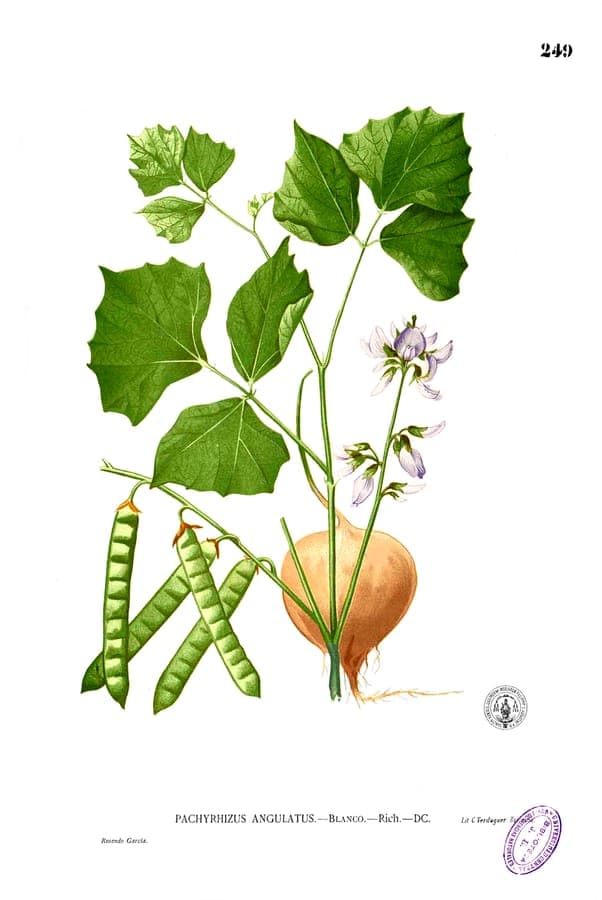
Francisco Manuel Blanco (O.S.A.) / Public domain, via Wikimedia Commons
Jicama (Yam-bean): complete guide
Pachyrhizus erosus
¿Quieres ver Jicama (Yam-bean): complete guide en tu jardín?
1 minuto, sin tarjeta de crédito
Overview
Pachyrhizus erosus, commonly known as Jicama or Yam-bean, is a climbing plant from Mexico and Central America with large edible tubers. This plant from the Fabaceae family (legumes) produces tubers that resemble potatoes but with fresh, juicy flesh that tastes somewhat like watermelon.
The plant is popular in many tropical and subtropical areas and offers an interesting food crop for gardeners in warmer climates. The edible parts are not only nutritious but also water-rich and refreshing.
Appearance and bloom
Jicama is a vigorous climbing plant that can reach 3-4 meters high. The plant has large, trilobed leaves with strong tendrils by which it clings. The stems are hairy and grow quickly.
The flowers are purple-white and small, appearing in clusters along the stems. Blooming occurs later in the growing season. The tubers grow underground and are large, round, and white or creamy in color.
Ideal location
Jicama grows best in a warm, sunny spot with support for climbing. The plant loves climbing vines and will climb walls, fences, or latticework. Provide at least 6-8 hours of direct sunlight.
The plant is sensitive to frost and is best grown in warmer regions, or as an annual crop in temperate climates with a long growing season.
Soil
Jicama thrives in loose, fertile, well-drained soil. The plant is fairly tolerant but performs better in humus-rich soil. A pH between 5.5 and 7 is ideal.
Work organic matter into the soil and ensure good drainage. The plant does not tolerate heavy soils well. Mulch helps keep the soil moist.
Diseño gratis
¿Quieres ver Jicama (Yam-bean): complete guide en tu jardín? Crea un diseño gratis ahora.
Watering
Water Jicama regularly, especially during dry periods. The soil should be moist but not waterlogged. Plenty of water stimulates larger tuber growth.
Moisture variation can lead to cracking in tubers, so aim for consistently moist soil. Water daily during dry periods.
Pruning
You can prune side vines to control growth and direct climbing. Leave sufficient leaf mass for photosynthesis. Topping the plant can stimulate side growth.
Pruning from the previous growing year helps promote more flowering and tuber production.
Maintenance calendar
February-March: Plant tubers (15-20 cm deep) after frost. April-May: Rapid growth, provide support. June-August: Flowers appear, water generously. August-October: Tuber formation, water regularly. October-November: Carefully harvest when leaves wilt.
Winter hardiness
Jicama is not winter-hardy in frost areas. In tropical regions, it can be perennial. In temperate climates, it should be treated as an annual crop.
Tubers can be frozen and used as starting material for next season.
Companion plants
Jicama grows well with:
- Corn as support
- Cucumber and pumpkin underneath
- Other climbing plants on the same frame
- Flowers for pollination
The nitrogen-fixing capacity of Fabaceae means it adds nutrients to the soil.
Closing remarks
Jicama is an exciting tropical vegetable for warm gardens. The plant produces many edible tubers and can use a lot of space in mixed gardens. The flesh is fresh and refreshing, great in salads.
You will find seeds or tubers at gardenworld.app/en and gardenworld.app/nl.
¿Quieres ver Jicama (Yam-bean): complete guide en tu jardín? Crea un diseño gratis ahora.
Sube una foto, elige un estilo y obtén un diseño fotorrealista con lista de plantas en menos de un minuto.
Más de 10.000 jardines diseñados
Sin tarjeta de crédito


Plantas similares
Tall Silky Lupine: complete guide
Lupinus elatus
Tall silky lupine is a fast-growing Californian perennial with silvery foliage and blue-purple flower spikes, ideal for a prairie-style garden.
Garfield Lupine: complete guide
Lupinus garfieldensis
The Garfield lupine is a rare, fast-growing American perennial for alkaline, dry grassland gardens, with striking blue flower spikes.
Lupinus elegans: complete guide
Lupinus elegans
Lupinus elegans, the elegant lupine, is a spectacular blooming plant from Mexico with blue flower spikes. Care, cultivation and garden use.