
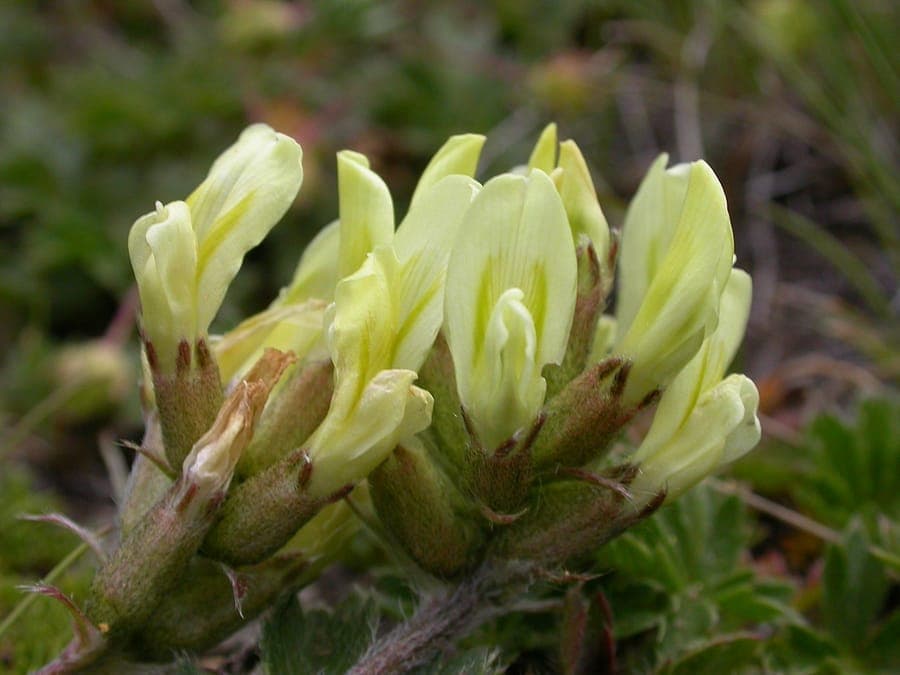
No machine-readable author provided. Thommybe assumed (based on copyright claims). / CC BY-SA 3.0, via Wikimedia Commons
Field locoweed: complete guide
Oxytropis campestris
¿Quieres ver Field locoweed: complete guide en tu jardín?
1 minuto, sin tarjeta de crédito
Overview
The field locoweed, botanically Oxytropis campestris, is a robust alpine plant from the legume family. This species grows naturally in mountainous regions of Europe and North America on moist alpine meadows and rocky ground. In gardens, this low-growing perennial forms elegant flower spikes with yellow or white blooms.
Oxytropis campestris is particularly popular with rock and alpine garden enthusiasts. On gardenworld.app, see how this mountain plant fits perfectly into modern minimalist designs with plenty of stone and gravel. The plant requires very little fertilizer or moisture management - perfect for low-maintenance garden designs.
Appearance and bloom
Field locoweed grows in neat, compact rosette forms of 20-40 cm height. The plant features yellow-gray, densely hairy leaves with a silvery sheen. This hairiness is an adaptation against drought and mountain wind.
Flower spikes appear from May to July and are usually bright yellow, sometimes with white accents. The flowers are characteristic of the legume family with a distinctive keel and prominent wings. Bees and bumblebees visit these flowers enthusiastically.
Ideal location
Oxytropis campestris thrives in very sunny locations. The plant tolerates no shade whatsoever. Choose a spot receiving at least 8-9 hours of direct sunlight daily. In mountain gardens this is usually no problem - in lowland gardens you must carefully consider placement.
This plant belongs in rock and alpine gardens, on stones, in planting pockets between paving, and on dry slopes. On gardenworld.app, design alpine gardens where this mountain plant takes center stage.
Soil
Field locoweed demands much better-draining soil than most garden plants. Heavy clay soil is completely unsuitable. Work the planting area deeply with gravel, stones, or sand. A mix of 50% sharp sand, 30% garden gravel, and 20% garden compost is ideal.
The plant prefers moderately limy substrate. If your soil is very acidic, add some broken limestone. After planting, cover the root zone with a layer of stones. This keeps the plant dry and cools its feet during hot summers.
Diseño gratis
¿Quieres ver Field locoweed: complete guide en tu jardín? Crea un diseño gratis ahora.
Watering
Once established, field locoweed tolerates long dry periods. In the first year after planting, water when the top soil layer feels dry. After that, virtually no watering needed - even during dry autumns.
Heavy watering must be avoided. In rainy periods you can forget the plant entirely. Excess water causes immediate root rot and plant death. This is the number-one killer of this alpine.
Pruning
Pruning is hardly necessary. Remove only spent flower spikes after blooming. This sometimes encourages additional branching and blooms. Withered leaves need not be removed - they are part of the natural structure.
Old growth is removed only in early spring if dead. The plant needs little else.
Maintenance calendar
May to July: Check for damage and enjoy the blooms. Water if very dry. August to October: Plant is fully dormant; never water. November to April: Winter rest; protect from extreme moisture. May: Check that plants are thriving.
Winter hardiness
Oxytropis campestris is extremely hardy, to minus 20 or even minus 25 degrees Celsius. The true enemy is not frost but moisture. Ensure the plant never becomes wet in winter. Good drainage is essential.
In very rainy winter regions, you may cover the planting area with extra gravel so excess water drains faster. In dry mountain regions you can grow this plant carefree.
Companion plants
Field locoweed combines beautifully with other alpine plants such as silene, dianthus, and saxifrage. It also feels at home beside bare gravel and stones. Avoid companion plants that need lots of nutrients and moisture.
On gardenworld.app, design alpine gardens where this plant plays the lead role, surrounded by other mountain treasures.
Closing
Field locoweed is perfect for gardeners seeking something different from typical rock garden fillers. It demands minimal care, tolerates extreme conditions, and offers abundant bloom character. Available through specialized garden centers.
¿Quieres ver Field locoweed: complete guide en tu jardín? Crea un diseño gratis ahora.
Sube una foto, elige un estilo y obtén un diseño fotorrealista con lista de plantas en menos de un minuto.
Más de 10.000 jardines diseñados
Sin tarjeta de crédito


Plantas similares
Tall Silky Lupine: complete guide
Lupinus elatus
Tall silky lupine is a fast-growing Californian perennial with silvery foliage and blue-purple flower spikes, ideal for a prairie-style garden.
Garfield Lupine: complete guide
Lupinus garfieldensis
The Garfield lupine is a rare, fast-growing American perennial for alkaline, dry grassland gardens, with striking blue flower spikes.
Lupinus elegans: complete guide
Lupinus elegans
Lupinus elegans, the elegant lupine, is a spectacular blooming plant from Mexico with blue flower spikes. Care, cultivation and garden use.