
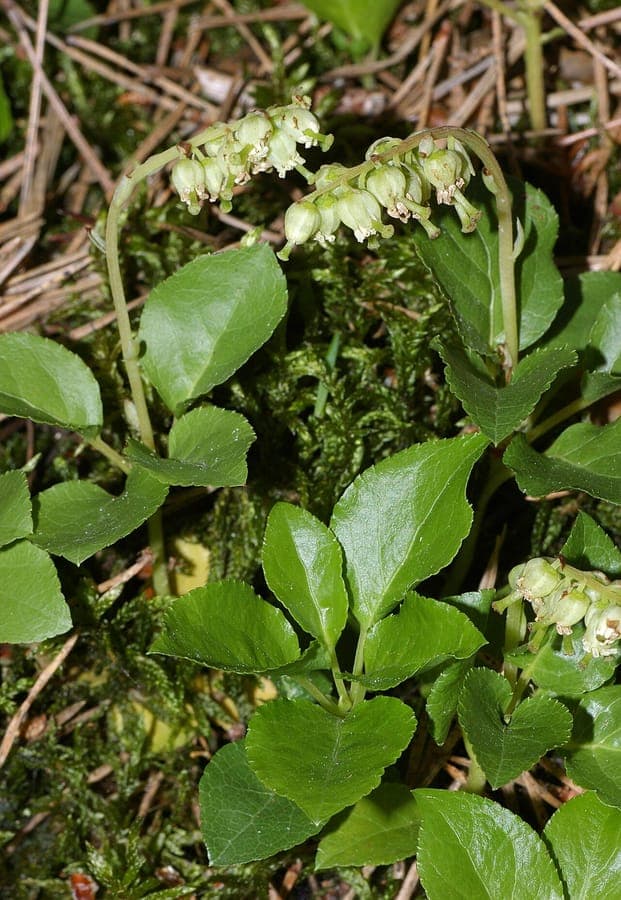
Christian Fischer / CC BY-SA 3.0, via Wikimedia Commons
Orthilia secunda: complete guide
Orthilia secunda
¿Quieres ver Orthilia secunda: complete guide en tu jardín?
1 minuto, sin tarjeta de crédito
Overview
Orthilia secunda, commonly known as serrated wintergreen or cascadeflower, is a fascinating low-growing creeper from the Ericaceae family. This plant belongs to the same family as rhododendrons and blueberries but differs significantly in growth pattern. Orthilia secunda naturally thrived in subarctic and temperate zones of the Northern Hemisphere, from Europe to Asia and even Mexico. This makes it a robust, climate-resilient plant.
In gardens, this plant is primarily valued as a groundcover in shaded areas. The plant flowers delicately with white-pink blooms that bend in a characteristic semicircular arc. The flowering period extends from May to June, providing a gentle color accent. The height ranges around 10 to 15 centimeters, making it a perfect low-growing filler for dark corners.
Appearance and Bloom
The leaves of Orthilia secunda are small, oval, and have a weakly toothed edge. They are dark green and typically remain on the plant year-round. This makes it interesting for winter gardens too. The flowers are small, about 6 millimeters long, and hang in a characteristic downward-curving spray. They usually have five white or pale pink petals with ten visible stamens.
After flowering, small seed capsules form, which are fascinating to observe. The plant profile is compact and dense, with many stems arising from the base. This makes it ideal for broader coverage of shaded spots.
Ideal Location
Orthilia secunda loves partial to full shade. It works well under deciduous trees, on the east side of buildings, or in other places where direct sunlight reaches for no more than two hours. In too-sunny locations, the plant will suffer and lose leaves. Unlike many other groundcovers, Orthilia secunda actually thrives in places where others fail.
The plant naturally grows in woodland environments, so it prefers a location with shrubs or trees nearby. Protection from strong wind is preferred but not essential.
Soil
Orthilia secunda grows on soil rich in organic matter, like that found in forests. An acidic to neutral pH is preferred (pH 5.5-7.0). Heavy clay soil should be worked with plenty of peat moss or leaf mold. Ensure good drainage. Waterlogging must be avoided; slightly moist soil is ideal.
Soil preparation: Mix composted pine needles, forest debris, and a handful of peat moss underneath. This imitates the plant's natural habitat. If your soil is very heavy, work in coarse sand underneath for better drainage.
Diseño gratis
¿Quieres ver Orthilia secunda: complete guide en tu jardín? Crea un diseño gratis ahora.
Watering
Keep the soil evenly moist, especially during the growing season (April to October). During dry periods, water at least twice per week. Ensure the soil never dries out but also doesn't become waterlogged. In winter, less water is needed. Rainwater is better than tap water, as it's often less alkaline.
Do not spray the plant directly with water; this can cause leaf damage. Drip irrigation or bottom watering is best. A mulch layer of several centimeters significantly improves moisture retention.
Pruning
Orthilia secunda doesn't need drastic pruning. Carefully remove dead or damaged stems in spring. You may gently shape the plant by carefully pinching back stems, but this is unnecessary. Note: the plant is fairly fragile, so handle it gently.
After flowering, you can remove spent flower clusters to keep the plant neat. This also encourages more compact growth.
Maintenance Calendar
Spring (April-May): Begin fertilizing and check for pests. Add mulch. Summer (June-August): Regular watering, especially during dry periods. Remove spent flowers. Autumn (September-October): Reduce fertilizing. Prepare the plant for winter. Winter (November-March): Minimal maintenance. Check soil moisture levels.
Winter Hardiness
Orthilia secunda is extremely cold-hardy, even in harsh winters. It can withstand temperatures down to -35 degrees Celsius. In higher-altitude regions or areas with severe winters, a layer of leaf mold provides protection. The plant will die back to ground level in winter but returns every spring.
Companion Plants
Orthilia secunda combines well with other shade-lovers such as hostas, broad-leaved hellebores, and evergreen groundcovers. Small ferns and moss combinations are also lovely. Planted in large groups, it creates a picturesque effect.
Orthilia secunda attracts various bee species and small pollinators, especially during flowering. This makes it valuable for the garden ecosystem.
Conclusion
Orthilia secunda is an excellent choice for gardeners who want to fill shaded spots with low-growing, reliable plants. With minimal maintenance and years of steadfast service, it stays true to its role. You'll find it in many European gardens, from the Netherlands to Scandinavia.
Want to read more guides? Visit gardenworld.app for comprehensive plant profiles and gardening advice for every situation.
Visit gardenworld.app for more plant guides and gardening tips. Discover thousands of plant profiles and make your garden dreams come true.
¿Quieres ver Orthilia secunda: complete guide en tu jardín? Crea un diseño gratis ahora.
Sube una foto, elige un estilo y obtén un diseño fotorrealista con lista de plantas en menos de un minuto.
Más de 10.000 jardines diseñados
Sin tarjeta de crédito


Plantas similares
Zenobia pulverulenta: complete guide
Zenobia pulverulenta
Everything about Zenobia pulverulenta (honeycup): siting, acid soil, pruning and the fragrant white bells, in this complete care guide.
Dwarf huckleberry: complete guide
Gaylussacia dumosa
Everything about dwarf huckleberry (Gaylussacia dumosa): acidic soil, partial shade, pruning and care for this compact North American berry shrub.
Drooping leucothoe: complete guide
Leucothoe fontanesiana
Everything about drooping leucothoe (Leucothoe fontanesiana): shade tolerance, soil, watering, pruning, hardiness and companion plants.