
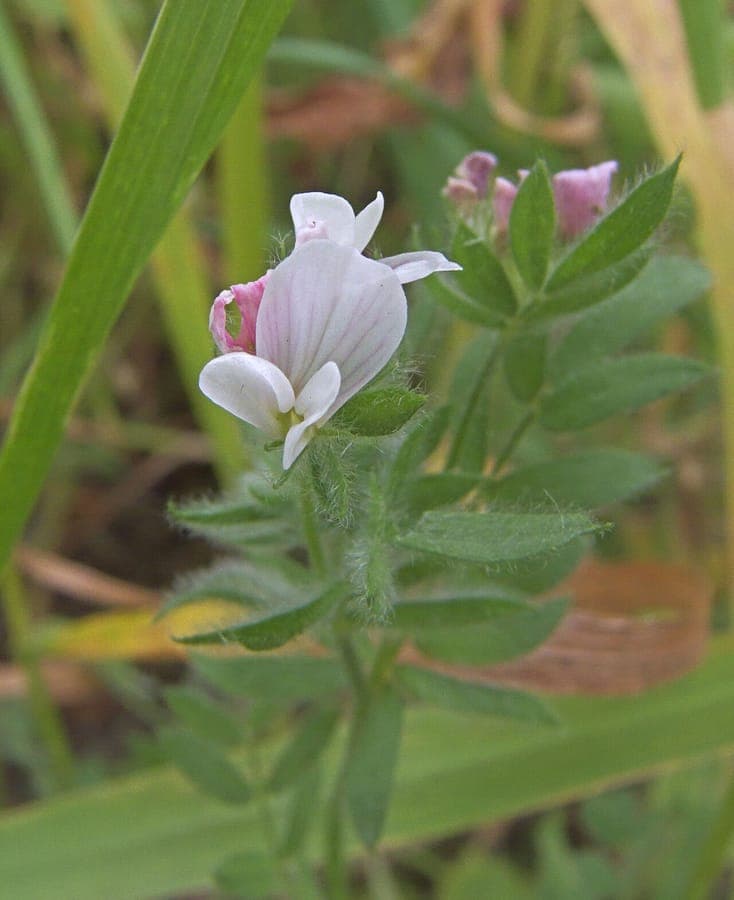
Rasbak / CC BY-SA 3.0, via Wikimedia Commons
Serradella: complete guide
Ornithopus sativus
¿Quieres ver Serradella: complete guide en tu jardín?
1 minuto, sin tarjeta de crédito
Overview
Serradella (Ornithopus sativus), also called bird's-foot or French serradella, is a valuable forage legume from southwestern France and North Africa. This member of the Fabaceae family blooms from May through June with attractive pink to red-yellow flowers.
The plant is primarily grown for forage and green manure purposes but also suits dry garden plantings. Serradella thrives on lean soils and helps enrich them with nitrogen through its nitrogen-fixing root nodules.
Appearance & bloom
Serradella reaches 30 to 60 centimeters in height. The leaves are pinnately compound with upright, lance-shaped leaflets. The foliage is fine-textured and lighter in color.
Flowers appear in dense, upright clusters. They're small, intense pink to red-yellow colored, highly attractive to bees and butterflies. Flowering spans May through June. After blooming, longer, curved pods form containing multiple seeds per pod.
Ideal location
Serradella grows optimally in full sun. The plant tolerates some shade but flowers more abundantly in bright light.
Plant serradella on sunny, warm sites. It suits forage fields, summer flower gardens, and drought-loving borders. Unfortunately, its forage-plant character makes it less suitable for formal gardens.
Soil
Serradella is highly tolerant of poor, dry soils. Sand, gravel, and light soils are ideal. The plant struggles on heavy, fertile clay.
Dry soils pose no problem - serradella is drought-adapted. Well-drained terrain prevents disease. Neutral to acidic (pH 6.0-7.5) is preferred. Lime-poor soil is optimal.
Watering
Sow serradella in March-April directly where it will grow. Seeds can also be sown deeply in autumn. Seed requires little water - the plant grows naturally.
On nutrient-rich ground, serradella grows without fertilizing. In dry summers, the plant needs no extra water after its first year. Fallen seeds create reserves for the next season.
Diseño gratis
¿Quieres ver Serradella: complete guide en tu jardín? Crea un diseño gratis ahora.
Maintenance
Serradella requires minimal attention. Leave faded flowers to set seed. The plant becomes stronger over time.
Fertilizing is usually unnecessary and may cause excessive growth without flowers. Allow natural decline - this is actually desired. Pruning is not recommended.
Maintenance calendar
March-April: Sow directly where plants will grow May-June: Flowering with pink clusters June-July: Pod formation July-August: Complete pod maturation August-September: Self-sows via mature pods October-February: Fallen seeds await spring Year-round: Minimal maintenance
Winter hardiness
Serradella is semi-hardy. In mild winters to -10 degrees, the plant may overwinter as a biennial. In severe climates, it dies back and restarts from fallen seeds.
In Northern and Central Europe, serradella grows primarily as an annual. In milder Mediterranean regions, it may return. Repeated self-seeding ensures annual appearance.
Companion plants
Serradella works well with other forage legumes and lean-soil species. Combine with lupine (Lupinus), yellow mustard (Sinapis alba), and other bird's-foot species.
In wild mixes, it pairs with cornflowers (Centaurea cyanus), thistles (Cirsium), and chamomile (Matricaria). This creates attractive forage fields with value for bees.
In conclusion
Serradella (Ornithopus sativus) is an excellent forage crop that can also be used ornamentally. For those seeking dry gardens with bee and butterfly appeal, serradella is a fine choice. Sow, watch it grow, and enjoy.
Serradella seed is found at specialized forage suppliers in France and Southern Europe. Online seed merchants also stock it. Visit gardenworld.app for more ideas.
Serradella seed is found at specialized forage suppliers in France and Southern Europe. Online seed merchants also stock it. Visit gardenworld.app for more ideas.
¿Quieres ver Serradella: complete guide en tu jardín? Crea un diseño gratis ahora.
Sube una foto, elige un estilo y obtén un diseño fotorrealista con lista de plantas en menos de un minuto.
Más de 10.000 jardines diseñados
Sin tarjeta de crédito


Plantas similares
Tall Silky Lupine: complete guide
Lupinus elatus
Tall silky lupine is a fast-growing Californian perennial with silvery foliage and blue-purple flower spikes, ideal for a prairie-style garden.
Garfield Lupine: complete guide
Lupinus garfieldensis
The Garfield lupine is a rare, fast-growing American perennial for alkaline, dry grassland gardens, with striking blue flower spikes.
Lupinus elegans: complete guide
Lupinus elegans
Lupinus elegans, the elegant lupine, is a spectacular blooming plant from Mexico with blue flower spikes. Care, cultivation and garden use.