
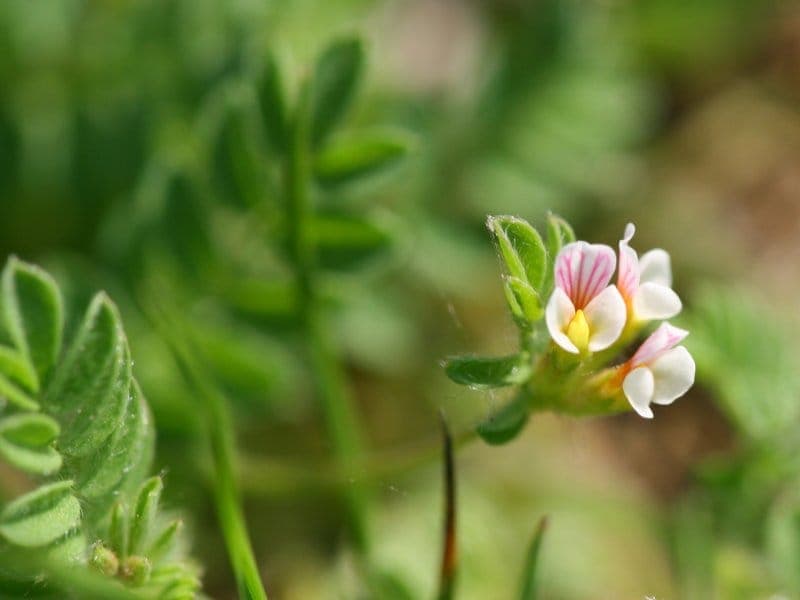
Kristian Peters -- Fabelfroh 07:22, 23 June 2007 (UTC) / CC BY-SA 3.0, via Wikimedia Commons
Bird's-foot: complete guide
Ornithopus perpusillus
¿Quieres ver Bird's-foot: complete guide en tu jardín?
1 minuto, sin tarjeta de crédito
Overview
Bird's-foot (Ornithopus perpusillus) is a delightful, tiny legume native to Northwestern and Central Europe. This member of the Fabaceae family blooms from May through June with delicate small flowers in soft pink to yellow.
The plant thrives on lean, dry soils where grasses and native herbs intermingle naturally. It's ideal for those wishing to create extensive meadows, heathlands, and natural plantings without intensive management.
Appearance & bloom
Bird's-foot is a very low plant, often just 5 to 30 centimeters tall. The fine, pinnate leaves form low rosettes. The plant has an elegant, filigree appearance.
Tiny flowers appear in loose clusters. They're very small, pink to yellow colored with purple markings and spotting. Flowering extends from May through June. After blooming, characteristic small bird's-foot-shaped pods form, justifying the plant's common name.
Ideal location
Bird's-foot thrives optimally on sunny, warm sites. The plant tolerates some shade but flowers best in full sun.
Place it on dry grasslands, heathlands, disturbed soils, and wildflower mixes. The plant naturalizes excellently in lawn and extensive plantings. Perfect for creating wild corners in the garden.
Soil
Bird's-foot is highly tolerant of poor, lean soils. Sand, gravel, and light, nutrient-poor soil are ideal. The plant struggles on heavy, fertile soils.
Dry soils pose no problem - bird's-foot is drought-adapted. Well-drained terrain prevents disease. Neutral to acidic (pH 6.0-7.5) is preferred.
Watering
Sow bird's-foot directly in March-April. Seed can also be sown directly in October into the soil. Seeds require light coverage in sand. Water sparingly - the plant grows on its own.
On poor soils, the plant grows without fertilizing. Even in dry summers, bird's-foot requires no extra water after the first growing year. Fallen seeds create reserves for the next season.
Diseño gratis
¿Quieres ver Bird's-foot: complete guide en tu jardín? Crea un diseño gratis ahora.
Maintenance
Bird's-foot requires virtually no maintenance. Leave faded flowers to set seed. The plant becomes stronger over time.
Avoid fertilizing. Extra nutrition results in excessive growth without flowers. Allow natural decline - this is actually desired. No pruning is needed.
Maintenance calendar
March-April: Sow directly into the soil October: Alternative sowing time for direct seeding May-June: Flowering and seed development June-July: Pod growth July-September: Self-sows via mature pods October-February: Fallen seeds await spring Year-round: No active maintenance needed
Winter hardiness
Bird's-foot is winter-hardy as an annual. It grows from fallen seeds that survive winter and germinate in spring. This is the natural growth pattern.
In very mild climates (Mediterranean), the plant may overwinter as a biennial. In the Netherlands, Germany, and France, it works best as a self-seeder.
Companion plants
Bird's-foot works beautifully in wildflower mixes with other lean-soil species. Combine with globeflower (Trollius), chamomile (Matricaria), daisy (Bellis), and bindweed (Convolvulus).
In grasslands, it pairs with clovers (Trifolium), other serradella species, and cornflowers (Centaurea). This creates attractive, wild corners without much effort.
In conclusion
Bird's-foot (Ornithopus perpusillus) is a wonderful plant for those loving wild, extensive plantings. Sow and let it grow - that's all that's needed. The plant takes care of itself and repeats year after year.
Seeds are available from seed suppliers and garden centers across Europe. Gamma and other retailers also stock wildflower mixes containing bird's-foot. Visit gardenworld.app for more ideas on natural gardens.
Seeds are available from seed suppliers and garden centers across Europe. Gamma and other retailers also stock wildflower mixes containing bird's-foot. Visit gardenworld.app for more ideas on natural gardens.
¿Quieres ver Bird's-foot: complete guide en tu jardín? Crea un diseño gratis ahora.
Sube una foto, elige un estilo y obtén un diseño fotorrealista con lista de plantas en menos de un minuto.
Más de 10.000 jardines diseñados
Sin tarjeta de crédito


Plantas similares
Tall Silky Lupine: complete guide
Lupinus elatus
Tall silky lupine is a fast-growing Californian perennial with silvery foliage and blue-purple flower spikes, ideal for a prairie-style garden.
Garfield Lupine: complete guide
Lupinus garfieldensis
The Garfield lupine is a rare, fast-growing American perennial for alkaline, dry grassland gardens, with striking blue flower spikes.
Lupinus elegans: complete guide
Lupinus elegans
Lupinus elegans, the elegant lupine, is a spectacular blooming plant from Mexico with blue flower spikes. Care, cultivation and garden use.