
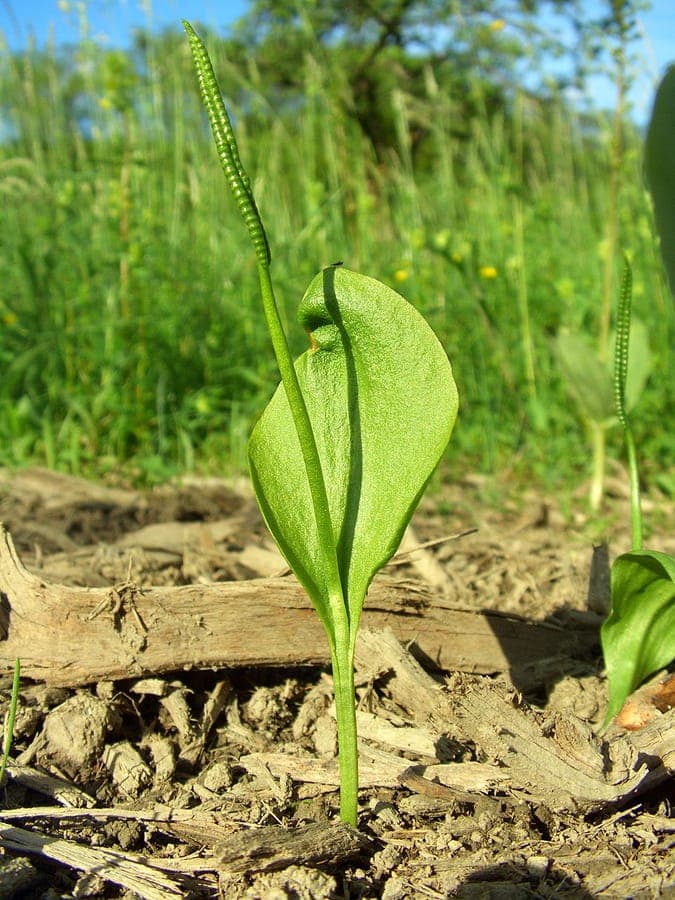
Orchi / CC BY-SA 3.0, via Wikimedia Commons
Ophioglossum vulgatum: complete guide
Ophioglossum vulgatum
¿Quieres ver Ophioglossum vulgatum: complete guide en tu jardín?
1 minuto, sin tarjeta de crédito
Overview
Ophioglossum vulgatum, commonly known as the adder's-tongue fern or common adder's-tongue, is an extremely fascinating and primitive fern belonging to the Ophioglossaceae family. This moisture-loving fern is native to temperate regions of Europe, Asia and North America and represents a rare sight in modern gardens. The adder's-tongue belongs to one of the most intriguing groups of ferns and differs significantly from more "common" leafy ferns. With its unique two-part leaf structure, where one part is photosynthesising foliage and the other part is a fertile spore-bearing element, the adder's-tongue offers a botanical classic in miniature form.
On gardenworld.app you can easily design a moisture-loving garden in which this delicate fern is showcased alongside other shade and moisture-loving plants. The adder's-tongue requires careful placement and careful care, but its botanical beauty makes every effort worthwhile.
Appearance and morphology
Ophioglossum vulgatum is a small fern with very distinctive morphology. The plant forms a simple, unbranched rhizome underground from which only a single leaf grows per season. This leaf consists of two distinctly different parts: the lower part is the actual "sterile" photosynthesising leaf, which is ovate to lanceolate in shape and has a whole, smooth edge. This leaf is only 5 to 15 centimetres long.
Above this sterile leaf part grows directly a very thin, stick-like structure that forms the "fertile" (reproductive) part. This fertile part bears the spores and resembles two rows of spore-cases (sporangia) closely packed in a compact, spore-bearing structure. This fertile part gives the plant its very characteristic appearance and its common name "adder's-tongue fern".
Ideal location
The adder's-tongue thrives best in semi-shaded to shaded environments. Direct midday sun is unwelcome and can cause leaf burn damage. Many moisture-loving ferns prefer growing under dense leaf canopies or near other larger plants that provide some shade. In a garden without many trees, a location under a wall or on the northwest side of the garden can be optimal.
The adder's-tongue grows naturally in moist grasslands, marshes and moist woodland floors. In cultivation this works well in shaded, moist locations, for example around ponds or in moist borders with other moisture-loving plants.
Soil requirements
The adder's-tongue has very specific soil requirements. The plant grows best in moist, humus-rich soils with high organic matter content. This can be achieved by adding large amounts of leaf mould, peat moss or fine compost. The soil must remain reasonably moist even in dry seasons, although waterlogged spots are not tolerated well.
The pH can be both slightly acidic and neutral, although more acidic conditions are usually preferred. In heavy clay soils, adding sand and humus can help improve drainage slightly while maintaining moist conditions.
Watering
Watering is crucial for the adder's-tongue. The plant must never dry out completely. This is different from many other garden plants; this is a plant that requires continuous soil moisture. During growing seasons (March to October) the soil must always be moist, not waterlogged and not dry. Regular hand watering or placing the plant on a moisture-retaining mat can help.
In winter, when the plant dies back, the soil can be somewhat drier, but must never dry out completely. In other words: the soil must remain wetter than normal throughout the year.
Diseño gratis
¿Quieres ver Ophioglossum vulgatum: complete guide en tu jardín? Crea un diseño gratis ahora.
Pruning and maintenance
Ophioglossum vulgatum is a minimal maintenance fern. The only thing you do is remove withered or damaged leaves by hand, carefully removed from the base of the plant. Since the plant produces only a single leaf per season, you cannot "prune" such a leaf; you remove it when it has reached its natural lifespan and dies back.
The plant does not form runners or unwanted growth, so further maintenance is not needed. Occasionally old foliage that wilts and dies in winter can be carefully removed if it takes up too much space.
Maintenance calendar
March-April: Young leaves emerge; continuous moisture supply essential. May-August: Growing season; water regularly. September-October: Sporulation; foliage begins to fade. November-February: Winter dormancy; less water, but soil remains moist.
Winter hardiness
Ophioglossum vulgatum is very hardy down to approximately -25 degrees Celsius and tolerates heavy frosts well. In temperate climates the plant is completely winter-hardy in open gardens without any protection. The plant is not susceptible to frost damage because the above-ground parts die back completely in winter and the underground rhizome can survive being deeply frozen.
This is actually an advantage of this fern; because everything dies back it cannot suffer "burning" (frost damage) or damage from winter wind erosion.
Plant companions
The adder's-tongue combines well with other moisture-loving, shade-tolerant plants, especially other ferns. Excellent plant partners include:
- Other ferns: Polystichum setiferum (soft shield-fern), Dryopteris filix-mas (male fern)
- Carex omnifera: sedge similarly moisture-loving
- Helleborus niger (Christmas rose): moisture-loving and shade-tolerant
- Astilboides tabularis: large foliage, moisture-loving
- Hosta varieties: shade-loving, moisture-loving
The combination of different ferns, with some growing taller, works nicely to create variety in height while maintaining moist conditions.
Propagation
Ophioglossum vulgatum can propagate via spores, although this is fairly difficult in cultivation. The spores are very fine, dust-like particles and require very specific moist conditions to grow. It is much more practical to propagate young plants by carefully digging up portions of the rhizome and replanting them in appropriate moist soil.
This propagation is best done in early spring when the plant is just beginning to grow and when the rhizome is less susceptible to damage.
Closing
Ophioglossum vulgatum is not an easy plant for everyone, but for those with moist, shaded corners in their garden, the adder's-tongue is a unique, classic ornament. With its remarkable two-part leaf structure and its small, delicate appearance, this fern adds botanical subtlety to any moist shaded border.
Want to include the adder's-tongue in your moist shaded border? On gardenworld.app you can easily create a moisture-loving garden plan in which this delicate fern, along with other shade and moisture-loving species, takes centre stage.
¿Quieres ver Ophioglossum vulgatum: complete guide en tu jardín? Crea un diseño gratis ahora.
Sube una foto, elige un estilo y obtén un diseño fotorrealista con lista de plantas en menos de un minuto.
Más de 10.000 jardines diseñados
Sin tarjeta de crédito


Plantas similares
Azores Adderstongue: complete guide
Ophioglossum azoricum
Ophioglossum azoricum is a rare fern from Europe and Macaronesia. Learn how to cultivate this delicate, moisture-loving fern in shaded gardens.
Botrychium matricariifolium: complete guide
Botrychium matricariifolium
Master cultivation of daisy-leaf grape fern: habitat requirements, propagation challenges, and specialized forest garden care.
Northern moonwort: complete guide
Botrychium boreale
Northern moonwort (Botrychium boreale), also called boreal moonwort, is a rare fern from northern regions with distinctive moon-shaped leaflets. Discover cultivation and care tips.