
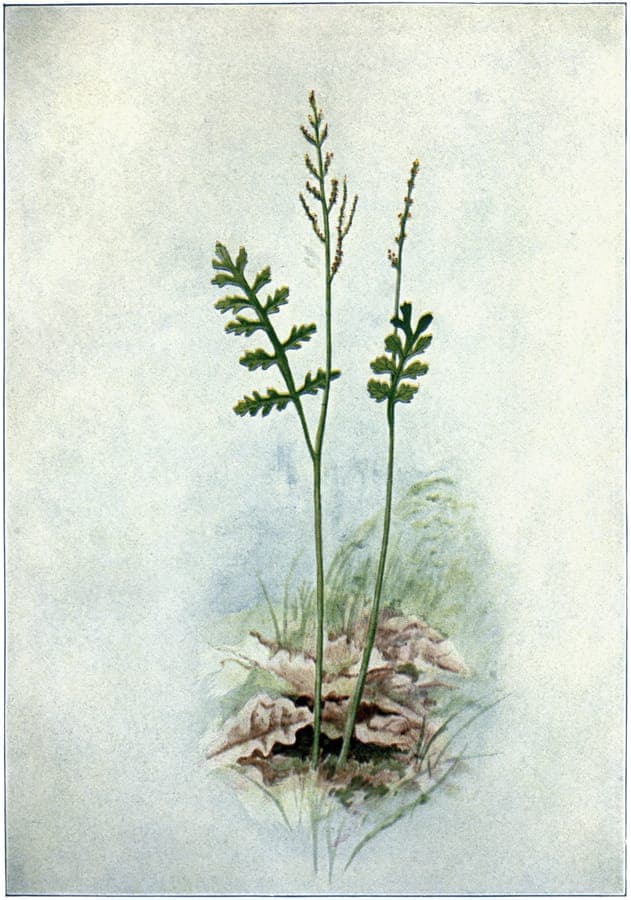
Willard Nelson Clute (writer) & William Walworth Stilson (illustrator) / Public domain, via Wikimedia Commons
Botrychium matricariifolium: complete guide
Botrychium matricariifolium
¿Quieres ver Botrychium matricariifolium: complete guide en tu jardín?
1 minuto, sin tarjeta de crédito
Overview
Botrychium matricariifolium, commonly called daisy-leaf grape fern, branched moonwort, or daisy-leaf moonwort, is a small, rare fern native to North America and Europe. This species belongs to the Ophioglossaceae family and is distinguished by its delicate, daisy-like foliage and distinctive reproductive structures. The plant grows in moist, partially shaded woodland settings and is less common than related moonwort species.
Botrychium matricariifolium is a frost-hardy, native fern suitable for shade gardens and natural woodland restoration projects, though cultivation remains challenging.
Appearance and characteristics
Botrychium matricariifolium is an extremely small fern, typically only 10-30 centimeters tall. The plant grows in clusters of 1-3 fronds per crown. The most striking feature is its division into two completely different segments: sterile and fertile.
Sterile segment: This portion is green and leaf-like, with finely branched divisions resembling chamomile leaves, hence the scientific name "matricariifolium." The foliage is deeply divided and gives the plant a delicate, lacy appearance.
Fertile segment: This reproductive structure grows above the sterile segment. It consists of a branched spike with numerous sporangia (spore-containing cases). This fertile portion is typically brownish-yellow.
Roots: The plant has short, dark rootlets that grow in surface soil layers.
Ideal location
Botrychium matricariifolium thrives only in specific conditions:
- Shade: Partial to full shade is essential
- Habitat: Woodland settings, preferably under deciduous trees
- Humidity: Moist environment is critical
- Temperature: Cooler climates strongly preferred
- Protection: Sheltered woodland edges ideal
Soil
Soil is critical for this delicate fern:
- Rich, humus-laden, nutrient-rich soil
- Well-draining yet moisture-retentive
- Acidic to neutral pH (5.5-7.0)
- High organic matter content
- Forest soil with abundant leaf litter ideal
Recommendation: Amend soil liberally with leaf mold and aged compost.
Watering
Watering requires careful attention:
- Consistent moisture essential
- Soil must never completely dry out
- Foliage misting helps during dry periods
- Summer drought weakens the plant
- Winter moisture crucial in cold climates
Diseño gratis
¿Quieres ver Botrychium matricariifolium: complete guide en tu jardín? Crea un diseño gratis ahora.
Growth patterns
Botrychium matricariifolium has an unconventional growth cycle:
- Young fronds emerge in spring
- Growth is exceedingly slow; plants take multiple seasons to mature
- Spore ripening occurs in summer/fall
- Spores are released in autumn
Note: Propagation from spores is exceptionally difficult; most spores are non-viable.
Maintenance calendar
March-April: Plant emerges from winter dormancy. Moisture monitoring essential.
May-June: Vegetative growth. Fronds expand. No fertilizing needed.
July-August: Reproductive structures mature. Fertile segment develops.
September-October: Spores ripen. Plant begins senescence.
November-February: Plant dormant. Minimal moisture provision.
Winter hardiness
Botrychium matricariifolium is highly frost-hardy:
- USDA hardiness zones: 3-8
- Tolerates temperatures down to -30 degrees Celsius
- Snow provides protection against extreme cold
- Excellent for northern climates
Conservation status
This fern has concerning rarity in many regions:
- Listed as rare in Great Britain
- Extinct in Netherlands and Belgium
- Still relatively common in North America
- Protected in some European countries
- Removal from wild not recommended
Companion plants
Botrychium matricariifolium thrives with:
- Other woodland ferns (Phyllitis, Dryopteris)
- Shade plants (Helleborus, Hepatica)
- Groundcover plants (Ajuga, Vinca minor)
- Hosta and other shade-tolerant species
- Moss-rich gardens
Propagation
Propagation is problematic:
- Spores have very specific germination requirements
- Most spores are non-viable
- Cultivation from spores is virtually impossible
- Growth from spores is extremely slow
- Commercially available plants are rarely seen
Recommendation: Purchase only from established growers. Harvesting from wild is unethical and illegal in many countries.
Final thoughts
Botrychium matricariifolium is a fascinating, frost-hardy fern for specialized woodland gardens. Though exceptionally rare and challenging to cultivate, it offers unique botanical interest. For serious fern collectors, it can be a rewarding addition, but only when sourced from sustainable growers. Its preference for moist, woodland-rich environments with acidic soil means this plant requires carefully managed habitat. Respect for this rare species and its natural occurrence is crucial for its conservation.
¿Quieres ver Botrychium matricariifolium: complete guide en tu jardín? Crea un diseño gratis ahora.
Sube una foto, elige un estilo y obtén un diseño fotorrealista con lista de plantas en menos de un minuto.
Más de 10.000 jardines diseñados
Sin tarjeta de crédito


Plantas similares
Azores Adderstongue: complete guide
Ophioglossum azoricum
Ophioglossum azoricum is a rare fern from Europe and Macaronesia. Learn how to cultivate this delicate, moisture-loving fern in shaded gardens.
Northern moonwort: complete guide
Botrychium boreale
Northern moonwort (Botrychium boreale), also called boreal moonwort, is a rare fern from northern regions with distinctive moon-shaped leaflets. Discover cultivation and care tips.
Botrychium virginianum: complete guide
Botrychium virginianum
Discover the enchanting grape fern, a rare botanical gem with unique bifid structure and spore clusters. Perfect for shade gardeners and collectors.