
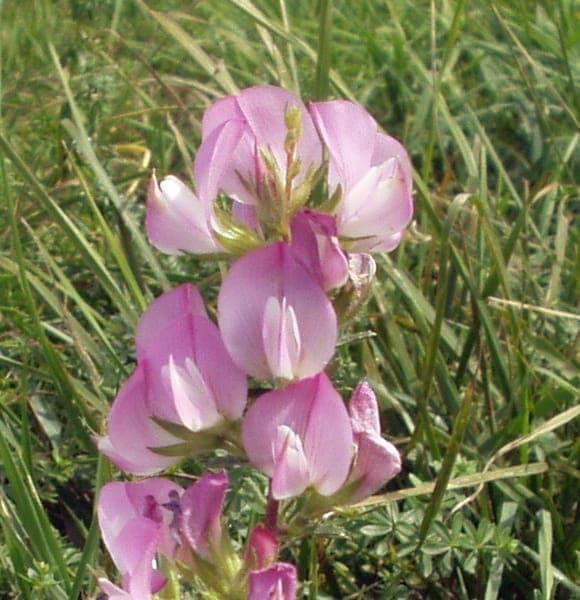
Stemonitis at English Wikipedia / CC BY-SA 3.0, via Wikimedia Commons
Thorny restharrow: complete guide
Ononis spinosa
¿Quieres ver Thorny restharrow: complete guide en tu jardín?
1 minuto, sin tarjeta de crédito
Overview
Thorny restharrow (Ononis spinosa), also known as European spiny restharrow, is a robust herbaceous shrub belonging to the Fabaceae family. This species originates from Europe and grows from the Caspian Sea to the Western Himalayas and North Africa. The plant is known for its bright pink flowers and especially for the spines that cover its stems - hence the name. Thorny restharrow is one of the most hardy choices for wild gardens and promoting biodiversity.
Thorny restharrow grows as a compact, spiny shrub with fine leaves and a deep taproot. The plant is exceptionally hardy and grows almost anywhere, from poor meadows to rocky slopes. This makes it ideal for gardens where you want less maintenance and more wild nature. The plant provides nectar for bees and butterflies and seeds for birds. It is a true champion of low-maintenance gardening.
Appearance and bloom
Thorny restharrow reaches a height of 30 to 80 centimeters, depending on growing conditions. It has fine, greenish leaves and notably spines that grow from the stems - these give the plant its characteristic appearance. The spines are not very sharp, more like thorny hairs. The plant has a rough, wild appearance perfect for natural garden concepts.
The flowers are bright pink to red, grouped in clusters. The flowering period runs from May to September, giving the plant an unusually long bloom time. After flowering, small fruits form containing seeds. The seeds disperse naturally, making the plant suitable for wild plantings and natural regeneration of your garden.
Ideal location
Thorny restharrow loves full sun. Plant it in a location where it receives at least 6 hours of direct sunlight per day. The plant can also grow in partial shade, but full sun promotes better flowering. Make sure the plant is well-ventilated and that water does not stagnate.
Place it in locations exposed to wind and natural elements. The plant is ideal for meadows, natural gardens, rocky slopes, or wild corners of your garden. It is not suitable for very sheltered, humid locations where dampness can promote fungal issues. It thrives in exposed positions.
Soil
Thorny restharrow thrives on virtually all soil types, from sand to clay, as long as they drain well. The plant prefers neutral to alkaline pH (6.5-8.0). The plant is not soil-critical and actually grows better on poor soils than on very nutrient-rich soils.
The plant has a deep taproot that makes it very drought-tolerant. Do not add much fertilizer, as this causes lush growth at the expense of flowering. Poor soil is actually better for this plant's health and bloom production.
Diseño gratis
¿Quieres ver Thorny restharrow: complete guide en tu jardín? Crea un diseño gratis ahora.
Watering
Thorny restharrow is very drought-tolerant once established. In the first growing year, you must water regularly until the plant is well-rooted. After that, the plant can grow without artificial irrigation, even during dry periods.
During very dry periods you can give some water, but this is usually not necessary. Too much water is more harmful than too little. This makes the plant valuable for water conservation in natural gardens. Once established, it is virtually self-sufficient.
Maintenance
Thorny restharrow requires very little maintenance. You do not need to prune or regularly maintain the plant. Let it grow wild and shape itself. The spines help the plant defend itself against unwanted growth from other plants.
If the plant becomes very large, you can burn it back or do heavy pruning. But overall, it is better to let the plant grow naturally. The plant's self-sufficiency is one of its greatest strengths.
Maintenance calendar
Throughout the year, thorny restharrow has different needs:
- January to February: Plant is dormant, no maintenance needed.
- March to April: Growth begins, check moisture levels.
- May to September: Long flowering period, ensure regular water in first year.
- October: Growth slows, seeds ripen.
- November to December: Plant rests, no maintenance needed.
Winter hardiness
Thorny restharrow is very winter hardy (hardiness zone 4-9). The plant tolerates even very severe winters. The plant usually does not die back above ground, although this can happen in extremely cold winters. The deep taproot will survive and the plant will regrow in spring.
The plant will recover from winter damage without special care. Its hardiness makes it invaluable for northern gardens.
Companion plants
Thorny restharrow fits well in wild gardens with other hardy plants. Combine it with other legumes such as clover and bergamot. Also works well with grasses and wildflowers, especially in meadow mixes.
The plant contributes to biodiversity by providing food and shelter for insects. Plant it together with other nectar providers for continuous summer bloomers. Create a complete ecosystem in your garden with complementary plants.
Closing
Thorny restharrow is a fantastic choice for those who want a wild garden with low maintenance costs. It combines beauty with robustness and is exceptionally sustainable. You can buy seeds at garden centers where they are usually available in spring. Visit gardenworld.app for more inspiration and designs with wild plant mixes. With thorny restharrow you get long blooms, biodiversity, and very low maintenance. Visit also gardenworld.app to completely set up your wild garden with the right native plant combinations and expert design guidance.
¿Quieres ver Thorny restharrow: complete guide en tu jardín? Crea un diseño gratis ahora.
Sube una foto, elige un estilo y obtén un diseño fotorrealista con lista de plantas en menos de un minuto.
Más de 10.000 jardines diseñados
Sin tarjeta de crédito


Plantas similares
Tall Silky Lupine: complete guide
Lupinus elatus
Tall silky lupine is a fast-growing Californian perennial with silvery foliage and blue-purple flower spikes, ideal for a prairie-style garden.
Garfield Lupine: complete guide
Lupinus garfieldensis
The Garfield lupine is a rare, fast-growing American perennial for alkaline, dry grassland gardens, with striking blue flower spikes.
Lupinus elegans: complete guide
Lupinus elegans
Lupinus elegans, the elegant lupine, is a spectacular blooming plant from Mexico with blue flower spikes. Care, cultivation and garden use.