
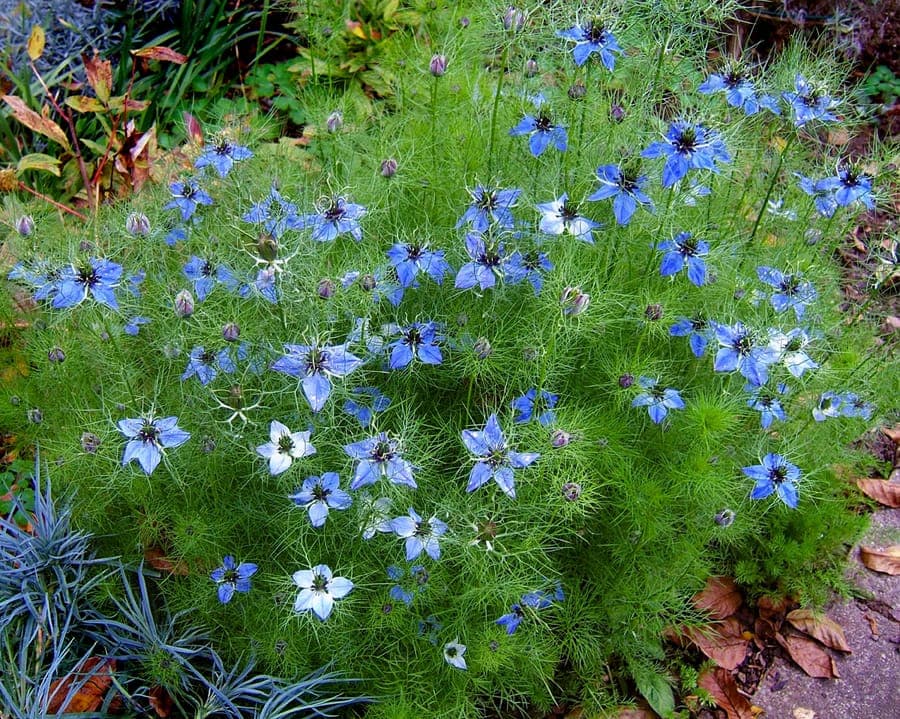
Wildfeuer / CC BY-SA 3.0, via Wikimedia Commons
Nigella damascena: complete guide
Nigella damascena
¿Quieres ver Nigella damascena: complete guide en tu jardín?
1 minuto, sin tarjeta de crédito
Overview
Nigella damascena, commonly known as Love-in-a-Mist or Fennel Flower, is a charming annual plant celebrated for its delicate, eye-catching blooms. This Mediterranean native is prized for producing spectacular flowers in shades of blue, white, pink, and purple, surrounded by feathery bracts that give the plant its whimsical common name. Native to Macaronesia and Mediterranean regions extending to northwestern Iran, this plant thrives as a summer annual in most temperate gardens. Reaching heights of 30 to 60 centimeters with a spread of 20 to 30 centimeters, Nigella damascena brings an airy, romantic quality to any garden.
The plant is notably self-seeding and easy to grow, making it a favorite for gardeners seeking effortless color and textural interest. Strong, upright stems make it ideal for cutting gardens, and the ornamental seed pods that follow flowers add weeks of visual interest. These distinctive pods are often dried for floral arrangements and home decor.
Appearance and Bloom
The flowers of Nigella damascena feature a unique morphology that defines its charm. Each bloom comprises four to ten petals surrounded by a crown of delicate, hairlike bracts - the source of the "mist" in Love-in-a-Mist. Petals are smooth and glossy, with prominent stamens crowded in the center. Flowers appear in blue, white, pink, purple, or bicolored combinations, blooming from June through August.
The foliage is exceptionally fine-textured and feathery, with leaves finely divided into threadlike segments, reaching 2-3 centimeters in length. Leaves are bright green and arranged alternately along firm stems. Following flowering, swollen seed pods develop (approximately 2-3 centimeters in diameter) with distinctive veining, turning from green through red to brown as they ripen. These pods are highly ornamental and persist through autumn if not harvested.
Plant development begins with a dense basal rosette of feathery leaves before stems elongate and flower buds form. Mature plants reach 30-60 centimeters in height depending on growing conditions.
Ideal Location
Nigella damascena performs best in full sun, requiring at least 6 to 8 hours of direct sunlight daily. Full sun exposure maximizes flower production, strengthens stems, and intensifies bloom colors. Plants in partial shade develop more foliage than flowers and flower production diminishes significantly.
The plant tolerates humid climates better than many annuals but thrives in temperate zones with moderate humidity levels. Protect plants from strong winds that may topple tall stems. In very hot climates, afternoon shade on the western or southern exposures can prevent heat stress while maintaining adequate light.
In cool maritime climates, south-facing positions maximize warmth and encourage flowering. In continentally hot regions, morning sun with afternoon protection maintains flower quality.
Soil
Nigella damascena adapts to nearly all soil types - from sandy to loamy - provided drainage is excellent. Optimal pH ranges from 6.5 to 7.5 (neutral to slightly alkaline). Heavy clay soils require amendment with sand and organic matter to improve drainage and prevent waterlogging.
The plant is undemanding regarding soil fertility. Moderate to poor soil is actually preferable, as overly rich soils promote excessive vegetative growth at the expense of flowers. A 2-3 centimeter layer of compost worked into planting holes provides adequate nutrition. Do not apply high-nitrogen fertilizers.
Soil must not remain permanently wet. Nigella damascena perishes in waterlogged conditions. Incorporate perlite or coarse sand into clay soils before planting.
Watering
Nigella damascena is drought-tolerant once established, though regular watering during the growing season produces optimal flowering. Seedlings and young plants (first 3-4 weeks) require consistently moist - not saturated - soil. Provide approximately 2 centimeters per week via rainfall or irrigation until plants are well-rooted.
Once flowering begins, reduce watering frequency. The plant tolerates short dry periods, though weekly watering during extended drought produces more abundant blooms. Water when plants show slight wilting, applying 5 centimeters deep around the base using drip irrigation or soaker hoses.
Avoid overhead watering that wets foliage, which promotes fungal diseases. Water only the root zone. In very wet summers, excessive moisture can cause rust and powdery mildew.
Diseño gratis
¿Quieres ver Nigella damascena: complete guide en tu jardín? Crea un diseño gratis ahora.
Pruning
Nigella damascena requires minimal pruning. Deadhead spent flowers to encourage continued blooming and maintain compact form. Use clean, sharp pruning shears and make cuts just below the flower head.
Allow plants to remain standing until seed pods brown completely (August-September) unless you wish to prevent self-seeding. To encourage self-sown seedlings next season, leave several mature pods on the plant to naturally disperse seed.
For cutting, harvest stems in early morning when flowers are half-open, selecting mid-length stems (approximately 30-40 centimeters) with clean diagonal cuts using a sharp knife. Remove lower foliage and place immediately in water.
Maintenance Calendar
April-May: Sow seed directly outdoors in prepared soil after final frost danger passes. Rake soil lightly to cover. Water regularly until germination (10-14 days). Ensure 18-20 degrees Celsius soil temperature for best results.
June: Thin seedlings to 15-20 centimeter spacing. First flowers appear mid-month. Begin regular watering (2 centimeters weekly) and apply balanced liquid fertilizer every two weeks at half strength.
July-August: Peak flowering period. Deadhead faded flowers weekly. Maintain consistent deep watering. Flowers are ideal for cutting arrangements.
August-September: Flowering intensifies. Seed pods swell and color. Allow some pods to mature if self-seeding is desired for next season.
October: Plants decline. Cease watering. Leave plants standing for seed dispersal or remove and compost.
Winter Hardiness
Nigella damascena is a frost-tender annual that cannot survive temperatures below -5 degrees Celsius. In all regions, it functions as a summer-annual. Sow seed directly outdoors in spring after final frost, or in autumn in mild-winter regions for earlier spring flowering.
Self-sown seedlings may emerge from autumn-shed seed in mild zones and overwinter as rosettes, flowering earlier the following season. To encourage hardier seed strains, collect seed from plants that successfully overwinter and sow these seeds in subsequent autumns.
Companion Plants
Nigella damascena combines beautifully with other annuals and perennials sharing its preference for sun and well-drained soil:
Blue harmony: Plant with low-growing Delphiniums (Delphinium belladonna), Speedwell (Veronica spicata), Agapanthus, Sage (Salvia nemorosa), and Flax (Linum perenne). This creates a cohesive blue-toned tapestry.
White contrast: Pair with white Gaura (Gaura lindheimeri "Whirling Butterfly"), white geraniums, white Nasturtiums, or white Tulips for striking visual contrast.
Pink accents: Combine with Cosmos, Pinks (Dianthus), Linaria, or pink-and-white Penstemons for gentle color transitions.
Yellow-green structure: Partner with fine-textured foliage plants like Statice (Limonium), Quaking Grass (Briza), or Santolina with silvery-white leaves to enhance textural interest.
Mixture with other self-seeding annuals including Orlaya (lace-white bloomer), Coneflower (Echinacea), Poppy (Papaver), and Sunflowers creates an exuberant, naturalized garden effect.
Also pairs well with spring bulbs like Allium that flower as Nigella's season begins.
Closing
Nigella damascena represents an excellent choice for gardeners seeking effortless elegance and textural sophistication without intensive management. Its tolerance for modest soils, drought-tolerance once established, and minimal maintenance requirements make it ideal for beginning and experienced gardeners alike. Seeds and young plants are readily available at major retailers including gardenworld.app. In the United Kingdom, garden centers nationwide stock seeds. Discover all the potential of this versatile beauty, blooming reliably from June through August with the bonus of ornamental seed pods extending garden interest through fall. The complete guide to growing Nigella damascena and countless other plants awaits you at gardenworld.app.
¿Quieres ver Nigella damascena: complete guide en tu jardín? Crea un diseño gratis ahora.
Sube una foto, elige un estilo y obtén un diseño fotorrealista con lista de plantas en menos de un minuto.
Más de 10.000 jardines diseñados
Sin tarjeta de crédito


Plantas similares
Black Cumin: complete guide
Nigella sativa
Nigella sativa, also known as black cumin, is a versatile plant with delicate blue flowers and aromatic seeds. Ideal for dry soils with minimal feeding. Hardy and low-maintenance.
European columbine: complete guide
Aquilegia vulgaris
Everything you need to know about European columbine (Aquilegia vulgaris): care, bloom time, ideal growing conditions, and companion plants for your garden.