
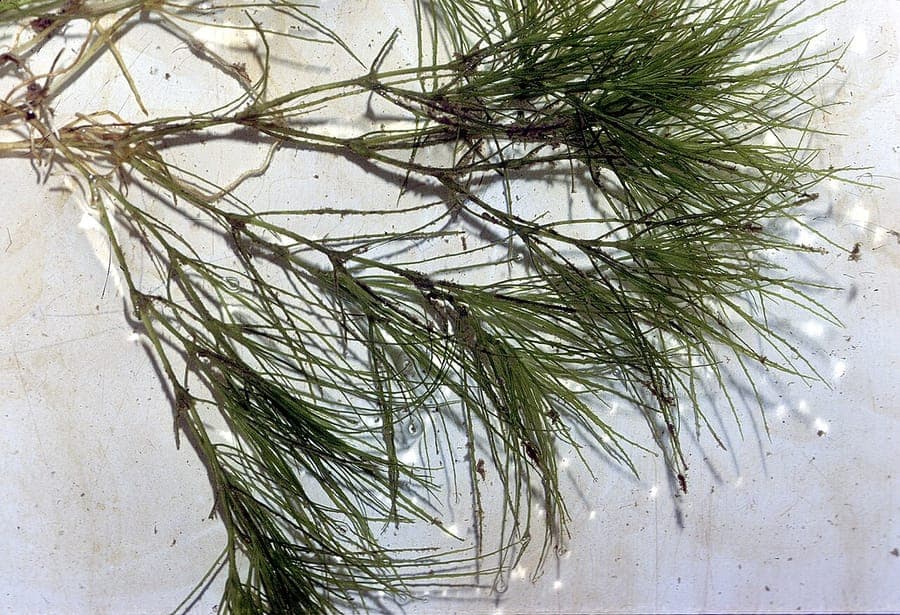
Robert H. Molenbrock / Public domain, via Wikimedia Commons
Slender naiad: complete guide
Najas minor
¿Quieres ver Slender naiad: complete guide en tu jardín?
1 minuto, sin tarjeta de crédito
Overview
Slender naiad (Najas minor), also known as slender-leaf naiad or Danube naiad, is an elegant, fast-growing submerged aquatic plant from the water-lily family (Hydrocharitaceae). This plant originates from temperate regions of Europe to North Africa and occurs in freshwater in lakes, rivers, and water gardens. Slender naiad distinguishes itself from its larger brother (Najas marina) through its even finer, more delicately formed leaves that create a very light, airy appearance in aquariums.
This plant is very popular among aquascapers (aquarium artists) because of its graceful growth habit, fast growth, and ability to quickly absorb nutrients. The plant grows elegantly and always forms beautiful aquarium landscapes without becoming intrusive. Slender naiad is also valuable for water ecosystem health because it absorbs much phosphate and nitrogen from water, which can prevent algae growth.
Appearance and growth pattern
Slender naiad has a very characteristic elegant appearance with very fine, slender, line-shaped leaves that are even thinner and finer than those of its larger brother Najas marina. The leaves are typically 0.5-2 cm long and only 0.2-0.4 mm wide, making it appear almost wire-like. However, the plant does not grow as fast as Najas marina, making it easier to manage in an aquarium.
The stem is very thin (approximately 0.3-0.5 mm thick) and can grow 10-40 cm long, depending on nutrient and light conditions. The color is bright green, sometimes with subtle red or brown tones under very intense light. The plant grows moderately to fast - under good conditions, growth can be 1-2 cm per day, which is much faster than many aquarium plants but slower than Najas marina.
The plant produces many side shoots, causing it to grow dense and bushy rather than lanky. This makes it very valuable for aquascaping, where the art of aquarium gardening is important. The plant very rarely produces visible flowers in aquarium conditions.
Ideal location
Slender naiad grows excellently under moderate to bright light, between 8 and 12 hours daily. The plant tolerates less light than Najas marina and can grow in semi-shaded aquarium corners, though growth will be slower there. In water gardens, slender naiad can grow in both full sun and partial shade; however, full sun stimulates faster and denser growth.
The plant performs best when floating freely in the water column, though it can also be planted in substrate or bundled with plant pins to expand further. This is less aggressive than Najas marina and can be more easily used in aquascape compositions.
Diseño gratis
¿Quieres ver Slender naiad: complete guide en tu jardín? Crea un diseño gratis ahora.
Water quality requirements
Slender naiad is very flexible regarding water quality. The pH can range between 6.5 and 8.0, though it grows best around pH 7.0. Water temperature should be between 15 and 28 degrees Celsius, with optimal growth between 20 and 25 degrees Celsius. The plant can grow in somewhat cooler water than Najas marina.
Carbonate hardness can be flexible - slender naiad grows in both soft and hard water. Water changes are beneficial; replace at least 25% of water volume every two weeks to keep water clean.
Nutrition and light requirements
Slender naiad is a nutrient-demanding plant requiring nitrogen, phosphate, and trace elements. Weekly fertilization with liquid aquarium fertilizer (for example Flourish or equivalent) significantly improves growth and color. The plant also responds well to supplementary CO2 but grows well without it too.
Light requirements are moderate to low - 8-10 hours daily suffices. Under very intense light, red or brown tones can develop, which can be very decorative. The plant also grows well under normal-power LED lighting.
Pruning and propagation
Regular pruning helps encourage dense, compact growth. Trim the upper 5-10 cm of stems when they reach desired height, leave these cuttings loose in the aquarium, and they will root and form new plants. This is easier than with Najas marina because growth is less aggressive.
To shape, carefully trim side shoots and let these fragments drift. The plant then grows denser and fuller. Also remove dark green or brown stems that no longer actively grow.
Maintenance calendar
April to May: Begin growing season. Change water weekly. Give fertilizer weekly. Provide 8-10 hours light daily.
June to August: Strong growth. Change water regularly (25% every two weeks). Fertilize weekly. Prune regularly to maintain compact form.
September to October: Growth begins to decline as light decreases. Continue water changes.
November to March: Slow growth. Monthly water changes usually suffice. Fertilize every two weeks.
Winter hardiness
Slender naiad is not winter hardy and cannot survive frozen water. In aquariums this is not a problem. In outdoor water gardens, the plant must be removed from water before frost. The plant can easily be grown as a summer plant and replanted the next season.
Special combinations
Slender naiad is ideal for aquascaping compositions. Combine it with foreground plants like dwarf sword plants for contrast. Pairing with red plants (Rotala, Ludwigia) creates beautiful color combinations.
The plant also works well as a mid-ground plant in hardscape-oriented aquariums. For natural styles, combine with wood fragments (driftwood) and stones.
Closing thoughts
Slender naiad is an ideal plant for aquascapers and aquarium artists. With its elegant, fine leaves, fast but manageable growth, and nutrient-absorbing ability, it offers many possibilities for creative aquarium designs. Obtaining is usually possible from specialized aquarium stores or online aquascaping suppliers. At gardenworld.app you will find inspiration for aquascaping projects and plant selection.
¿Quieres ver Slender naiad: complete guide en tu jardín? Crea un diseño gratis ahora.
Sube una foto, elige un estilo y obtén un diseño fotorrealista con lista de plantas en menos de un minuto.
Más de 10.000 jardines diseñados
Sin tarjeta de crédito


Plantas similares
Najas gracillima: complete guide
Najas gracillima
Discover Slender Waternymph, a delicate water plant for aquariums and ponds. Nutrition, growth, and aquascaping explored.
Ottelia alismoides: complete guide
Ottelia alismoides
Learn how to grow Duck-lettuce in aquariums and water gardens. Tips for growth, water conditions and care of this aquatic plant.
Hydrilla verticillata: complete guide
Hydrilla verticillata (L.f.) Royle
Discover Florida elodea, a fascinating submerged aquatic plant for ponds and aquariums. Complete growing and care guide.