
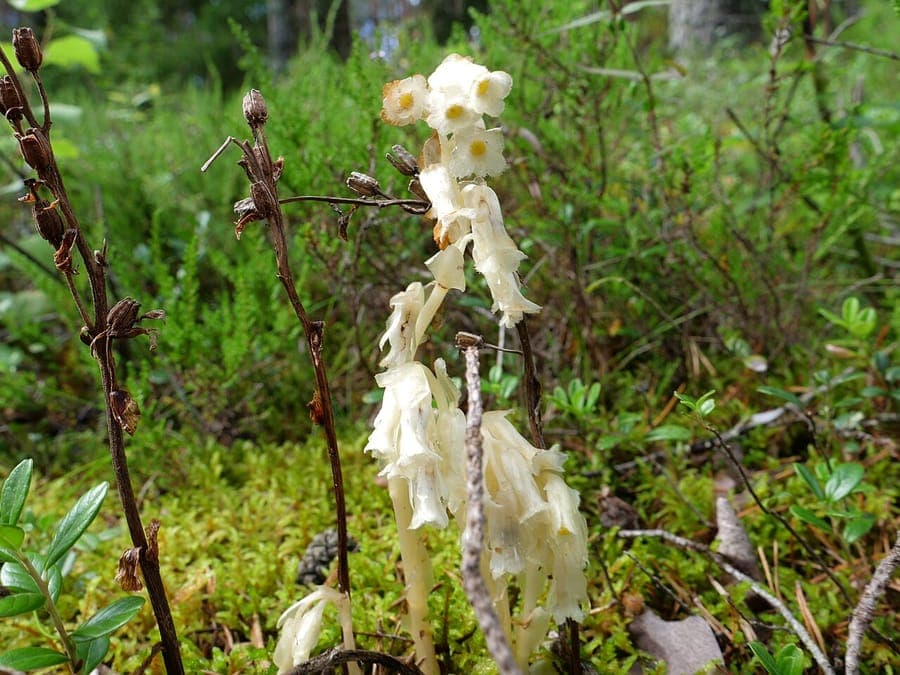
Leonhard Lenz / CC BY-SA 4.0, via Wikimedia Commons
Monotropa hypopitys: complete guide
Monotropa hypopitys
¿Quieres ver Monotropa hypopitys: complete guide en tu jardín?
1 minuto, sin tarjeta de crédito
Overview
Monotropa hypopitys, commonly known as yellow bird's-nest or pinesap, is an extraordinary and enigmatic woodland plant distinguished by a completely unique nutritional strategy. Rather than performing photosynthesis like typical plants, Monotropa hypopitys is entirely dependent on fungal partners (mycorrhizae) that extract nutrients from decomposing forest soil. This plant belongs to the Ericaceae family and occurs in temperate forests throughout the Northern Hemisphere. Lacking green leaves or chlorophyll, it grows as a ghostly, pale yellowish plant pushing through rich forest humus. Gardenworld.app recognizes this fascinating phenomenon as an exceptional yet extremely challenging plant to cultivate.
The plant reaches merely 10-40 centimetres in height with complete absence of green colour. The flowering spike is densely packed with small, pendant flowers in yellow, white, or pale pink tones. This is no plant for beginners but rather for highly passionate, experimental gardeners.
Appearance & Bloom Cycle
Monotropa hypopitys emerges as an entirely whitish-yellow plant without any green leaves. The stem is thick, fleshy, and yellowish-white coloured, bearing small, scale-like structures rather than true leaves. The entire plant feels waxy and greasy to the touch - remarkably different from normal plants.
Flowers emerge in a dense cluster at the spike's apex from June through August. Each flower measures approximately 10-12 millimetres long, hangs downward, and displays yellow, orange, or occasionally pink colouration. Flowers contain ten stamens and one pistil. Following flowering, upright seed capsules develop, ripening by August.
The plant disperses via extremely tiny seeds spread by wind, capable of germinating only under specific conditions with appropriate fungi present.
Ideal Location
Monotropa hypopitys grows beneath deciduous trees in deep, stable shade. The plant requires highly sheltered woodland environment and cannot grow in open gardens. The plant naturally inhabits forest floor where dense leaf litter accumulates annually and where mycorrhizal fungi flourish.
In garden environments, Monotropa hypopitys is virtually impossible to cultivate without replicating very natural woodland conditions. Specialized growers occasionally achieve success in large, undisturbed forest patches.
This plant is unsuitable for normal gardening practice; it serves better as a botanical curiosity.
Soil Requirements
Monotropa hypopitys demands extremely humus-rich forest soil with very high mycorrhizal infection rates. The soil must receive substantial annual leaf litter and be strongly acidic (pH 4.5-5.5). The presence of specific fungal species (particularly Russula species and other forest fungi) is absolutely essential for plant growth.
Attempts to grow Monotropa in typical garden soils will almost invariably fail. The plant demands truly natural forest environment. Cultivation in containers is possible only under exceptional circumstances, requiring very humus-rich forest soil, abundant leaf litter, and ground fungal material.
Diseño gratis
¿Quieres ver Monotropa hypopitys: complete guide en tu jardín? Crea un diseño gratis ahora.
Watering
Monotropa hypopitys requires deeply shaded, natural woodland environment with consistently high soil moisture. Regular watering is necessary but must be performed carefully to avoid disturbing mycorrhizal associations.
Water must be exceptionally soft (distilled or rainwater ideal). During dry periods, supplemental watering may be necessary, though the plant tolerates artificial, intensive watering poorly. The plant performs best beneath large tree canopies where leaf litter accumulates and nature creates its own moist microclimate.
Pruning
Monotropa hypopitys requires no pruning. The plant is extremely small and compact. Only maintenance involves careful removal of dead material and prevention of disturbance to the natural woodland environment.
Maintenance Calendar
April-May: Plant emerges after winter. Very careful watering as temperatures rise above 10°C. No other care needed.
June-July: Blooming period. Minimal care. Appreciate this rare phenomenon.
August: Seeds ripen. No care needed.
September-October: Plant dies back. Natural leaf litter prepares for next season.
November-March: Plant is completely dormant. Minimal care. Expect the plant may be absent for one or more seasons before returning.
Winter Hardiness
Monotropa hypopitys demonstrates hardiness to USDA zone 4 (-30°C winter minimum). Throughout the Netherlands, Belgium, and Germany, it could theoretically grow naturally, though occurrence remains extremely rare.
The plant survives without risk in extremely sheltered woodland environments. In open gardens, winter damage is probable.
Companion Planting
Monotropa hypopitys is not planted in mixed borders; the plant requires completely natural woodland environment. In very large, undisturbed forest patches, it may spontaneously appear under preferred conditions.
Gardenworld.app advises against attempting to grow Monotropa in normal gardens. The plant functions more as a natural phenomenon than as a cultivated garden plant.
Closing
Monotropa hypopitys is no garden plant in the traditional sense. Rather, it is a fascinating woodland plant that appears in very natural, mycorrhiza-rich forest environments. For those wishing to observe Monotropa, the advice is to explore sheltered woodland paths in temperate climates where it naturally occurs. For those attempting cultivation: expect very low success rates unless you possess a large, completely natural forest plot. This plant serves as reminder that not all natural phenomena can be brought into cultivation. Gardenworld.app acknowledges its profound biological fascination while recognizing it belongs in its natural environment.
This plant beautifully captures the mystery and wonder of forest ecosystems.
¿Quieres ver Monotropa hypopitys: complete guide en tu jardín? Crea un diseño gratis ahora.
Sube una foto, elige un estilo y obtén un diseño fotorrealista con lista de plantas en menos de un minuto.
Más de 10.000 jardines diseñados
Sin tarjeta de crédito


Plantas similares
Zenobia pulverulenta: complete guide
Zenobia pulverulenta
Everything about Zenobia pulverulenta (honeycup): siting, acid soil, pruning and the fragrant white bells, in this complete care guide.
Dwarf huckleberry: complete guide
Gaylussacia dumosa
Everything about dwarf huckleberry (Gaylussacia dumosa): acidic soil, partial shade, pruning and care for this compact North American berry shrub.
Drooping leucothoe: complete guide
Leucothoe fontanesiana
Everything about drooping leucothoe (Leucothoe fontanesiana): shade tolerance, soil, watering, pruning, hardiness and companion plants.