
Walter Siegmund (talk) / CC BY-SA 3.0, via Wikimedia Commons
Moneses uniflora: complete guide
Moneses uniflora
¿Quieres ver Moneses uniflora: complete guide en tu jardín?
1 minuto, sin tarjeta de crédito
Overview
Moneses uniflora, commonly known as single delight or one-flowered wintergreen, is an enchanting miniature woodland plant distinguished by its solitary, elegantly pendant white flower and evergreen foliage. This rare botanical treasure belongs to the Ericaceae family (heath family) and naturally occurs in subarctic and temperate forests across the Northern Hemisphere. Though challenging to cultivate, Moneses uniflora rewards patient gardeners with exquisite refinement. Gardenworld.app recognizes this plant as a valuable component of natural, acidic woodland gardens.
The plant grows merely 5-15 centimetres in height, forming tight mats of persistent, glossy foliage. Each plant typically produces only a single flower per season, hence the common name - a solitary moment of pure beauty, a 'single delight.'
Appearance & Bloom Cycle
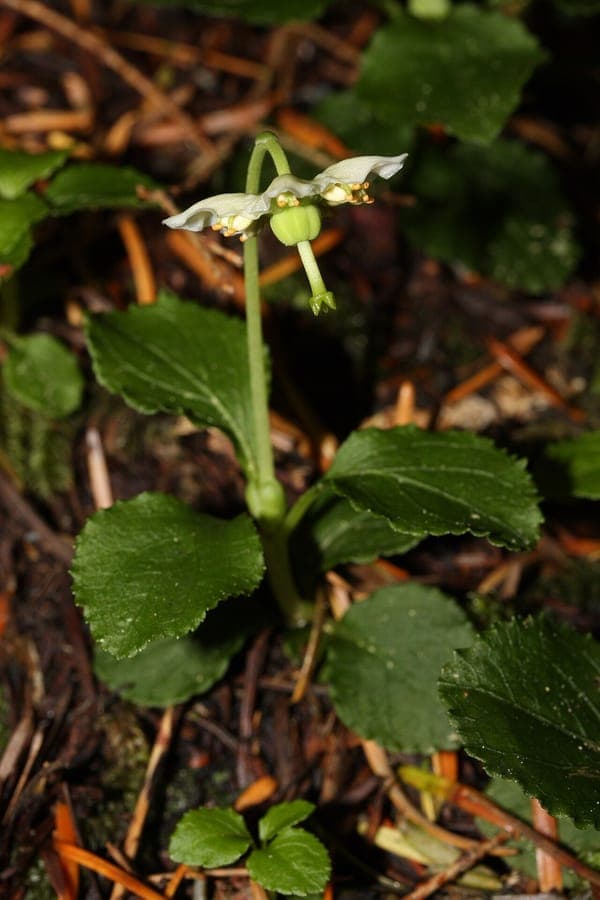
Moneses uniflora establishes itself as an extremely low mat of obovate, leathery, glossy leaves that remain intensely green and visible year-round. Leaves are just 1-3 centimetres long and rigidly stiff with a waxy surface minimizing water loss. The plant is completely evergreen, maintaining foliage even in severe winters.
The flower appears on a remarkably thin, pale stem (approximately 10-15 centimetres) emerging from the mat's centre in June-July. Each flower measures approximately 8-10 millimetres in diameter with five white, inverted-heart-shaped petals arranged to dangle downward like a gentle bell. Ten yellow stamens form a striking golden centre. The fragrance is subtle and pleasant - described as sweet and fresh.
Following flowering, small seed capsules develop, ripening in August. The blooming period is extraordinarily brief - merely 2-3 weeks - underscoring this plant's rarity and preciousness.
Ideal Location
Moneses uniflora thrives in deep, stable shade beneath deciduous and coniferous trees where direct sun is excluded. The plant tolerates no direct sunlight and performs poorly in partial shade. Locations beneath large evergreen conifers (spruce, pine) prove ideal, providing stable, cool microclimates.
In landscape design, this plant serves in natural, acidic woodland gardens, alpine troughs, and within shade-loving plant collections. It performs well on steep slopes under large trees where root competition is intense. The plant requires extremely sheltered positions - wind, elevated temperatures, and direct sun cause desiccation and death.
Moneses uniflora is unsuitable for exposed locations or warmer garden sections.
Soil Requirements
Moneses uniflora demands extremely acidic, exceptionally well-draining soil with very high organic matter content. pH should be 4.5-5.5 (strongly acidic) - neutral or alkaline soil produces poor growth. The plant naturally inhabits humus-rich forest soil with abundant leaf litter and tree roots.
Optimal soil consists of 60% acidic peat, 30% leaf mould, and 10% coarse sand by volume. In conventional gardens, this is achieved by incorporating large quantities of acidic leaf mould and sand into standard garden soil. Limestone-containing soils must be absolutely avoided; this plant is extremely intolerant of lime.
In containers, the plant can be cultivated in extremely acidic potting media of acidic peat and sand (70:30).
Diseño gratis
¿Quieres ver Moneses uniflora: complete guide en tu jardín? Crea un diseño gratis ahora.
Watering
Moneses uniflora has highly specific water requirements. The plant loves consistent moisture but tolerates no waterlogging. Regular, light watering surpasses infrequent, heavy irrigation. During warm, dry periods, the plant cannot tolerate extended drought; exceptional attention is required.
Critically important: water must be exceptionally soft - distilled or rainwater is ideal. Tap water, especially hard water, damages the plant. This remains one of cultivation's greatest challenges. A 4-5 centimetre layer of acidic leaf mulch greatly aids moisture retention.
Pruning
Moneses uniflora requires no or minimal pruning. The plant grows very slowly and compactly. Maintenance involves only careful removal of dead foliage and prevention of leaf litter compaction around the plant.
In extreme cases where the plant becomes overgrown or diseased (rare), very careful pruning at juvenile stage may help, but this is not recommended. The plant is extremely fragile and recovers poorly from cutting.
Maintenance Calendar
March-April: Plant begins cautious new growth. Monitor for fungal issues. Water carefully as temperatures rise above 5°C.
May-June: Flowering prepares. Consistent moisture remains critical. Full shade protection essential.
June-July: Brief blooming period - cherish it! Minimal care needed.
August: Seed development. Moisture management remains important.
September-October: Dormancy begins. Careful moisture management. Remove dead leaf litter gently.
November-February: Deep dormancy. Plant rests beneath snow cover. Minimal care. Water only in exceptionally dry winters.
Winter Hardiness
Moneses uniflora demonstrates hardiness to USDA zone 3 (-40°C winter minimum). In Scandinavia, northern Germany, and North American mountains, it grows naturally. In warmer regions (southern Netherlands climate), more intensive care may be necessary, particularly in winters without snow cover.
The plant thrives under snow or in extremely sheltered environments. In warm winters without frost, damage occasionally occurs.
Companion Planting
Moneses uniflora is rarely planted alongside other species; the plant's specific requirements make companionship challenging. In very natural woodland gardens, other acid-loving plants such as Pyrola secunda (pink wintergreen), Goodyera repens (adder's tongue) and select Carex species may share the same environment.
In alpine troughs, Moneses uniflora can coexist with other alpine rarities - extremely dwarf conifers, Empetrum nigrum (crowberry), and very fine grasses - provided extremely acidic, well-draining conditions are maintained.
Gardenworld.app recommends treating Moneses uniflora as primarily a solitary specimen rather than component of mixed planting schemes.
Closing
Moneses uniflora is not an obvious choice for gardeners, yet for those capable of meeting its highly specific requirements, it represents exceptional reward. The delicate white flower, ever-present green foliage, and botanical rarity place it in a separate category. This plant functions more as a collector's item than garden workhorse, yet for those with shaded, acid-loving garden corners and patience to provide very soft water, Moneses uniflora offers incomparable satisfaction. Available through specialized alpine nurseries rather than general garden centres, this botanical gem awaits dedicated cultivation in suitable environments.
¿Quieres ver Moneses uniflora: complete guide en tu jardín? Crea un diseño gratis ahora.
Sube una foto, elige un estilo y obtén un diseño fotorrealista con lista de plantas en menos de un minuto.
Más de 10.000 jardines diseñados
Sin tarjeta de crédito


Plantas similares
Zenobia pulverulenta: complete guide
Zenobia pulverulenta
Everything about Zenobia pulverulenta (honeycup): siting, acid soil, pruning and the fragrant white bells, in this complete care guide.
Dwarf huckleberry: complete guide
Gaylussacia dumosa
Everything about dwarf huckleberry (Gaylussacia dumosa): acidic soil, partial shade, pruning and care for this compact North American berry shrub.
Drooping leucothoe: complete guide
Leucothoe fontanesiana
Everything about drooping leucothoe (Leucothoe fontanesiana): shade tolerance, soil, watering, pruning, hardiness and companion plants.